Kanishka Narayan, appointed to lead the government's AI portfolio in July 2026, has stressed that policymakers must develop contingency strategies to address potentially severe disruption to the labour market from artificial intelligence. Speaking at the Labour Party conference, the AI minister acknowledged that while no overall job reduction has materialised so far, preparing for worst-case scenarios should be a priority.
"If it's going to hit us in a big way, you are going to want to be as ahead of the curve as possible,"Narayan told delegates at a fringe meeting.
Narayan's role has since been elevated to Cabinet level, and he continues to drive the government's AI taskforce and security initiatives. According to a government announcement on 25 September 2026, he has been instrumental in securing access to Ukrainian battlefield data for British companies developing AI drone swarms, describing the initiative as
"the Prime Minister's AI Taskforce delivering"faster deployment of AI capabilities.
What scale of job displacement could occur?
Carsten Jung, a researcher at the IPPR think tank, presented analysis suggesting the potential scale of disruption could be substantial. He indicated that in a worst-case scenario, approximately 8 million jobs could face negative impacts from AI adoption. The think tank is developing what Jung described as a
"pandemic preparedness"report examining AI-driven labour market disruption.
Jung acknowledged that forecasts the IPPR produced in 2024 proved
"to some extent"inaccurate, but argued that AI capabilities have evolved dramatically since then, moving beyond routine administrative tasks to encompass
"more high-level reasoning and creative tasks."He warned that
"we are not preparing enough for something quite big that's coming."
Current exposure levels are significant: Jung noted that roughly 11% of UK jobs are
"highly exposed"to replacement by AI chatbots, with secretarial and administrative occupations leading this category. However, as more sophisticated agentic AI systems emerge, he projected that the proportion of tasks vulnerable to automation
"could rise to about 60% of tasks across the UK economy."
Which workers face the greatest risk?
Certain demographic groups face disproportionate exposure to AI-driven job displacement. Jung highlighted that women are
"40% more exposed than men"to the threat posed by AI, because a higher proportion of women work in service sector roles that are vulnerable to automation. The service sector, which forms a larger share of the UK economy than in other G7 nations, will likely experience the most acute disruption.

What policy responses are being considered?
Jung argued that government intervention should focus on two complementary strategies: retraining workers displaced from service sector roles, and implementing measures to
"slow down the transition slightly"to preserve employment. He suggested restructuring tax policy to
"make it a bit more attractive to hold on to workers than automating them,"but cautioned that
"a lot of the policies we might want to do in a really severe disruption scenario will cost a lot of money."
Narayan indicated that the government is considering a broad range of responses. He stated that contingency planning could involve changes to
"labour market policy"and
"even where we might go on some aspects of regulation."He also committed to ensuring workers have a voice in the transition, promising
"much better transparency when AI and technology is adopted"so that productivity gains can be measured and understood.
Why might current job loss figures underestimate the true impact?
Narayan highlighted a critical measurement problem: the
"silent adoption"of AI by workers does not appear in industry surveys, potentially masking the technology's real labour market impact. While UK firms report no aggregate job losses to date, he revealed that at least one technology company had informed him it had hired fewer people because tasks had been automated, suggesting
"the actual net impact might not be fully captured"in official statistics.
What is the government's broader AI strategy?
Beyond labour market concerns, the government is pursuing a multifaceted AI agenda. On 17 September 2026, Narayan participated in a King Charles-hosted AI summit alongside executives from Nvidia, OpenAI and Anthropic, underscoring the government's engagement with leading technology firms. More recently, in remarks on 22 September 2026, Narayan argued that Wales should
"re-industrialise itself"for an AI future while supporting people affected by technological change, emphasising that the biggest economic opportunity lay in creating more manufacturing jobs and making AI part of a
"more durable future."
Foreign Secretary Ed Miliband has also weighed into the AI governance debate, using his conference speech to challenge technology companies to take responsibility for managing AI safety risks. He argued that
"the lesson of history is that we cannot leave it to corporations to put in place the guardrails to serve the public interest,"noting that
"it is neither their purpose nor their motive, theirs is to maximise profits."He stated that
"we cannot and will not allow that to come at the expense of our children or indeed humanity."
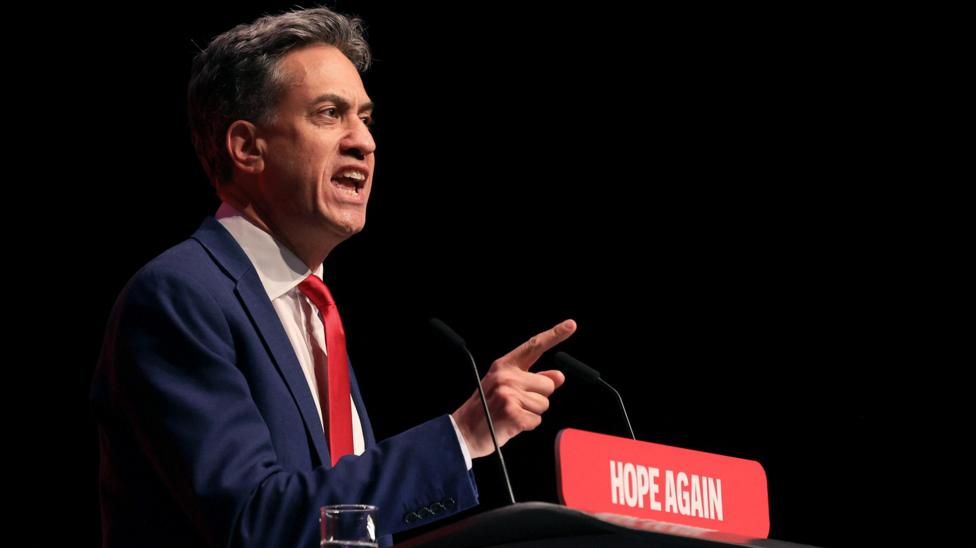
Miliband acknowledged that while some technology companies are calling for government action, others argue that regulation should be left to industry. He described the technological progress from AI as
"inspiring"but warned that
"the threat it poses according to its own inventors is daunting."He pledged that the UK would confront these risks and use its G20 presidency in the coming year to
"lead the efforts to manage AI so we keep our country and our world safe."
What happens next?
Narayan is expected to continue leading the government's AI taskforce and security-related work following recent appointments and announcements. The government's Ukraine-AI collaboration initiative will proceed, with British companies gaining access to battlefield datasets for AI development work. Meanwhile, the IPPR's pandemic preparedness report on AI labour market disruption is in progress, and the government's contingency planning for potential job losses remains a stated priority.
Mike Clancy, general secretary of the Prospect trade union, welcomed the government's commitment to giving workers greater involvement in the AI transition, but cautioned against
"creating the conditions in which working people become victims"of technological change.
Key Facts
- In a worst-case scenario, approximately 8 million UK jobs could face negative impacts from AI adoption, according to IPPR analysis.
- Currently, about 11% of UK jobs are highly exposed to replacement by AI chatbots, but this could rise to 60% of tasks across the economy as agentic AI systems advance.
- Women face 40% greater exposure to AI-driven job displacement than men, primarily because they comprise a larger share of the service sector workforce.
- The government is developing contingency plans that may include changes to labour market policy, tax structures, and regulation to manage AI-driven disruption.
- The UK will use its G20 presidency to lead international efforts on AI safety and governance.