A sharp sell-off in technology and artificial intelligence-related shares has swept across global markets, driven by mounting concerns over US inflation and the heavy debt burden carried by companies in the AI sector. Semiconductor manufacturers and major tech investors have borne the brunt of the downturn, with indices across Asia, Europe and North America all posting significant losses.
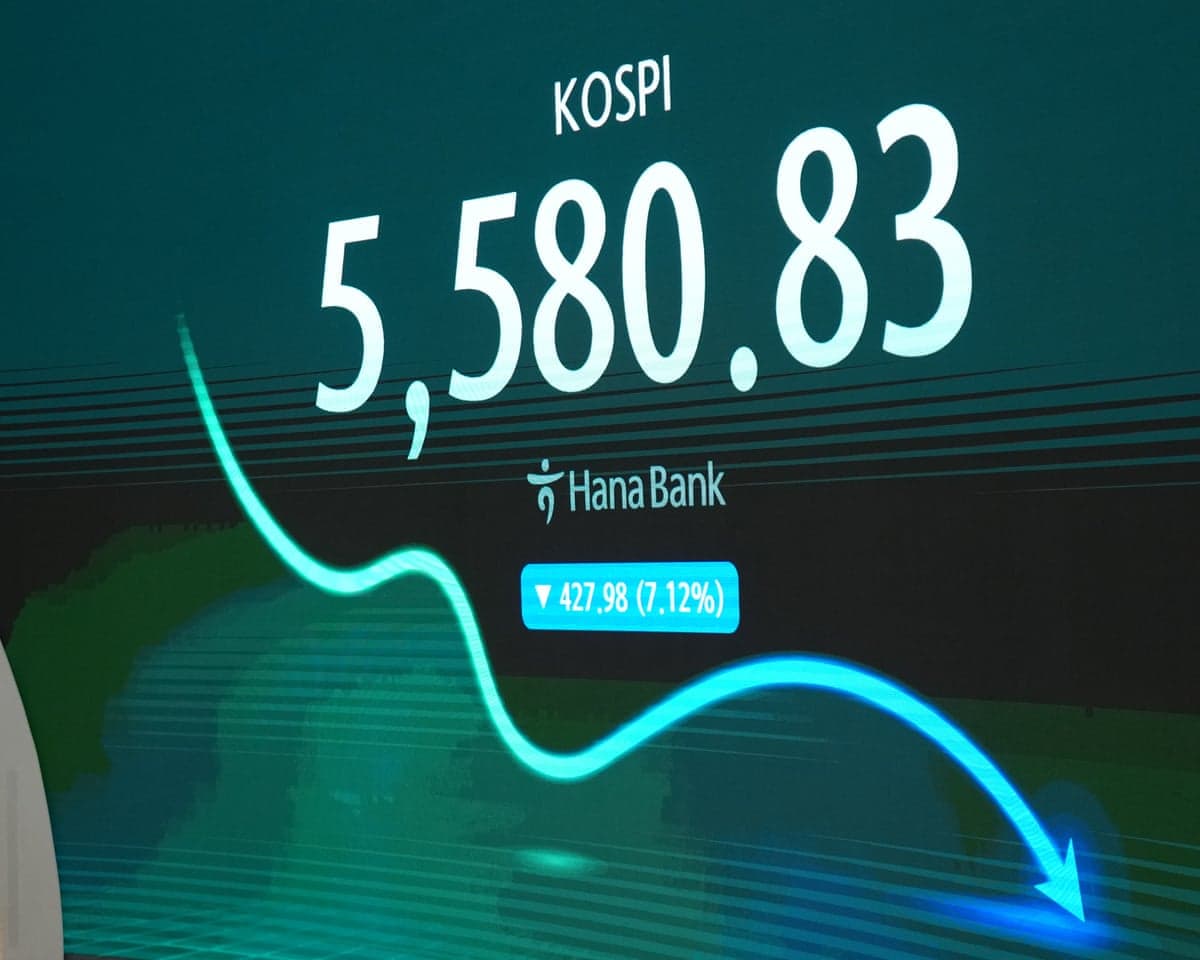
South Korea's benchmark Kospi 200 index, which has a substantial weighting towards memory chip producers, fell more than 8% overnight to close at a six-month low, triggering circuit breakers that halted trading at multiple points during the session. The index closed down 8.1%. Memory chip manufacturers were hit particularly hard, with SK Hynix plunging nearly 11% and Samsung Electronics dropping 9.5%. Foreign investors sold more than $10 billion of South Korean shares during October, while the Kospi's decline from its June peak has approached 40%.
Japan's Nikkei 225 index fell 4.9% on Thursday, following an 11% slump in memory chip maker Kioxia and a 10% drop in SoftBank, which holds a significant stake in OpenAI, the creator of ChatGPT. The declines extended a pattern of weakness that began on Wall Street, where the Nasdaq Composite fell 1.9% and the S&P 500 dropped 1.1%, marking its worst performance since July.
When US trading resumed on Thursday, the Nasdaq fell a further 1.4% at the opening bell. Data centre equipment manufacturers led the decline, with Dell, which produces servers for data centres, and Coherent, a supplier of components for AI data centres, among the early fallers. CoreWeave fell a further 6.3% in premarket trading after dropping 15% on Wednesday, while Oracle fell 2.1% following a nearly 9% decline.
The market turmoil was triggered by fresh US inflation data released on Wednesday, which showed consumer prices rose 3.7% year over year and 0.6% month over month in September, marking the fastest increase in prices since the consumer price index hit a three-year peak of 4.2% in May. Core inflation, which excludes volatile food and energy prices, rose 2.6% annually and 0.3% monthly. The figures demonstrated that price pressures were broad-based rather than concentrated in energy markets. Fresh data on Thursday showing US producers increased their prices by 6.3% year on year in September – the sharpest rise since December 2022 – intensified concerns about persistent inflation.
The inflation readings have alarmed investors, many of whom now anticipate additional interest rate increases from the US Federal Reserve. Some market participants are pricing in another rate rise as soon as the end of the month. The Federal Reserve raised its benchmark rate by a quarter point in September, its first increase in more than three years, to a target range of 3.75%–4%.
Markets have just had an incredibly tumultuous 24 hours, as a strong US CPI print was then followed up with mounting fears around the AI trade.
These words came from Deutsche Bank analysts led by Jim Reid, who noted that the inflation surge was not driven solely by energy costs, which have been elevated by geopolitical tensions including the ripple effects from the US war on Iran. Reid observed that broad-based price increases across the consumer basket indicated a more systemic inflationary problem.
Why are AI stocks particularly vulnerable?
The sell-off has exposed vulnerabilities in the heavily indebted artificial intelligence sector. The International Monetary Fund warned this week that the threat of an AI share price crash could ripple across global markets and pose a risk to world financial stability.
The consequences of an AI correction could be global,the IMF said, noting that aside from the US, Asian markets would face the greatest exposure, while the UK and eurozone might be more insulated – though investors with US holdings would still be affected. Capital spending by the five largest hyperscalers is expected to exceed their operating cash flow in 2026, increasing reliance on external financing.
How widespread is the market impact?
The sell-off has extended well beyond the US and Asia. China's Shanghai Shenzhen CSI 300 index slipped by as much as 2.4%, marking its lowest level since August 2025. In Taiwan, TSMC, one of the world's leading chip makers and Asia's most valuable company, fell 2% despite reporting its sixth straight quarter of profits. Competitive pressures have intensified in the semiconductor sector, with Chinese chipmaker CXMT making reported progress on advanced memory chips, adding to downward pressure on AI-related semiconductor shares.
European stocks also came under pressure, with Germany's DAX down 0.36% in afternoon trading and the Italian FTSE MIB dropping by 1.3%. The broader market shift saw investors flee to safer assets, with US Treasuries rallying as risk appetite diminished. The 10-year Treasury yield fell to 5.08%, its lowest level in three weeks.
What is the broader economic context?
The current market turbulence occurs against a backdrop of significant AI-driven investment across the global economy. The International Monetary Fund had raised its 2026 growth forecast for Asia to 4.8%, citing the AI investment boom as a key driver. However, the fund also projected growth to slow to 4.4% in 2027 and warned that a correction in AI valuations could expose vulnerabilities in the region's technology supply chain.
What happens next?
Markets were expecting the Federal Reserve to hold rates steady at its October meeting and potentially raise them again in December, depending on incoming inflation data. The trajectory of US price pressures will be critical in determining whether the Fed proceeds with further rate increases, which would add to borrowing costs for the heavily leveraged technology and AI sectors.
Key Facts
- South Korea's Kospi 200 fell 8.1% to a six-month closing low, with memory chip stocks SK Hynix and Samsung Electronics down 11% and 9.5% respectively
- US September inflation rose 3.7% year over year, the fastest pace since May, with core inflation at 2.6% annually
- The International Monetary Fund warned that an AI sector correction could pose risks to global financial stability, with Asia most exposed
- Capital spending by major hyperscalers is expected to exceed their operating cash flow in 2026, forcing greater reliance on external financing
- The Federal Reserve is expected to hold rates steady in October but may raise them again in December if inflation remains elevated