For most of his life, Nate Amos made music just to get through the day. The singer-songwriter and Water from Your Eyes guitarist became steadily more prolific while also developing a growing dependence on substances, and he is now sober as he reflects on his new album and the songs that helped him turn his life round.
By 35, Amos has released dozens of self-produced albums and EPs since his This Is Lorelei project launched in 2012 on Bandcamp, making him something close to the platform’s defining artist: part bedroom-pop whiz, part alt-country troubadour, and part indie rock rascal with a heavy heart. His peers treat him like a lost folk hero from a bygone era.
He is sitting in the basement of a cafe in Camden Town, north London, cradling an iced matcha. Coffee makes him “feel like shit”, he says, and he no longer indulges such foibles. The title of one of those Bandcamp albums, OK N8, is tattooed on his knuckles. A friend inked it a few years ago, soon after Amos got sober. “Exactly when you’re not supposed to be making decisions like getting a tattoo on your hand,” he jokes. His active blue eyes move behind a golden-brown fringe and an unruly, woodchip beard. In a tough spot he swings back in his chair and searches for answers that seem to be hiding beneath the table. Each time he finds the truth, he looks up with a hungry smile.
Amos recorded his new album, The Singer in My Band, at the Brooklyn apartment he moved into in 2017. It had a “punk house vibe” then, but as housemates moved on, he gradually took over the place. The home studio setup allows him to work fast, the only way he knows. He may speak in a slow drawl, but his torrential work ethic belies any affinity with slackerdom. He finished the new record before signing to Matador, but kept its existence secret from the label, which is also home to his other band, art-rock misfits Water from Your Eyes.
“I sent them the completed album within half an hour of signing the contract,” he says, stirring his bright green drink with a straw. “I was like: ‘Actually, it’s done!’”
The Singer in My Band is unexpectedly jaunty, an outlier in a bric-a-brac catalogue that has wandered from sad chamber pop to murky post-punk to midsize indie anthems. He cuts twangy riffs, hearty harmonies and bunnyhopping basslines that nod back to his childhood under the spell of his bluegrass-maestro father, Bob Amos. Had he made something so ripe and bucolic a decade ago, it might have seemed like a joke.
In truth, Amos has always had a country soul. He was born in Denver but felt more at home in rural Vermont, where his family holidayed and eventually moved to a house on the side of a mountain. He was 14 then, and getting sick of school. “I lashed out, like teenagers do,” he says wryly. By 16, he was skipping classes to hang out on dirt roads, smoke weed and absorb the influence of more seasoned truants. Daunted by the busyness of impending adulthood, he spent the best part of six months tripping on psychedelics. “I did a pretty good number on myself.”
He graduated, somehow, and settled in Chicago in his early 20s. Music fascinations multiplied. He made psychedelic beats for rappers, played electric guitar in bands and occasionally travelled to play bluegrass with his father. This Is Lorelei emerged from the chaos, with songs that burbled like Animal Collective one month and thrashed like Hüsker Dü the next.
He was still well acquainted with vices he now groups together as “substance issues”. Looking back, he sees his all-consuming focus on music and drugs as a way to postpone a brewing storm. “You find ways to be excited when you’re younger, and for me that was through drugs. I settled into what, at the time, I was sure was going to be a pattern of just being a lifelong addict.”
Despite courting a hectic social life, he craved peace and quiet, the kind he left behind in Vermont. “People say they’re born in the wrong generation: they’re talking about the 60s or whatever. I honestly feel like I would have been a happier person working on a farm 300 years ago.” The closest he could get was “drowning out bad noise through substances, dumbing myself down to a point where it felt like things were simple”.

That bad noise re-emerged in his music. He was briefly banned from the online distributor Distrokid for uploading so many epic drone dirges he was flagged as a bot. A flood of similarly experimental work was themed around “technology corrupting nature”, he says, but he describes it less as an art concept than as a symptom of anxiety and depression. “The beauty was in the unknown, because I was having such a hard time with the known.”
His shaggy, lurking presence at shows drew the attention of Rachel Brown, a fellow music obsessive in Chicago’s DIY scene. They became a band and, after he got a haircut, a couple. As Water from Your Eyes, the duo ran a long-distance operation making silly, stoned electropop while Brown studied film and television at New York University. In 2017, Amos left Chicago to join her in New York. The band and friendship survived their breakup two years later.
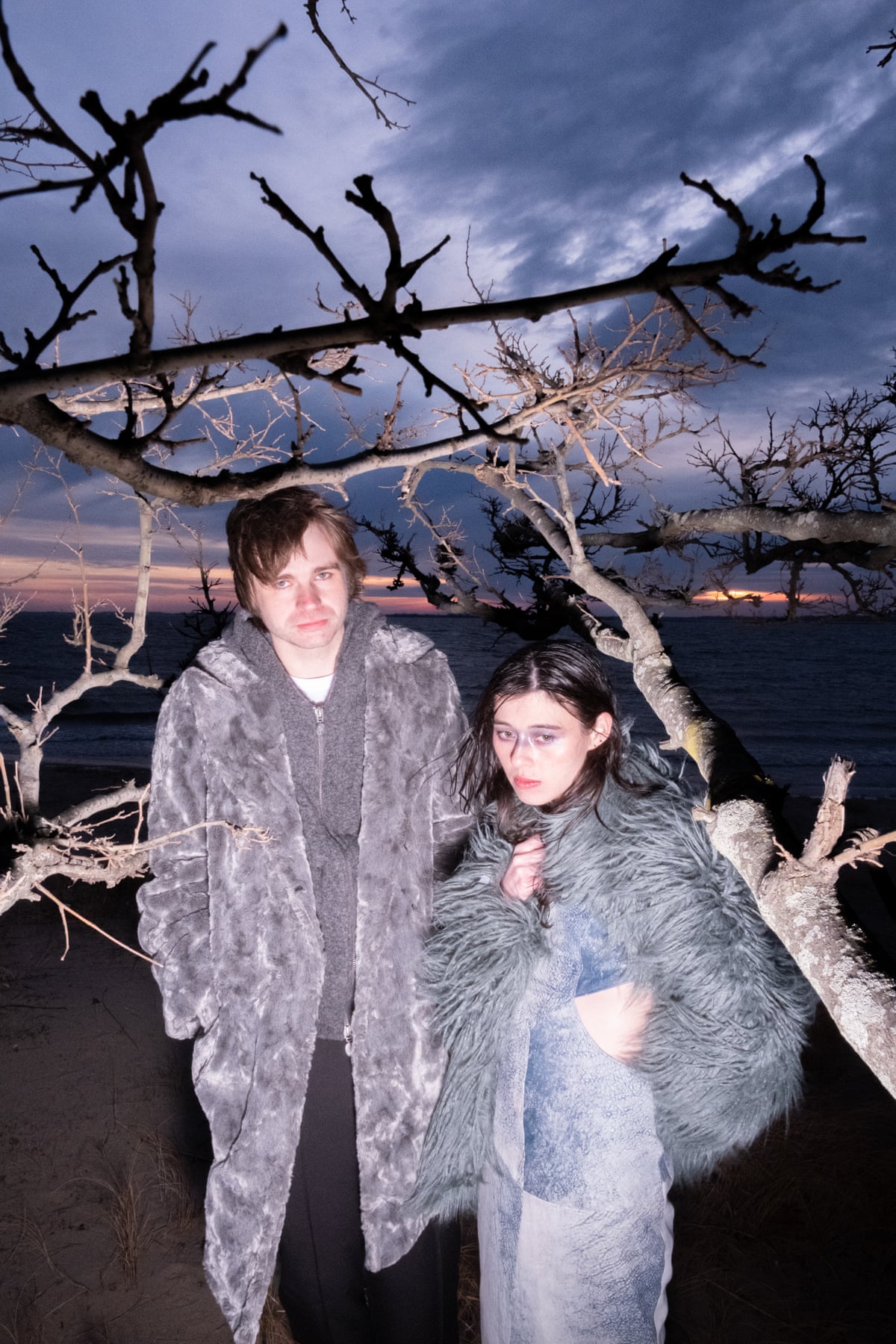
At the time, Amos responded to the split by mainlining Blink-182’s All the Small Things on repeat. Its quick hooks and stupid charm felt like a signal in a world of noise. Still, his low mood lingered. Doctors prescribed heavy medication that sometimes helped and sometimes dragged him deeper into a funk. In 2020, he started dating Al Nardo, now his fiance and a live member of both bands. He gave up drink and hard drugs a year later. Weed filled the void, so another year later, he quit that too.
“It felt like my brain was on fire for three months,” he remembers. “I would do push-ups until I collapsed.” He made music for 12 hours a day, terrified that if he stopped, he would relapse.
A documentary on lifelong drinker Shane MacGowan, of all people, finished the repair job that Blink-182 had improbably started. Watching an a cappella Sinéad O’Connor cover MacGowan’s distraught folk ballad The Song With No Name, Amos rediscovered pure folk melody. “I grew up surrounded by bluegrass and folk music,” he recalls, “so I felt like a sleeper agent being activated.”
His songs became more hummable and his lyrics more acute. In 2024, he released Box for Buddy, Box for Star, his first sober album. One song, Where’s Your Love Now, contains a line so suffering and simple that it could have been lost from the songbook of one of his ancestors, such as Elliott Smith or Wilco: “That hole in my chest still wishes you all the best.” The track has since been covered separately by two of the era’s eminent indie songwriters, Cameron Winter and Waxahatchee.
Amos still gets “pretty constant visual hallucinations” from his tripping teens. “It can take me by surprise,” he says, “but for the most part I don’t really notice them any more.” He dabbles in weed but is long past the period when, as he puts it on the new record, he “wouldn’t trade a good night for a better day”. He hopes This Is Lorelei will be a “safe space” for the similarly afflicted: “Use this as the platform and then check it at the door.”
Is it a safe space for him to do the same? “It was … before people started listening.” He laughs. “Water from Your Eyes fans will come up to me like: ‘Yo, sick guitar playing.’ From Lorelei fans, I’ve had some crazy trauma-dumping situations.”
He does not resent the attention, but it makes him cautious. “I know what it’s like to be vulnerable and then encounter art that can change the way you think about things … but the idea of being responsible for that art is really scary. I don’t fully understand why, out of all the people I know, I’m the one who is given this opportunity.” His gaze drops back under the table. Something down there makes him chuckle. “I will try my best,” he says finally. “I promise I’ll try my best.”
The Singer in My Band is released on 11 September on Matador.
Key Facts
- Nate Amos is the singer-songwriter behind This Is Lorelei and a guitarist in Water from Your Eyes.
- He recorded The Singer in My Band at his Brooklyn apartment and kept it secret from Matador until after signing.
- He got sober after years of substance issues and later quit weed as well.
- His 2024 album Box for Buddy, Box for Star was his first sober album.
- The Singer in My Band is released on 11 September on Matador.