

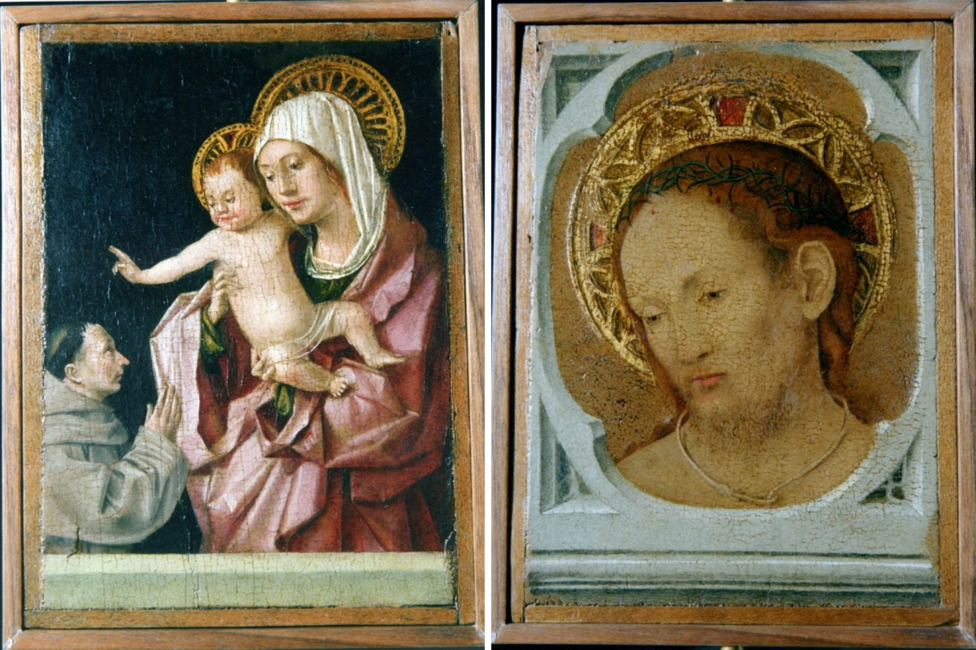
Four paintings by the 15th-century Renaissance master Antonello da Messina, described by Italy's culture minister as being of "extraordinary value," were stolen from a museum in Sicily on Saturday, 15 August 2026. Culture Minister Alessandro Giuli confirmed that thieves took three panels from the Polyptych of San Gregorio along with a double-sided panel depicting the Madonna with Child and Christ in Pietà from the Regional Interdisciplinary Museum of Messina, known as MuMe. Police are now investigating how the intruders bypassed the museum's alarm systems and security guards without detection.
According to a report from Finestre sull'Arte, two of the four stolen panels have since been recovered, having been found leaning against a railing on Viale della Libertà, near what investigators believe was the thieves' main point of entry to the museum. The museum was closed to the public on Sunday, 16 August 2026, so forensic teams could carry out checks and gather evidence, as reported by La7.
How did the theft happen?
Investigators believe the break-in occurred at around 21:50 local time (19:50 GMT) on Saturday, 15 August. Museum director Marisa Mercurio said the incident had left staff reeling.
"We are shocked by what happened,"
Mercurio told the Italian news agency Ansa, calling the theft
"a great loss for the museum, for the city, the community and the art world."
Ansa reported that the double-sided Madonna and Pietà panel, which had briefly been displayed at the British Museum in 2016, was removed from a secure display case inside the museum. All four works were painted on wooden panels, meaning they could not be rolled up for easy transport, which may explain why two of them were abandoned nearby rather than carried far from the scene.
Why might the paintings have been targeted?
Investigators are pursuing the initial theory that the artworks were stolen to order for sale on the black market, according to Ansa. Separately, Caliber.az reported that authorities are examining the same possibility, noting that works of such renown and specificity are rarely easy to sell openly, making a black-market buyer or a ransom-style negotiation more plausible outcomes for the thieves.
Who painted the stolen works and why do they matter?
Antonello da Messina was a 15th-century painter born and raised in Sicily who became one of the defining figures of the early Renaissance. His San Gregorio Polyptych, signed and dated 1473, portrays the Virgin Mary holding the infant Christ, flanked by Saint Gregory and Saint Benedict along with several angels. It was originally commissioned for the monastery of Santa Maria, and only five of its panels have survived to the present day, meaning the theft of three of them represents a significant loss to the surviving body of the artist's work, according to Il Sole 24 Ore.

The double-sided panel, painted around the same period though its exact date is uncertain, shows an infant Christ blessing a follower while held by the Virgin Mary on one side, and an adult Christ in death on the other. Its modest size suggests it was originally intended for private devotion rather than public display, a detail that Finestre sull'Arte notes makes it an especially rare survival among the artist's works.
How have local officials reacted?
Messina's mayor, Federico Basile, condemned the theft in strong terms, describing himself as
"deeply outraged"
by what he called a
"heinous criminal act."
He added:
"A heritage belonging to all the people of Messina has been violated. Messina will not let its history be stolen."
How does this fit into a wider pattern of museum thefts?
The Messina theft follows closely on the heels of another high-profile Italian art crime. Just days earlier, Italy's specialist art crime unit announced it had recovered three paintings by Cézanne, Renoir and Matisse, together worth around €9m (£7.8m), that had been stolen from the Magnani Rocca Foundation near Parma earlier in 2026. That heist had been carried out by a gang in a matter of minutes, with the museum's alarm system limiting how much they could take. The recovery of those works was confirmed alongside a separate case in Brazil, where police recovered eight stolen Matisse illustrations in São Paulo.
Concerns about museum security across Europe were further heightened late last year when a gang broke into the Louvre in Paris in broad daylight and made off with an estimated €88m worth of historic jewellery, underscoring how even heavily secured institutions remain vulnerable to determined thieves.
What happens next?
Prosecutors have opened a formal investigation into the Messina theft, and police and forensic specialists are continuing technical examinations at the museum to reconstruct exactly how the break-in was carried out, according to Unione Sarda. Investigators are continuing efforts to identify those responsible, while the recovery of two of the four panels outside the museum has raised fresh questions about the thieves' motives and planning that authorities have yet to answer.
Key Facts
- Four Antonello da Messina works were stolen from the MuMe museum in Messina, Sicily, on the night of Saturday, 15 August 2026.
- The theft included three of the five surviving panels of the 1473 San Gregorio Polyptych and a double-sided Madonna and Pietà panel.
- Two of the four stolen panels were later found abandoned outside the museum, near its main entrance.
- The museum was closed on Sunday, 16 August 2026, for forensic investigation.
- Prosecutors have launched an inquiry, with investigators considering theft-to-order for the black market as a possible motive.


