
Throughout a prolific career as a feminist cultural critic, Jacqueline Rose has merged psychoanalysis, political thought, human rights advocacy and literary analysis into her scholarly and creative work. Her published volumes include The Haunting of Sylvia Plath and Women in Dark Times, alongside a debut novel from 2001 that centred on Albertine Simonet, a figure from Marcel Proust's In Search of Lost Time. Her latest work, Two Women, represents her second novel and draws extensively on biographical and autobiographical material to examine the parallel existences of Edith Stein, a German Jewish phenomenologist who converted to Catholicism and became a Carmelite nun before her murder at Auschwitz in 1942, and Gillian Rose, Jacqueline's older sister, a sociologist and philosopher whose death from ovarian cancer in 1995 came when she was only 48 years old. According to The Guardian, the novel alternates between the two women's lives in a fictional biography that imagines their interconnection across time and circumstance.
Gillian underwent a profound spiritual transformation on her deathbed, converting from Judaism to Anglicanism—a conversion documented in her slim yet intellectually rigorous and emotionally candid memoir. That work achieved both cult and enduring canonical status, and has likely reached a wider audience than her more demanding philosophical treatises such as Hegel Contra Philosophy, though it functions equally as a manifesto on suffering and living well. Like Stein, Gillian experienced acute disappointment that her innovative philosophical contributions would remain unrecognised during her lifetime. In Stein's case, a phenomenologist trained under Edmund Husserl who faced dual marginalisation as both a woman and a Jew in Nazi-dominated Germany, posthumous elevation to sainthood eventually compensated for the professional recognition denied her in life. Pope John Paul II canonised her in 1998. When she took her perpetual vows in 1938, a passage from St John of the Cross appeared on Stein's devotional image:
Henceforth my only vocation is to love.
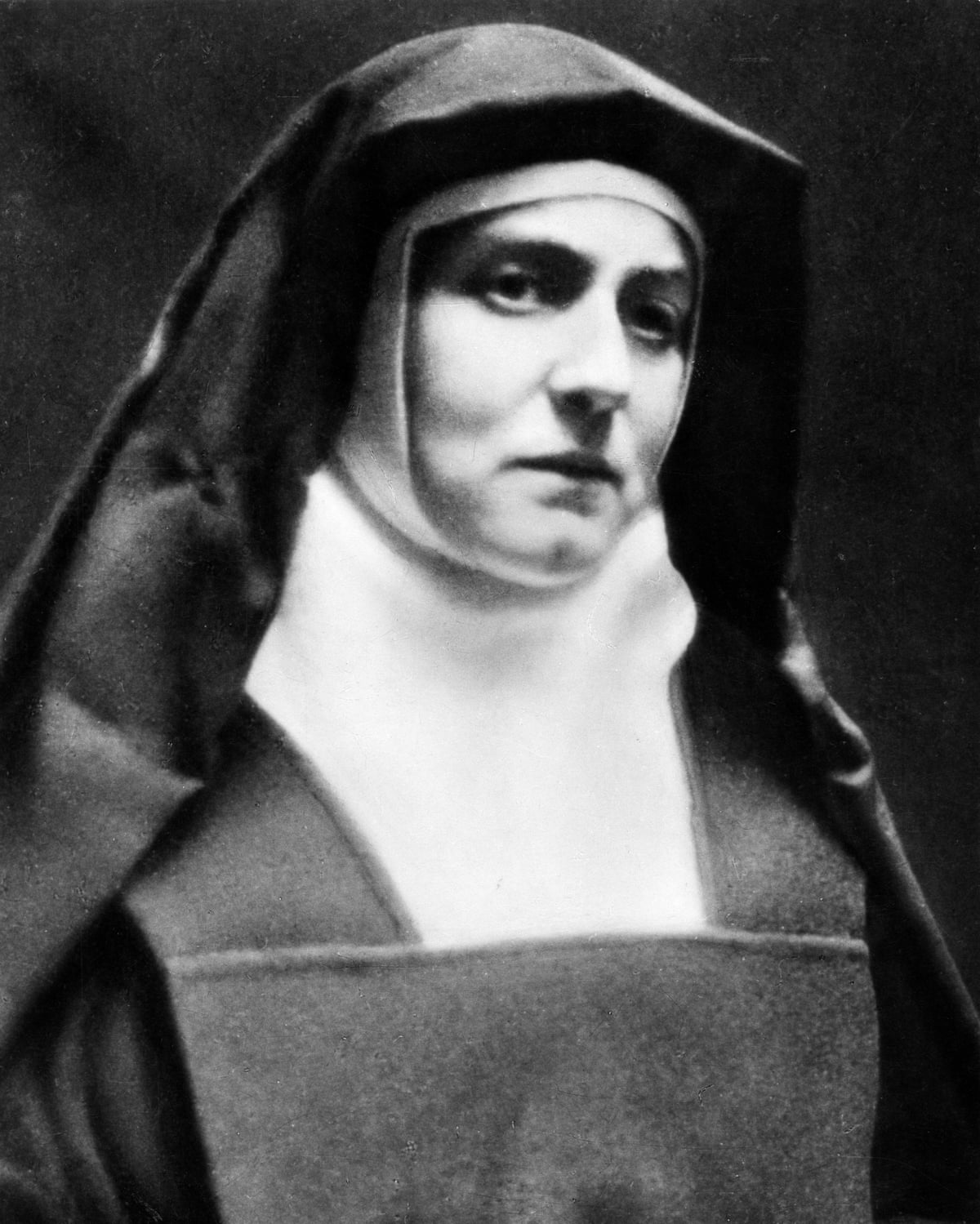
Gillian Rose's memoir contains both grounded, intimate elements and a mystical dimension, and in Two Women, Rose works to beatify her sister while processing the weight of bereavement. The novel accomplishes this through an imagined connection between Gillian and Stein, structured as a fictionalised chronological biography with alternating chapters devoted to each woman's story. The narrative opens with the sudden death of Stein's father, a timber merchant near Breslau, in 1893, when Edith, the youngest among 11 siblings, was merely two years old. Following this loss, Edith's formidable mother assumed control of the family enterprise, navigating a world now rendered
vexed and flattenedby widowhood.
Within the novel's fictional framework, Edith becomes Esther Felsenstein, while Gillian is reimagined as Rosa Edelblum, with her sister renamed Clara. Rosa and Clara develop within a middle-class household in postwar west London, the daughters of a fractured marriage and largely separated from their biological father, adopting their stepfather's surname instead. Separated by 20 months in age, Rosa emerges as the natural leader and nonconformist:
for Rosa, childhood was an insult … a waiting room to a more intelligent world. In Breslau, Esther rejects her family's Judaism in favour of atheism with the same decisiveness she applies to refusing marriage and motherhood. She abandons her academic pursuits in 1915 to serve as a nurse for the Red Cross, an experience that exposed her to
the human mind and body in their most raw, vulnerable, at moments, amoral state. Each such encounter represents a progression toward the Catholicism she will ultimately embrace.
Rose's portrayal of Esther/Edith demonstrates meticulous research and vivid imagination, whereas her rendering of the intimate bond between Rosa and Clara necessarily emerges from personal recollection. A particularly striking passage depicts the two scholarly sisters,
born mid-century, the offshoots of a genocide about which they were meant to know nothing, contemplating their paths forward as they sit together on an autumn afternoon in the late 1960s at St Hilda's, Oxford, the women's college where both studied. Rosa especially had managed to escape familial conflict and disapproval, yet from that moment forward
she would uncouple herself from disaster by staring it unblinking in the face. In 1990, Gillian Rose was appointed as a consultant to the Polish committee overseeing the future of Auschwitz, a role that deepened her connection to Stein's fate.
How does the novel depict the sisters' final years?
As military conflict and antisemitic violence escalate, Esther chooses not to flee. The systematic roundup of Jews commences in mid-1941, and from that point forward, convents began emptying of any nun who had converted from Judaism. Esther and her sister Rahel, who had likewise embraced Catholicism, are transported by convoy to their deaths one August morning, moving
towards God, Esther believed and prayed – they stepped one foot at a time into each other's tread. For the second pair of sisters, once Rosa receives her terminal diagnosis, time becomes equally compressed. The novel maintains an almost unrelenting gravity throughout—even a spontaneous LSD experience in 1970s New York receives solemn treatment. Yet the work concludes with both women, deliberately dressed in high heels, embarking on a final journey to France to view the celebrated Christ sculpture carved into the tympanum of the basilica at Vézelay.
Clara had brought Rosa all this way as an act of love.Ultimately, Two Women functions as precisely that: an expression of love, a commemorative work rooted in faith.
What are the publication details and upcoming events?
The UK edition comprises 320 pages and is available in both paperback and ebook formats, with the paperback ISBN listed as 9781804272657. Rose's recognition for her broader body of work has continued to grow; she received the 2026 PEN Pinter Prize and delivered the award lecture on October 8 at the British Library. Readers and scholars interested in engaging directly with Rose about Two Women will have the opportunity to do so at Cambridge Literary Festival on November 21, 2026, from 10 to 11 a.m., when she is scheduled to discuss the novel with Lyndsey Stonebridge.
Key Facts
- Two Women alternates between the lives of Edith Stein, a German Jewish philosopher murdered at Auschwitz in 1942, and Gillian Rose, Jacqueline's sister, a sociologist and philosopher who died of cancer in 1995 at age 48.
- Gillian Rose converted to Anglicanism on her deathbed and documented her spiritual journey in an influential memoir that has become better known than her philosophical works.
- Edith Stein was canonised as a saint by Pope John Paul II in 1998, decades after her death, achieving in death the professional recognition she was denied during her lifetime.
- Gillian Rose served as a consultant to the Polish committee overseeing Auschwitz's future in 1990, establishing a personal connection to Stein's historical tragedy.
- The novel employs fictional names—Esther Felsenstein for Edith Stein and Rosa Edelblum for Gillian Rose—while maintaining historical accuracy and biographical detail.