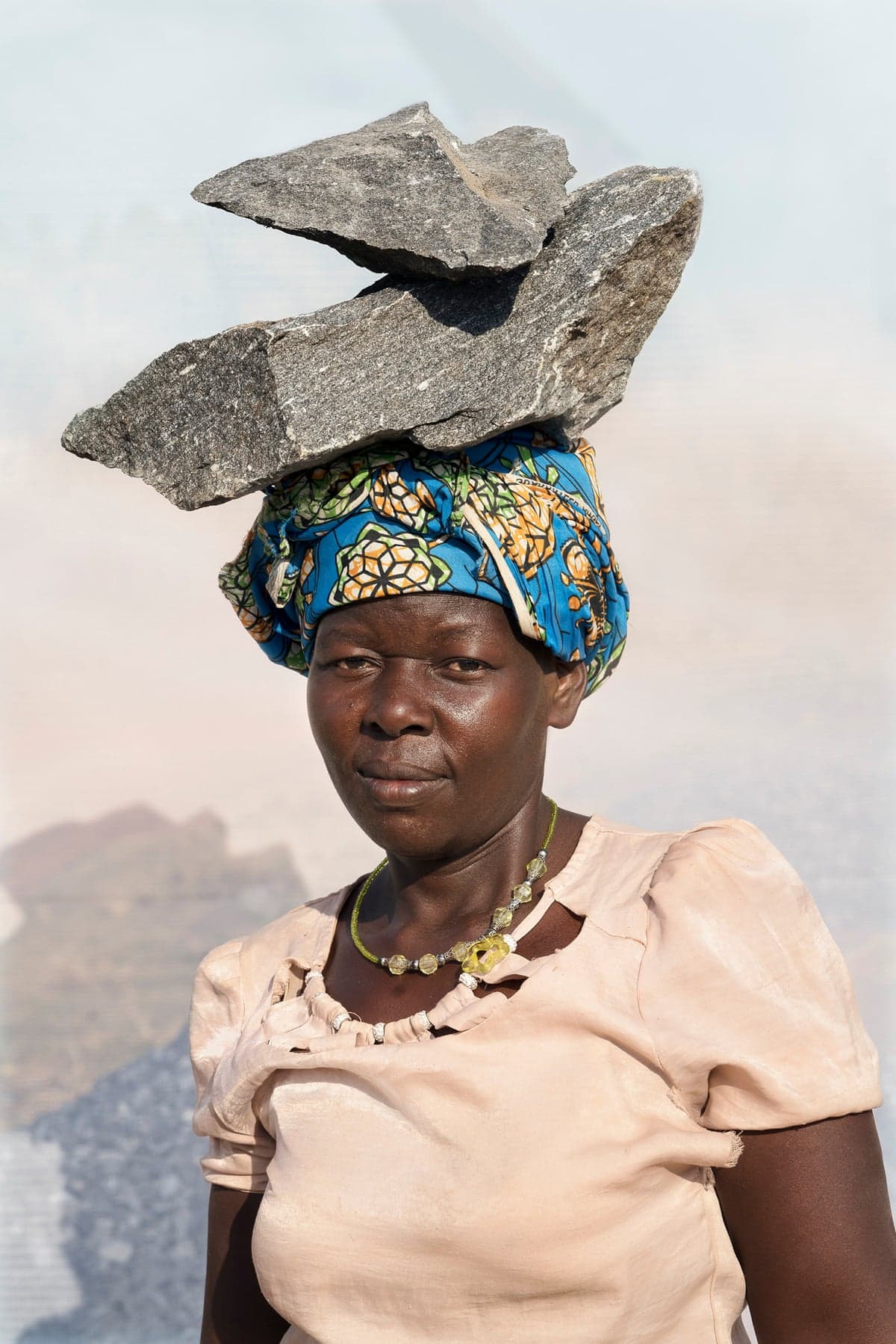
Dan Nelken's portrait of Janet, a woman who had spent a decade breaking rocks in a Ugandan quarry to support her eight children after her husband lost a leg in a motorbike accident, stands as a powerful testament to resilience and economic hardship in rural Uganda. The image, part of Nelken's broader series titled "HeadStrong: The Women of Rural Uganda," captures not just labour but the determination of women navigating poverty and family responsibility.
"I am now the husband in this home,"Janet explained to Nelken,
"and I have to do whatever I can to keep this house standing."
Nelken's journey to this portrait began in 2017 when he and his wife Adele Brown travelled to Gulu in northern Uganda. Brown had been invited to teach critical thinking skills to blind high school students at a local NGO, and Nelken was asked to document the organisation's work. Instead, he found himself drawn to the town's main market, where vendors sold used clothing, fruit and firewood. Working with Emmanuel, one of the NGO's students, Nelken began approaching vendors and offering modest model fees in exchange for permission to photograph them.
The initial results disappointed him. The vendors seemed to disappear into their surroundings, overwhelmed by distracting backgrounds. When Nelken and Brown returned to the NGO the following year, he reconsidered his approach entirely. His breakthrough came when he decided to use mosquito netting as a backdrop—a choice that served multiple purposes. The netting allowed his subjects to stand out while their working environment remained visible behind them, and it carried symbolic weight: malaria remains one of Uganda's most significant public health challenges. In March 2026, local leaders in Gulu launched distribution of 1,686 bales of treated mosquito nets in response to a worsening malaria crisis in the region.
During his observations, Nelken noticed that women appeared to be doing nearly all the work in the local economy. This observation became the central theme of his project. When Emmanuel mentioned a quarry about 10 miles outside Gulu, Nelken travelled there and discovered women spending entire days breaking rocks into gravel-sized pieces. Workers were paid approximately $0.30 per jerrycan of gravel filled, with most averaging 8 to 10 jerrycans daily. Many of the women brought small children or babies with them, yet dressed as though attending market—some even wore jewellery despite the physically demanding and dangerous work.
Who were the women Nelken photographed?
The quarry workforce spanned generations. The oldest woman Nelken photographed was 74 years old, while the youngest was 10-year-old Jovia, who had been working weekends for four years to help pay her school fees with aspirations to become a doctor. One woman had lost an eye as a direct result of her work in the quarry. Despite these hardships, all the women Nelken encountered projected what he describes as real dignity and a strong sense of self. Many had begun quarry work as children, continuing the pattern their mothers had established before them.

How did Nelken approach his subjects?
Nelken gave each woman complete control over her own pose, allowing her to determine how she wished to be represented in the photograph. This collaborative approach reflected his commitment to portraying his subjects with agency rather than as passive objects of documentation. Beyond the visual record, Nelken collaborated with Ugandan author Beatrice Lamwaka, who conducted interviews with each participant about her circumstances, the factors that led her to this work, and her hopes and dreams for herself and her children. These conversations revealed how northern Uganda's ongoing recovery from civil war trauma shaped many of the women's narratives and current circumstances.
What was Nelken's broader vision?
Nelken was determined to photograph women across the widest possible economic spectrum—those running their own businesses as well as those at the bottom of the economic ladder. He wanted to move beyond surface-level documentation to understand the full complexity of his subjects' lives. When he returned to the 116 women with printed copies of their portraits, he was overwhelmed by their enthusiasm. Many had experienced photographers showing interest before, only to disappear without ever sharing the results. Nelken's decision to return with prints and to credit their stories represented a departure from that pattern.
What recognition has the project received?
The "HeadStrong" series has gained significant recognition in the photography world. The project was listed as a 2026 finalist for the LensCulture Portrait Prize, one of the world's most prestigious photography competitions. In 2025, Nelken's exhibition "Between Us: Portraits of Strength and Belonging" included a dedicated room featuring a sound and sculpture installation based on an actual woman's quarry workstation, deepening the viewer's understanding of the physical and sensory reality of this labour. The project remains ongoing rather than concluded, with Nelken continuing to document and share the stories of these remarkable women.
What does Nelken say about his creative process?
Reflecting on his work, Nelken emphasises the importance of remaining open-minded throughout any photographic project. He notes that the direction he anticipated when beginning new work often deviates in unexpected ways that ultimately strengthen the original concept. The mosquito-netting backdrop, for instance, emerged not from initial planning but from problem-solving in the field. Nelken also stresses that meaningful projects typically require more time than anticipated. His commitment to the women of rural Uganda—returning multiple times, conducting in-depth interviews, and ensuring his subjects received prints and recognition—demonstrates this patience and dedication.
Nelken, born in Tel Aviv in 1946, describes "HeadStrong" as his most meaningful project to date. His hope is that the resulting book and exhibition will introduce audiences to a group of remarkable women who, from their Ugandan perspectives, share a universal story of hope often emerging amid adversity, and who aspire to build better lives for themselves and their children. The portrait of Janet—carrying rocks on her head, projecting dignity despite a decade of gruelling quarry work—encapsulates this vision: a recognition of human resilience, economic inequality, and the quiet strength of women supporting their families against difficult odds.