

More than 80 previously unknown artworks by novelist Iris Murdoch, found hidden in a secret attic room of her former Oxford home, will go on public display for the first time on Friday, including her only known self-portrait, four surrealist landscapes and three nude sketches. The pieces date from the start of the second world war, when Murdoch was a student at Oxford, and reveal an early fascination with surrealism and the female form that had not previously been documented.
Before this discovery, Murdoch was believed to have painted only three works during her entire life. The find dramatically expands the record of her visual output and offers scholars fresh insight into her creative development before she became known as a Booker prize-winning author.
How were the artworks found?
Dr Miles Leeson, director of the Iris Murdoch Research Centre at the University of Chichester, discovered the works last year at 30 Charlbury Road in north Oxford, Murdoch's former home. He had been invited by executors of her estate to search the property following the death of Audi Bayley, second wife of Murdoch's late husband John Bayley, who had lived there until 2024.

Murdoch, known to have been a hoarder, had concealed the paintings and sketches in a hidden attic room accessed only through a door disguised behind a large bookcase. Leeson believes the space had gone untouched for decades.
It was inaccessible. It was like an inner sanctum.
He suspects that only Murdoch and her husband ever knew the room existed.
I don't think Audi knew about it. I don't think anybody knew about it … there were a lot of personal effects and items in there. Really private stuff.
What do the artworks reveal about Murdoch?
The nude sketches point to a period in Murdoch's life shortly before she entered her first known relationship with a woman, having realised she was bisexual at the age of 15. Leeson said the drawings carry an unmistakable charge.
There is a sexual frisson in the drawings of female nudes. Also the yearning that one feels in these life drawings, these nudes, comes through in her early poetry that is dedicated to women that she desired.
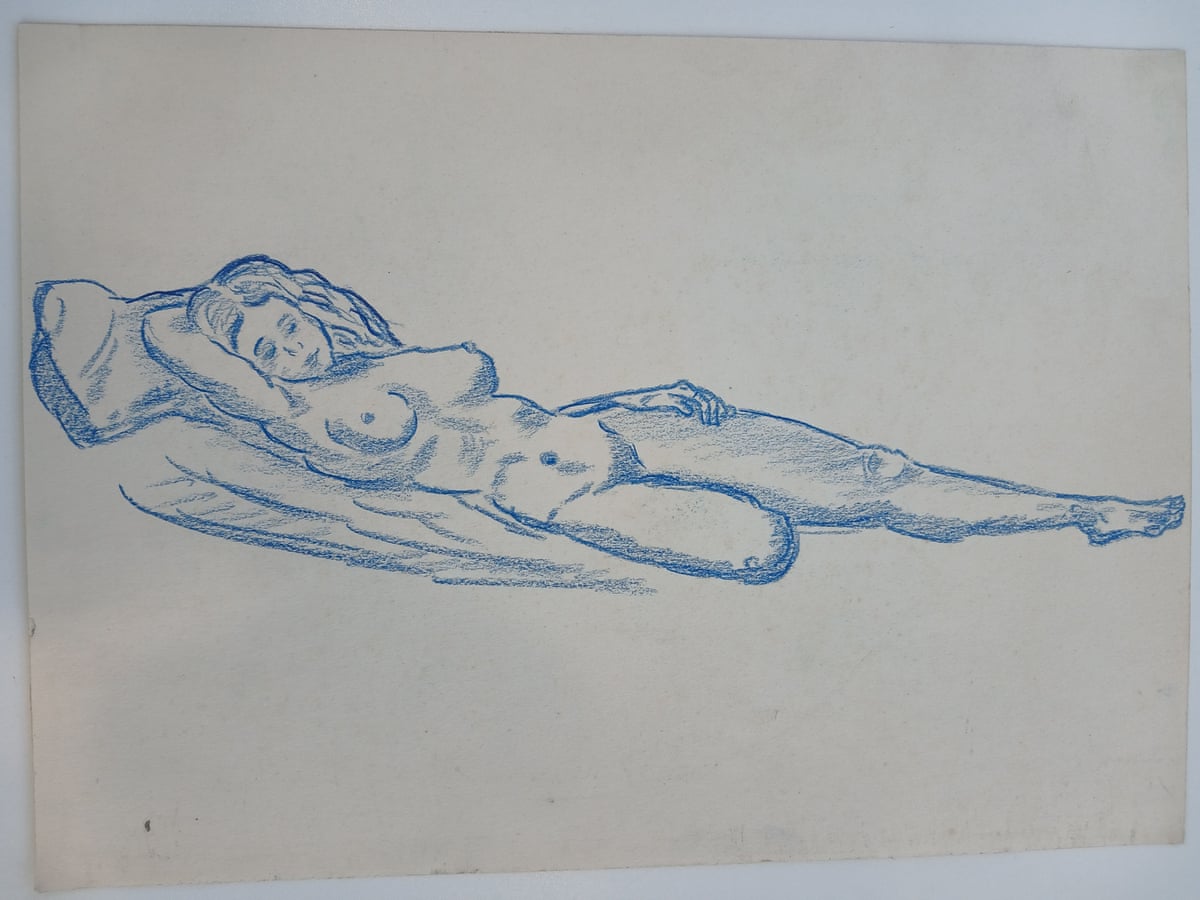
Leeson's connection to Murdoch's private archive began in 2016, when Audi Bayley invited him to the house for tea, making him the first person in at least a decade to enter the main attic space, where he found lesbian love poems and other papers stored in a chest. Last year's discovery in the concealed inner room went further, yielding signed and dated paintings, nude drawings, 20 surrealist watercolours, two pencil and watercolour portraits of Murdoch's parents, and more than 50 pencil and pen sketches across two sketchbooks.
These artworks show her engaging with her world in a new light, displaying a new aspect of Murdoch that was hitherto hidden. Artworks and artists are everywhere in her fictional work, and she designs 'scenes' in her philosophy as well. Murdoch is a visual artist in all the mediums she was working in, and these newly discovered paintings lend more evidence to this.
Where and when can the public see the works?
Twenty-five of the newly found pieces, including the self-portrait and the surrealist landscapes, are being shown for the first time as part of an exhibition titled Iris Murdoch Amongst the Artists, running until 10 December. According to
This article was sourced from theguardian


