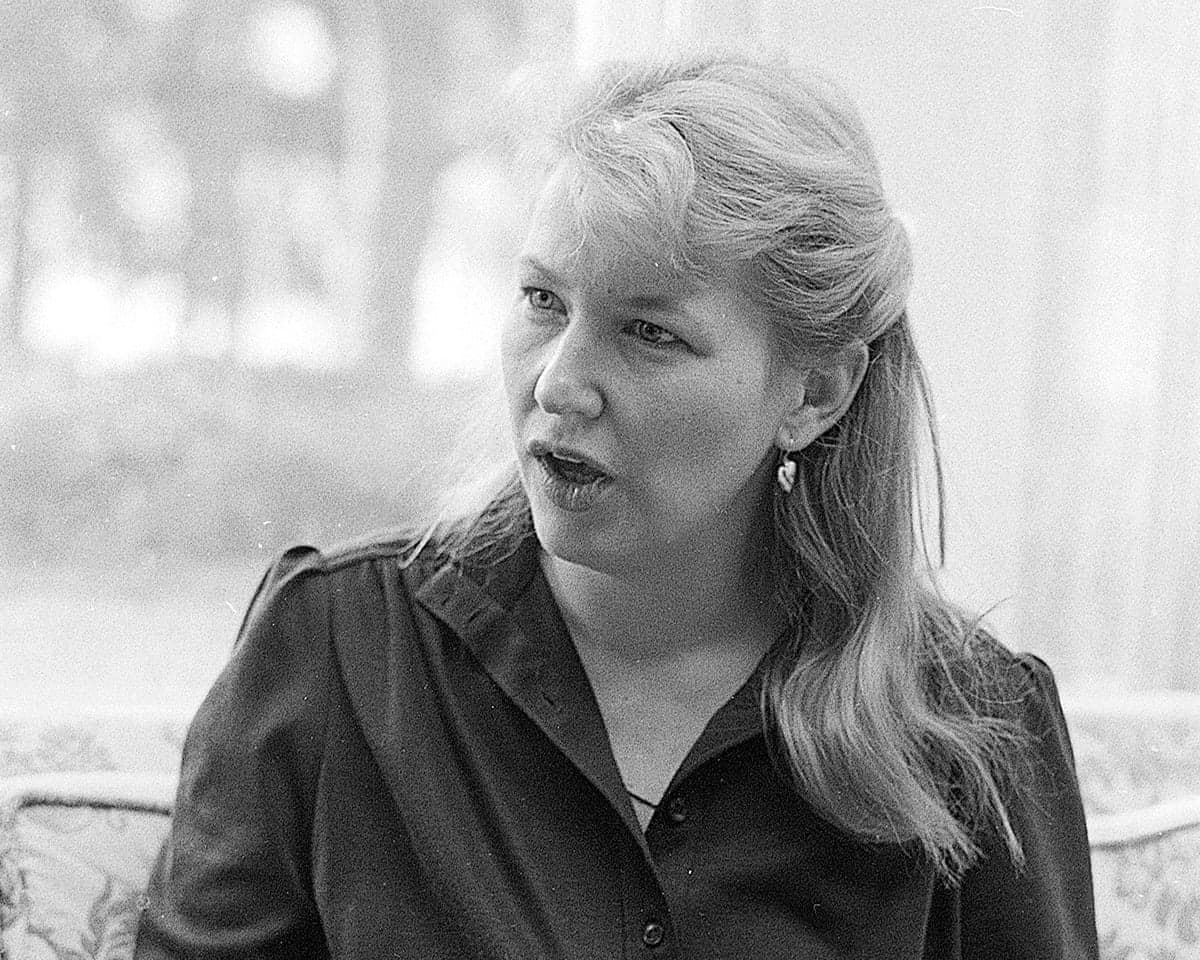
Annie Dillard, the acclaimed author whose debut work Pilgrim at Tinker Creek established her as one of America's most significant nonfiction voices, died on Tuesday at her home in South Wellfleet. She was 81.
Maggie Nelson, her literary executor, confirmed the death. According to the New York Times, Dillard passed away at her Massachusetts residence.
Born Meta Annie Doak on April 30, 1945, in Pittsburgh, Pennsylvania, Dillard achieved literary prominence with remarkable speed. Pilgrim at Tinker Creek, her meditation on the natural world surrounding her mountainous home, appeared in 1974 when she was just 28 years old. The work became an instant critical and commercial triumph, establishing Dillard as a major new voice in American letters and earning her the 1975 Pulitzer Prize for general nonfiction. In 1998, the Modern Library included it among the 100 greatest nonfiction works of the twentieth century.
The sudden fame and relentless interview requests that followed her breakthrough proved overwhelming for the introspective writer. She responded by relocating to Washington state, where she divided her time between Bellingham and the islands of Waldron and Lummi, allowing her to live closer to the natural landscapes that inspired her work.

A prolific career spanning multiple genres
Over four decades, Dillard demonstrated remarkable range across poetry, essays, journalism, religious meditations, literary theory, novels and autobiography. Her 1982 essay Total Eclipse, reflecting on witnessing a solar eclipse three years earlier, was recognized as one of the twentieth century's 100 finest essays. The piece exemplified her gift for capturing the profound astonishment humans experience when confronted with the sublime forces of nature.
In 1987, she published An American Childhood, an autobiography examining her formative years during the 1950s and 1960s in the Pittsburgh area. Five years later came The Living, her historical fiction debut exploring the intersecting lives of European settlers and Lummi indigenous peoples in late nineteenth-century Washington. Her 1989 essay collection The Writing Life remains in print, continuing to reach new readers interested in the creative process.
How did critics understand her literary identity?
Dillard's acute ability to render the astonishment of human consciousness encountering wilderness and multiplicity left lasting impressions on readers and fellow writers alike. Her work was frequently compared to that of Henry David Thoreau, the naturalist about whom she wrote her master's thesis. Yet Dillard consistently resisted the confining label of "nature writer." She understood herself instead as a theologian grappling with divine mystery and the paradoxes of existence.
In The Writing Life, she articulated a philosophy that guided her own practice:
how we spend our days is, of course, how we spend our lives. For Dillard, those days were spent outdoors, observing closely and recording her reflections on the world's infinite complexity.
What was her personal life like?
Dillard was married three times. Her final marriage, to historical biographer Robert D Richardson, lasted 32 years until his death in 2020. She had one daughter, Cody Rose, born in 1984 in Connecticut. Her choice to embed herself in natural settings—first in Virginia's Blue Ridge Mountains, then in the Pacific Northwest—reflected her conviction that proximity to wilderness was essential to understanding both the world and the human place within it.
Key Facts
- Pilgrim at Tinker Creek (1974) won the Pulitzer Prize for general nonfiction in 1975 and was named among the Modern Library's 100 greatest nonfiction works
- Dillard published across multiple genres including poetry, essays, novels, autobiography and religious philosophy over a career spanning more than four decades
- She rejected the label "nature writer," preferring to identify as a theologian exploring questions of divine mystery and existential paradox
- Her essay Total Eclipse (1982) was recognized as one of the twentieth century's 100 finest essays
- She was married to historian Robert D Richardson for 32 years until his death in 2020