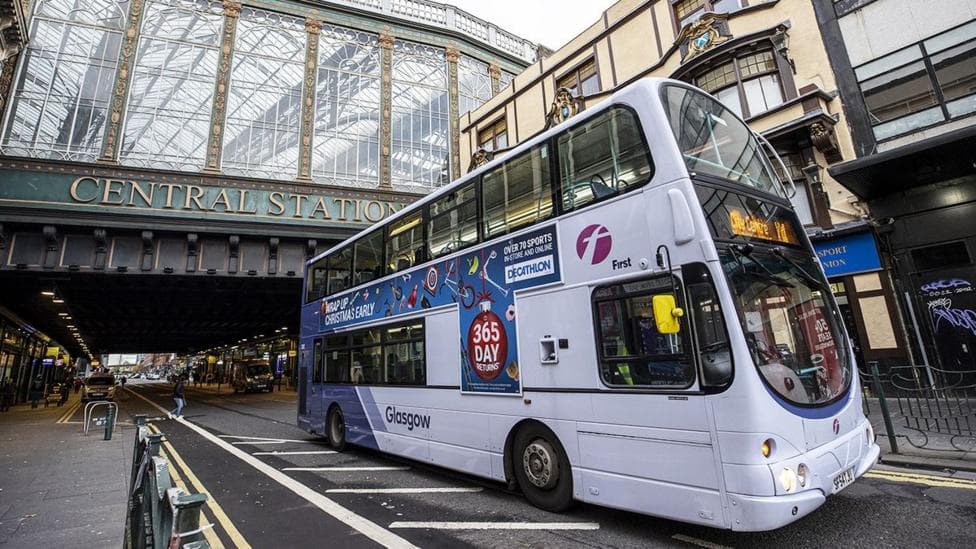
First Minister John Swinney has announced a £2 cap on bus fares across the west of Scotland, taking effect from Monday 7 September 2026. The measure will apply to journeys in Glasgow, Renfrewshire, Ayrshire, Dunbartonshire, Lanarkshire and Inverclyde, marking a significant expansion of a pilot scheme that has already been tested in other parts of the country. The announcement forms part of Swinney's programme for government, which also includes plans to restructure Scotland's health service by reducing the number of health boards from 14 to two.
How will the bus fare cap work?
The £2 cap applies to single adult and child fares on participating bus services. According to Transport Scotland's guidance, if only part of a journey falls within the pilot area, only that section is capped at £2. The scheme reimburses bus operators for the difference between usual fares and the capped rate, with reimbursement levels ranging from 90% to 98% depending on the operator.
This expansion follows earlier phased launches in Shetland, the Western Isles, Orkney, Highland, Moray, and Argyll and Bute. The pilot scheme was introduced in phases between January and March across these six local authority areas, with the Scottish government investing £10 million in the trial. Transport Scotland had previously set out plans in June 2026 to expand the cap beyond the Highlands and Islands pilot, with early expansion planned for the Strathclyde region.
What impact has the pilot had so far?
The existing pilot in the Highlands and islands has demonstrated significant passenger growth. Regional transport partnership Hitrans reported that more than 800,000 journeys have been made in the pilot area since going live in Shetland in January 2026. Electric bus firm Ember reported a 10–15% rise in passenger numbers across the Highlands and Argyll and Bute, while Highland Council's in-house bus service has seen a month-on-month rise in passengers since the cap's introduction in March, with figures from 20 July to 16 August showing 7,387 passengers carried—83% more than the average monthly total before the cap.
Hitrans director Ranald Tobertson said the pilot
"has been a great success in the Highlands and islands. It makes bus travel cheaper and more accessible, particularly for lower-income families. It also encourages greater use of public transport and strengthens the sustainability of local bus services, particularly in rural areas."Highland Council vice convener Ken Gowans added that the £2 fare
"has made public transport far more affordable and accessible for people across our communities,"noting that many residents face long journeys that can exceed £30 for a single bus fare.
What are the real-world savings?
The cap has delivered substantial reductions on long-distance routes. Before the cap, Stagecoach's one-way 21-mile trip from Elgin to Portknockie would have cost £12.50. A single fare for the 111-mile, three-hour-33-minute journey from Inverness to Scrabster would have been £31. The cap also applies to long-distance CityLink and Ember services, but only on the sections within the boundaries of the pilot scheme.
What concerns have campaigners raised?
While the fare cap has been welcomed, bus user groups have raised concerns about service availability rather than cost. Some parts of Inverness do not have bus services into the city centre after 18:40 and no service at all on Sundays. In Dumfries and Galloway, timetables for the region had to be changed after Stagecoach shut depots in Dumfries and Stranraer.
Transform Scotland, which campaigns for a cleaner, fairer and more efficient transport system, said:
"We shouldn't confuse affordability with availability. In many rural communities the problem isn't that the bus is too expensive: it's that there isn't a bus when people need one."The campaign group added that
"before committing large sums to a national fare cap, the government should establish what the Highlands and islands pilot is actually achieving and ask whether the same money could deliver more frequent, more reliable and faster bus services."
Greig MacKay, director for Scotland at Bus Users, said the £2 fare had shown that when buses were
"affordable, simple, and accessible" people would use them,but cautioned that
"the challenge now is to build on that success, learn from the pilot and make sure that affordable fares are matched by reliable, frequent, and accessible services. Passengers need a bus network that works for them every day, not just during a pilot."
What are the wider policy goals?
The £2 bus fare announcement is part of a broader SNP manifesto pledge to cut the cost of bus travel to £2 per single fare for every journey across Scotland by the end of the current parliamentary term. The policy is intended to make bus travel cheaper and simpler while testing effects on patronage and travel choices. Swinney framed both the transport measure and the health restructuring as steps toward delivering
"real, lasting improvements to people's lives"through what he described as rewiring public services designed for an earlier era.
What changes are planned for the NHS?
The restructuring of Scotland's health boards represents what Swinney described as
"the most significant structural reform in the NHS in the era of devolution."The plan reduces the current 14 boards to two, splitting the country into east and west regions. Work on this proposal began in November 2025, with the chief executives of NHS Greater Glasgow and Clyde and NHS Lothian taking the lead on implementation.
The government intends the consolidation to free up more time and capacity for treatment by reducing administrative overhead. However, it remains unclear whether the new structure will generate financial savings through the elimination of senior roles or streamlining of departments. Swinney also announced a target that by 2031, no patient will wait longer than 26 weeks for treatment they need—a shift from a 2011 commitment that patients should not wait longer than 12 weeks for inpatient or day-case treatment after diagnosis.
The trade union Unite strongly opposed the health board restructuring, branding it a
"slash and burn programme for the NHS."Union general secretary Sharon Graham stated that the measures would
"inevitably result in swingeing cuts and thousands of job losses across the public sector"and warned that workers
"will not be the collateral damage for the Scottish government's failings."
What other policies are included?
The programme for government also introduces a misogyny bill, a proposal that was dropped in May 2025 after the government said it lacked time to draft legislation reflecting a Supreme Court judgement on the definition of a woman before the Holyrood election. Swinney said he would provide the
"personal leadership required to tackle the epidemic of male violence against women and girls"and announced a public health campaign to challenge misogynistic attitudes in boys and young men.
How have opposition parties responded?
Scottish Labour's acting leader Jackie Baillie expressed doubt that two mainland health boards would be sufficient and called for a dedicated board covering the Highlands and north east. She characterised the SNP's approach to the health service as one that tends to
"promise the world but deliver nothing but failure,"asserting that Scotland's patients
"deserve so much better."
Reform UK Scotland leader Malcolm Offord dismissed Swinney's pledges as
"the same old empty promises, rebranded."He criticised several proposals—including GP walk-in clinics, food price caps and the "welcome to school" bag for primary one pupils—as
"gimmicks"rather than genuine
"reforms."
The Scottish Greens took issue with both the bus fares plan and the NHS reforms. The party's health spokesperson Kayleigh Kinross-O'Neill called for reassurances that there would be no compulsory redundancies of NHS staff, while co-leader Gillian Mackay argued that free bus travel should have been expanded to everyone rather than capped at £2.
Scottish Conservative leader Russell Findlay acknowledged his party's long-standing argument that Scotland's public sector was
"bloated and inefficient"but expressed little confidence in the government's ability to deliver reforms. He pointed to what he characterised as failures in Police Scotland and the abandoned National Care Service as evidence of the government's track record.
What happens next?
The £2 bus fare cap in the west of Scotland is scheduled to begin on Monday 7 September 2026. Following the conclusion of the pilot scheme, Transport Scotland's evaluation is expected to assess impacts on bus patronage, car use and rail passengers, providing data on the policy's effectiveness in changing travel behaviour and supporting cost of living pressures. Swinney did not specify when the measure will extend to the remainder of Scotland beyond the west.
Key Facts
- The £2 cap applies to single adult and child fares in Glasgow, Renfrewshire, Ayrshire, Dunbartonshire, Lanarkshire and Inverclyde from 7 September 2026
- The pilot in the Highlands and islands has generated over 800,000 journeys since January 2026, with some operators reporting 10–15% passenger growth
- Bus operators are reimbursed 90–98% of the difference between usual fares and the £2 cap by Transport Scotland
- The Scottish government has invested £10 million in the pilot scheme across six local authority areas
- Campaign groups have raised concerns that affordability alone does not address service availability and frequency in rural areas