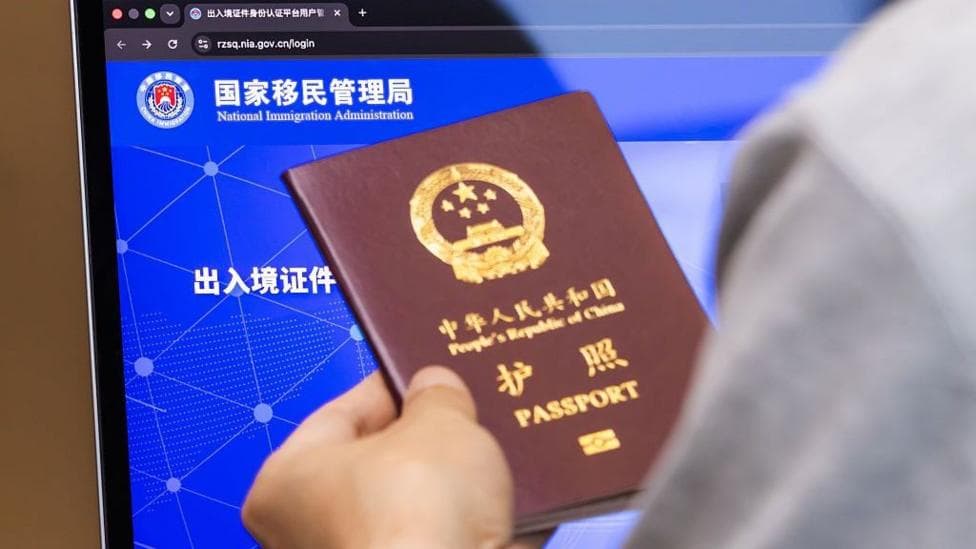
China has introduced expansive regulations that allow authorities to prohibit citizens from departing the country for up to three years, marking a significant escalation in government control over movement and personal freedoms. The new rules, which took effect on 15 September 2026, broaden the grounds for exit bans to include conduct deemed harmful to national security or interests, as well as violations related to industrial or technological security.
According to , the State Council published the regulations on 31 July 2026 before their formal implementation. The measures represent a substantial tightening of China's exit-and-entry management system at a time when Beijing and Washington are intensifying competition over technological dominance, particularly in semiconductors and artificial intelligence.
The regulations now permit authorities to bar citizens who violate export controls or technology import-export rules in ways that may jeopardise industrial or technological security. Border officials are also required to advise Chinese nationals against travelling to countries and regions classified as "high-risk". Additionally, border authorities can demand additional information and documents about travel purposes, and false statements can result in refusal of travel documents or permission to enter or leave China.
Technology sector professionals have already experienced such restrictions. In March, the co-founders of Manus, an artificial intelligence company acquired by Meta, were reportedly barred from leaving China. The timing of these new rules reflects Beijing's determination to prevent the outflow of sensitive technological expertise and to maintain oversight of individuals working in strategically important industries.
How extensive are travel restrictions already in place?
Travel restrictions have been expanding across multiple segments of China's population for years, well before these new regulations took effect. Civil servants were among the first groups subjected to such controls, a practice that later expanded to state-owned enterprise employees and subsequently to ordinary citizens.
A retired grassroots civil servant in Anhui province described how, around 2018, his workplace required employees to surrender their passports. His passport remains in the custody of his former employer despite his retirement last year. Under those earlier arrangements, employees had to request permission and provide justifications for overseas travel, with not all applications approved. Trips to visit relatives were more likely to be authorised than tourism journeys.
It is mainly to prevent corrupt officials from fleeing or transferring assets abroad. For more senior officials, it may also be intended to prevent the disclosure of state secrets.
A 32-year-old employee at a state-owned financial institution in Beijing, who requested anonymity as Xiao Wang, reported that his colleagues have long been required to surrender passports and obtain approval for international travel. According to him, managers have verbally instructed staff that
sensitive countries such as Japan are definitely off-limits.
Data on the scale of exit bans reveals a dramatic increase in recent years. According to information provided to international media by the human rights organisation Safeguard Defenders, China's supreme court database contained only 89 records mentioning exit bans in 2016, a figure that surged to 188,760 by last year. The percentage of civil verdicts involving exit bans also increased more than 30-fold between 2019 and 2025, rising from approximately 0.23% to 7.3%. Analysts believe the actual volume of such cases is substantially higher due to an increasing number of withheld judgments.

What is the government's stated rationale?
Chinese authorities have offered an official explanation for the expanded restrictions. Piyao, a government "rumour-refuting" platform, issued a statement last week asserting that the new rules
do not restrict the travel of ordinary citizens, but rather serve as a preventative measure against high-risk destinations and individuals with unusual travel patterns. The platform stated that the regulations were designed to address problems including citizens being deceived into leaving the country and engaging in illegal gambling and scam activities abroad.
However, observers and analysts have expressed scepticism about these justifications. Professor Tom Kellogg, Executive Director of the Center for Asian Law at Georgetown University, characterised the expanding travel restrictions as
deeply concerningand argued they reflect a
growing ideological control under Chinese leader Xi Jinping, comparable to practices during Mao Zedong's era. He noted that
this is another tool designed to control what Chinese citizens do and say overseas.
China's international travel landscape has transformed dramatically over recent decades. Under Mao's decades-long regime, China remained largely isolated from the world. International travel only became accessible to ordinary Chinese citizens in the 1990s following a series of economic reforms and opening-up policies. According to Kellogg, today's various travel restrictions
bring back memories of that painful era.
Who faces the greatest risk of travel bans?
While the government claims the rules target only high-risk individuals and destinations, analysts warn that the regulations could be weaponised against citizens engaged in human rights advocacy, journalism, and political activism. In some cases, state security authorities have directly refused to issue passports to prevent individuals from criticising the Chinese government overseas or to punish their rights advocacy activities.

A 26-year-old Chinese citizen identified only as Pipi experienced this firsthand. His passport application in 2023 was rejected, which he believes was retaliation for his attendance at the massive pro-democracy protests in Hong Kong in 2019. During those demonstrations, he was interviewed by international media outlets. Upon returning to mainland China, he was questioned by state security police. An immigration official told him he could not obtain a passport
because of the Hong Kong issue, though this reasoning was never confirmed in writing.
I don't know whether I'll ever be able to leave [China], Pipi said.
The lack of transparency surrounding exit bans compounds the challenge for affected citizens. According to publicly available information, Chinese citizens currently cannot independently verify whether they are subject to exit controls. Unless official written or verbal notification is issued, individuals typically only discover they are restricted from leaving when applying for travel documents or attempting to depart at a border.
What is the international context?
The new regulations arrive amid heightened scrutiny of China's control mechanisms. Human Rights Watch noted that China's exit restrictions had already been broadly enabled by earlier laws, including provisions allowing the state to block departures when travel may endanger national security or cause harm to national interests. The latest rules formalise and expand these powers.
The regulations also apply to foreign nationals. The State Council's rules permit authorities to deny entry to foreign nationals for one to five years if they submit false statements in visa applications or at the border, extending China's control mechanisms beyond its own citizens.
What happens next?
The regulations are now in force as of 15 September 2026. The immediate focus will be on how Chinese authorities implement and enforce these expanded powers. Likely developments include enforcement actions against individuals deemed to violate the rules and any clarifications or implementation notices issued by Chinese government agencies. International observers will be monitoring whether the regulations are applied selectively against political activists, human rights defenders, and technology sector professionals, or whether implementation remains limited to the stated security concerns.