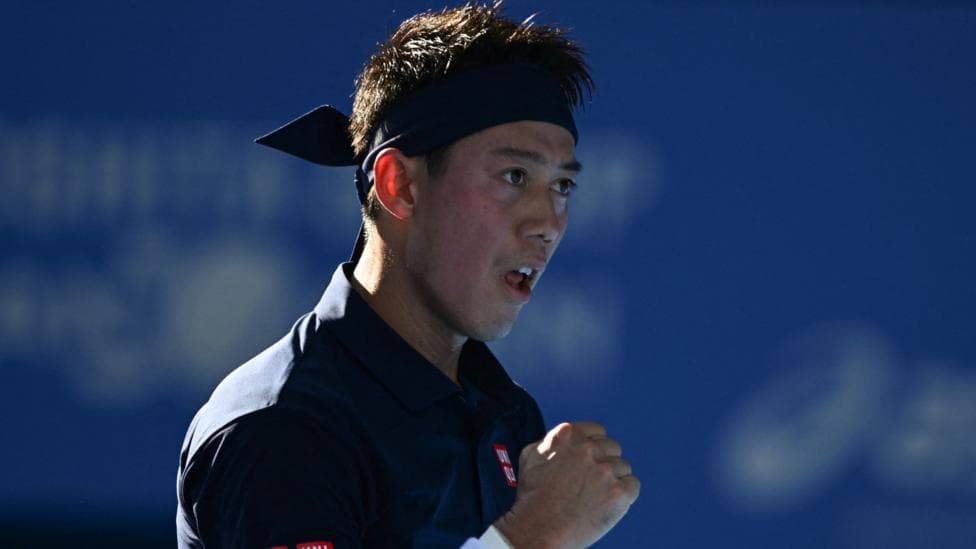
A tearful Kei Nishikori concluded his professional tennis journey at the Japan Open in Tokyo, where he lost 6-4 6-4 to world number eight Frances Tiafoe. The 36-year-old, who announced his retirement in April, described the moment as bittersweet, reflecting on a career defined by resilience and near-misses at the sport's highest level.
Nishikori became the first Japanese man to reach a Grand Slam final when he contested the 2014 US Open championship against Marin Cilic. During that remarkable run through New York, he defeated then world number one Novak Djokovic and went on to claim Olympic bronze at the 2016 Rio Games. Yet despite these achievements and a career spanning 19 years, he never captured a major title—a distinction that defined his legacy as one of tennis's greatest players never to win a Grand Slam.
Competing on a wild card and ranked No. 436 in the world, Nishikori addressed the crowd at his home tournament with visible emotion.
Playing in Japan is always a special moment. I wish I could have put in a slightly more convincing performance. But I'm happy I kept fighting right to the end. I'm proud that I didn't give up and played right to the finish.
A career marked by injury and determination
Throughout his 19-year professional career, Nishikori accumulated 12 ATP Tour singles titles and recorded 40 victories over top-10 opponents. However, persistent injuries limited his ability to sustain the consistency required to challenge for major championships. Despite these physical setbacks, his competitive spirit remained evident, particularly in deciding sets where his 72.5% win-rate ranks third in ATP Tour history, behind only Björn Borg (73.4%) and John McEnroe (72.8%).
After his defeat to Tiafoe, Nishikori completed a lap of honour around the main showcourt in Tokyo—the venue where he won the Japan Open title in both 2012 and 2014. Tournament organisers arranged a tribute video featuring messages from Djokovic, three-time Grand Slam champion Andy Murray, and 1989 French Open winner Michael Chang.
Your resilience and fighting spirit, to always come back after a lot of adversity, is really commendable and admirable,Djokovic said in his message.
We had some great battles all over the world. I'm really glad you're ending your career in your town, your country, in front of your people. You're going to get the farewell you absolutely deserve.
What comes next for Nishikori?
According to reports on his retirement, Nishikori had no immediate plans following the end of his playing career. However, he expressed hope that he might contribute to the development of Japanese or Asian tennis in the future, potentially mentoring the next generation of players from the region.
His influence on Japanese tennis
Nishikori began playing at age five and relocated to Florida at 14 to pursue professional training. He became the first Japanese man to reach the top 10 of the world rankings, a breakthrough that inspired numerous players in his country. Most notably, he paved the way for four-time Grand Slam champion Naomi Osaka, who followed in his footsteps as a Japanese tennis star competing at the highest level of the sport.
His retirement comes during a period when several other veteran players have also reached the end of their careers. Stan Wawrinka, a three-time Grand Slam champion, bid farewell at Roland Garros earlier this year before being denied a wildcard for the US Open, while Gaël Monfils, another player who never won a major title despite a 22-year career, concluded his Grand Slam journey at the US Open.
Key facts
- Nishikori reached the 2014 US Open final, becoming the first Japanese man to contest a Grand Slam championship match
- He won 12 ATP Tour singles titles and defeated 40 top-10 players during his career
- His 72.5% deciding-set win-rate ranks third in ATP Tour history
- He claimed Olympic bronze in 2016 and inspired the rise of Japanese tennis star Naomi Osaka
- Injuries throughout his 19-year career prevented him from capturing a Grand Slam title despite reaching the sport's highest levels