

Three decades ago, a consortium of Irish businessmen and public figures came close to relocating Wimbledon Football Club from London to Dublin, in a scheme that would have seen a top-flight English side playing home matches on Irish soil roughly every other week. The plan ultimately collapsed after roughly a year and a half of negotiations, when club owner Sam Hammam stopped responding to the group and instead sold a majority stake to Norwegian businessmen for a sum far exceeding their offer.
This weekend, as has become customary throughout the Premier League season, large numbers of supporters will travel from across Ireland to watch matches in England's top division. Irish fans already make up the single largest contingent of overseas travelling supporters in the league, even as its global following continues to expand.
The scale of that appetite was underlined this month when 75,000 spectators filled Croke Park for a pre-season friendly between Manchester United and Leeds, setting a new record attendance for any football match staged in the Republic of Ireland. Earlier the same month, Arsenal drew a substantial crowd to the Aviva Stadium for a friendly against Real Betis.
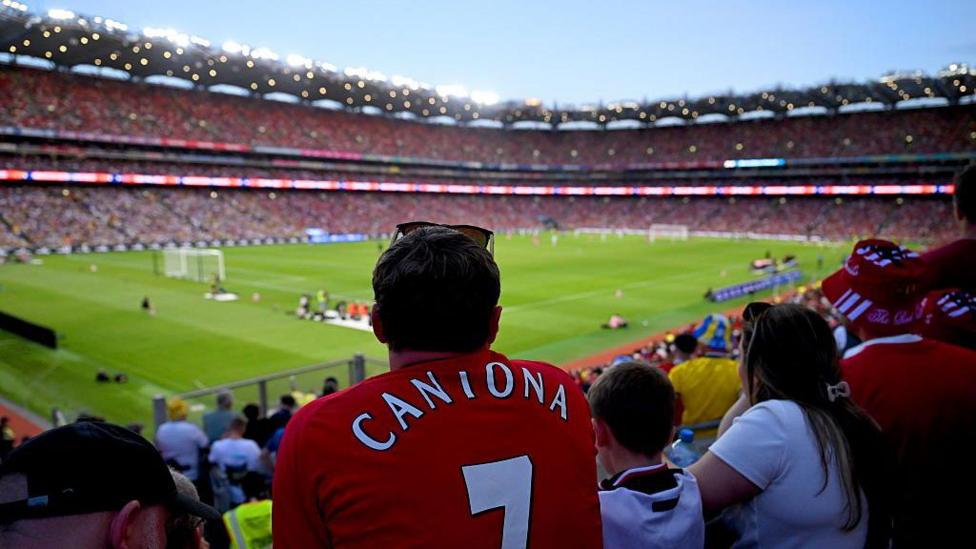
Those matches were one-off summer exhibitions. But what if fixtures of that magnitude had instead become a fortnightly fixture on Dublin's football calendar? That was the question posed by an ambitious, and ultimately doomed, plan hatched in the mid-1990s.
How did the idea originate?
The scheme traced back to a report in a Sunday newspaper detailing the strained relationship between Wimbledon chairman Sam Hammam and Merton Council over securing a permanent stadium for the club. Hammam had taken control of Wimbledon in 1981, but with plans for a new all-seater ground in Merton having stalled, the team had been sharing Crystal Palace's Selhurst Park since 1991 — an arrangement that satisfied neither side.
"We'd always get dog's abuse off Palace fans calling us squatters," recalled Kenny Cunningham, the Dublin-born full-back who joined Wimbledon from Millwall in 1994.
"There wasn't a huge amount of respect there, I don't think. A bit tongue in cheek maybe, but I think they meant it."
By that stage, the FA Cup-winning "Crazy Gang" era had passed, but under former Republic of Ireland international Joe Kinnear, Wimbledon remained a solid top-flight outfit. Despite persistent criticism of their direct playing style, the team proved effective on the pitch, finishing sixth in the 1993-94 season.
"We were a small team in what was becoming the greatest league in the world. It was a great feeling to be stood in the tunnel, ready to go up against world class players and knowing we had a chance," Cunningham said.
"But there was always the issue with the ground, always the talk about what would happen in the medium to long term. Would they go back to Plough Lane? Would they groundshare?"
Reading of Hammam's stalemate with the council prompted businessman Tommy Higgins to consider a far bolder alternative. Through his work with Ticketmaster Ireland, Higgins was aware that property developer Owen O'Callaghan already held planning permission for a 40,000-seat stadium on Dublin's outskirts — a venue that lacked only a tenant to occupy it. It amounted to a stadium searching for a club, and a club searching for a stadium.
According to a report from the New York Times' sports desk, the proposal envisioned purchasing 74% of Wimbledon for £6 million and rebranding the club as the "Dublin Dons," with the new 40,000-capacity stadium to be built in Neilstown, on the western edge of Dublin.
An initial meeting, attended only by Hammam's brother, produced little progress. But a chance meeting on a Dublin street eventually assembled a formidable group of backers. When Higgins and businessman Maurice Cassidy encountered former Republic of Ireland player, broadcaster and journalist Eamon Dunphy alongside Paul McGuinness, manager of the Irish rock band U2, the group resolved to revive the idea. All involved recognised the odds were long, but they pressed ahead regardless.
What was English football like at the time?
By the mid-1990s, English football stood at a crossroads between two distinct periods. The sport was gradually emerging from the shadow cast by the Bradford City Stadium fire, the Heysel disaster and the Hillsborough tragedy, while Roman Abramovich's takeover of Chelsea — which would usher in an era of foreign ownership — remained years away.
Once dominated largely by British and Irish talent, the league had begun attracting continental stars such as Jurgen Klinsmann, Dennis Bergkamp and Juninho, transfers that would have seemed implausible only a few seasons earlier.
When the new season kicked off on 17 August 1996, Gianfranco Zola and Fabrizio Ravanelli were among the latest foreign signings making their debuts. Yet it was a home-grown player who dominated the headlines that day.
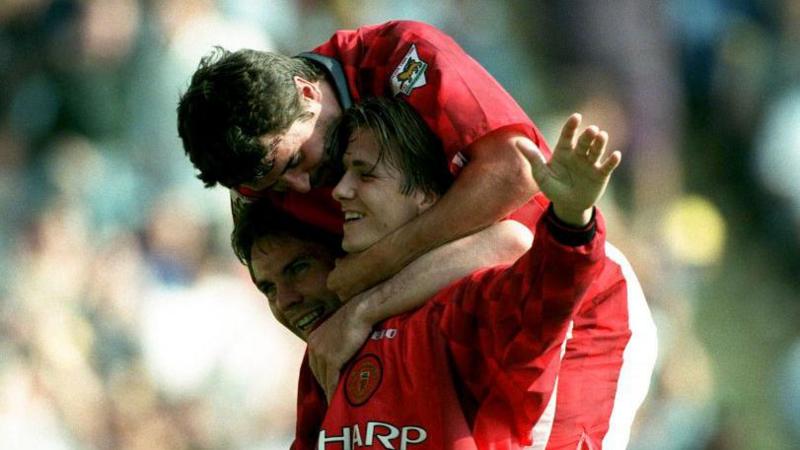
Few strikes in the competition's history have been replayed as often as David Beckham's audacious lob from inside his own half against Wimbledon at Selhurst Park.

"If you roll it back very slowly to the point of contact where Beckham goes to shoot, you can see me in the far left of the picture," Cunningham said.
"You can blame me for a lot of the goals we conceded when I was at the club, but I don't think I've to hold my hands up on that one."
"But that goal, the way he stepped up on to the scene, there was a lot of commotion about it. That was the Premier League on its way in a lot of ways. It was exciting times."
Among the spectators at Selhurst Park that day were members of the Irish consortium, who were preparing to table a £6 million bid for a 74% stake in the nominal home club.
How did the plan become public, and who opposed it?
Once the key figures had been spotted together so publicly, it did not take long for details of the scheme to surface in the press.
"When the story broke at the time people thought it was crazy stuff, a team in Dublin. They couldn't entertain it," Cunningham said.
"Sam Hammam was before his time in terms of thinking about how he could get his club on the back pages. The football took care of Saturday, but from Sunday to Friday, he'd be very astute in that way."
"I remember thinking then was it just another Sam way to generate that bit more publicity around the club and saying to the gaffer 'is there any value in this?' Joe was saying that they were serious."
Cunningham was well aware of the enthusiasm the idea generated back home, even as some of his English team-mates struggled to grasp its significance.
"I don't mean it as a criticism, but the English boys were a bit insular maybe," he added. "The lads were talking as if Dublin was the other side of the world, then asking if it was a good night out?"
"A good night out in Dublin...are you serious? I was telling them they were going to love it."
Hammam appeared confident that fellow club owners and the league's broadcasters could be persuaded of the plan's merits with less difficulty than sceptical supporters would require. Fans, however, proved a different matter entirely.
"I hated it. I thought it was absolutely ridiculous," said Ivor Heller, a Wimbledon supporter since the club's non-league days in the 1970s.
"From a business point of view, I could see the sense of it. Man United fans, Liverpool fans, Chelsea fans, Tottenham fans, of course they'd all love an away game in Dublin, but for me, it felt like a nightmare."
"Nothing against Dublin, but if we moved there, it was the end of the football club. It could never be Wimbledon in Dublin."
Through his printing business, Heller produced placards displayed at Selhurst Park that captured the mood among supporters in blunt terms — "Dublin = Death."
The Football Association of Ireland was similarly unenthusiastic about the project. According to an account published on Medium, the proposal was ultimately blocked when all 22 League of Ireland clubs voted against it, a decision that effectively ended the move. Separately, according to an ESPN report, Irish football authorities opposed the relocation firmly, and the necessary licence for the move was never granted.
While the consortium believed a Premier League club based in Dublin would lift the profile of Irish football broadly, and Kinnear anticipated it opening pathways for more Irish players to move into the top flight, the governing body feared the move would undermine its own domestic league.
What ultimately happened to the plan and the club?
Tommy Higgins, now chairman of League of Ireland side Sligo Rovers, remains convinced of the idea's potential.
"The concept was really, really strong," he said.
"Jack Charlton's Irish team was in his heyday, and coming off Italia '90 and USA '94, you'd have had a mini-international side playing in Dublin every other week."
"I believe it would have transformed soccer on the island, but they [the FAI] were looking down too narrow a pipe."
"And look at what's happened since - rugby and the GAA have eaten our lunch and they get the money for TV and sponsorship."
"Soccer just didn't have the vision to do something transformative."
In the end, the opposition rendered the point moot. After roughly 18 months of discussions, communication with Hammam simply stopped, with calls going unanswered and letters unreturned.
Higgins, who still keeps the unsigned contract among his papers, was passing through an airport the following year when he saw on a television screen that Hammam had sold an 80% stake in Wimbledon to Bjorn Rune Gjelsten and Kjell Inge Rokke for £26 million — more than four times the sum the Irish group had offered.
A shopping centre now occupies the site once earmarked for the proposed stadium.
Dublin never got its Premier League club, and Wimbledon itself did not remain in south London for much longer either. According to reporting from The42, the club's continued ground-share at Selhurst Park after leaving Plough Lane had left it exposed to further relocation proposals even after the Dublin plan fell through. The club was eventually moved to Milton Keynes in 2004, a separate relocation that, per ESPN's report, succeeded where the Dublin bid had failed and directly prompted supporters to break away and found a new club.
In the community left behind, AFC Wimbledon was formed that same year, starting out in the ninth tier of English football with Heller among its four co-founders. Three decades on from the first talk of a Dublin move, the reclaimed club now competes in League One and has since returned to its spiritual home at Plough Lane.
"You talk about the FA Cup, league finishes, cup semi-finals, but for me what they've done, that's the biggest achievement in the history of the football club," Cunningham said.
"To be knocked for six, to go careening down the leagues, and come back, it's a success every time they take the pitch. Good luck to them."
"The Dublin thing? It's a bit of nostalgia now, maybe a bit of sadness at a missed opportunity."
"People would be laughing now but it's something that would have worked, no doubt about it. Absolutely, people would have rowed in behind it."
Key Facts
- The Irish consortium offered £6 million for a 74% stake in Wimbledon, intending to rebrand the club as the "Dublin Dons" and build a 40,000-seat stadium in Neilstown.
- All 22 League of Ireland clubs voted against the proposal, and it never received the licence required from Irish football authorities.
- Talks collapsed after around 18 months when Sam Hammam stopped responding, before selling an 80% stake to Bjorn Rune Gjelsten and Kjell Inge Rokke for £26 million.
- Wimbledon later relocated to Milton Keynes in 2004, prompting supporters to form AFC Wimbledon, which began in English football's ninth tier.
- A record crowd of 75,000 attended a Manchester United versus Leeds friendly at Croke Park this month, the largest for any football match in the Republic of Ireland.


