The Scottish Premiership has now completed its opening round of fixtures, with all 12 teams having faced one another at least once. According to BBC Sport, this milestone offers meaningful insights into how the season might unfold, even though managers routinely caution that it remains early in the 38-match campaign.
Historical data suggests the league table at this juncture carries predictive weight. In two of the last three seasons, the teams occupying the top six positions after 11 matches remained there through May. While the season is undoubtedly young, the patterns emerging from these opening weeks can illuminate potential trajectories for the title race, the battle for European qualification, and the fight to avoid relegation.
Can Hearts sustain a three-way title challenge?
Hearts emerged as one of European football's compelling stories last season when they came agonisingly close to becoming the first non-Old Firm club to claim the Scottish Premiership title since 1985. Under Belgian manager Wouter Vrancken, the Edinburgh side has implemented a substantial summer rebuild alongside a new tactical approach he characterises as "organised chaos", and the early returns have been encouraging.
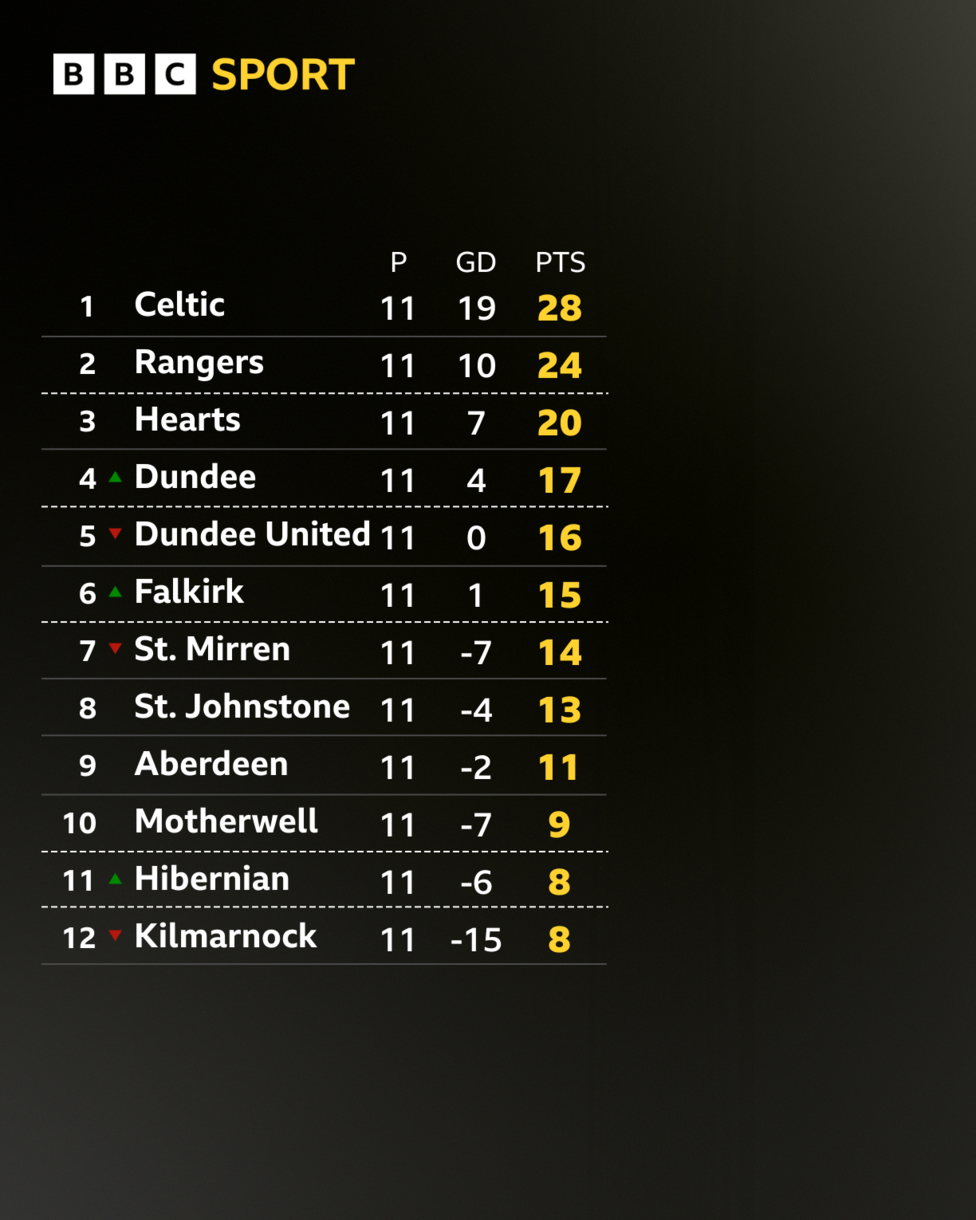
Currently sitting third, Hearts trail Celtic by eight points and Rangers by four despite their significant squad overhaul and tactical transition. The attacking output has been particularly impressive, with only Celtic scoring more goals across the division. At Tynecastle, Hearts have constructed an imposing fortress, remaining unbeaten in league competition since April 2025—a sequence spanning 26 consecutive matches. Victories over Dundee United and St Mirren at home have demonstrated their capacity to dismantle opponents on their own pitch.
However, Wednesday's 2-2 draw against Rangers at home exposed vulnerabilities that may prove costly in a title race. Hearts appeared positioned to claim victory and close the gap on the top two, but an injury-depleted squad faltered in the closing stages, leaving them closer to fourth-placed Dundee than to the leaders. The combination of injuries sustained while managing European commitments, coupled with an unconvincing away record that includes a 7-1 defeat at Celtic Park, suggests Hearts may struggle to maintain the pace established by their rivals.
Celtic and Rangers, despite scepticism from sections of their own support, occupy commanding positions across multiple performance indicators. Both clubs rank comfortably in the top two for expected goals for and against, shots on target per game, and chances created. Crucially, they are the only sides conceding fewer than one goal per game on average—a defensive solidity that reflects their financial resources and, in Rangers' case, the absence of European football commitments this season. Celtic's trajectory suggests they are on course to accumulate over 90 points, a significant increase from the 82 points with which they won last season—the lowest winning total since 2017-18.
Why are Kilmarnock in such danger despite being level on points?
Kilmarnock occupy the bottom position in the table, yet they are not isolated from safety. They sit level on points with Hibernian and only one point behind Motherwell, suggesting the relegation battle remains wide open. Nonetheless, bookmakers have installed them as clear favourites for automatic demotion, and the statistics explain why.
Neil McCann's side have conceded 26 goals already—the worst defensive record at this stage of a season since Dundee in 2018-19, who conceded 28 goals in 11 matches before being relegated. Over the past decade, only twice has the team with the poorest defensive record avoided finishing bottom. Tony Docherty's Dundee in 2024-25 and Hamilton Academical in 2017-18 both escaped the drop, but both possessed attacking firepower sufficient to compensate for their defensive frailties. Dundee scored the fourth-most goals in the league that season, while Hamilton finished sixth for goals scored.
Kilmarnock currently rank among the joint-lowest scorers in the Premiership, creating a mathematical problem that appears unsustainable. To win matches while conceding at their present rate, they would need to score three goals every week—a frequency no team can maintain over a full season. McCann has appealed for patience from supporters as the club attempts to build momentum, and he demonstrated last season that he possesses the capability to revitalise a struggling side. Yet if the defensive bleeding does not stop, even his managerial acumen may prove insufficient to prevent relegation.
How tight is the race for the top six?
The middle section of the Premiership presents a strikingly compressed picture. Only six points separate fourth-placed Dundee from ninth-placed Aberdeen, yet the atmospheres surrounding these two clubs could scarcely be more different. Dundee, managed by Steven Pressley, have defied expectations to sit fourth, while Aberdeen find themselves in a more precarious position despite being separated by a handful of points. Even the bottom three—Motherwell, Hibernian, and Kilmarnock—remain within touching distance of the top half, meaning a sustained run of victories could rapidly alter the landscape.
With so many teams closely matched and individual matches decided by fine margins, examining the "expected points" table offers a useful lens for predicting future outcomes. This metric calculates how many points a team might reasonably have accumulated based on the quality of chances they have created and conceded, rather than actual results.
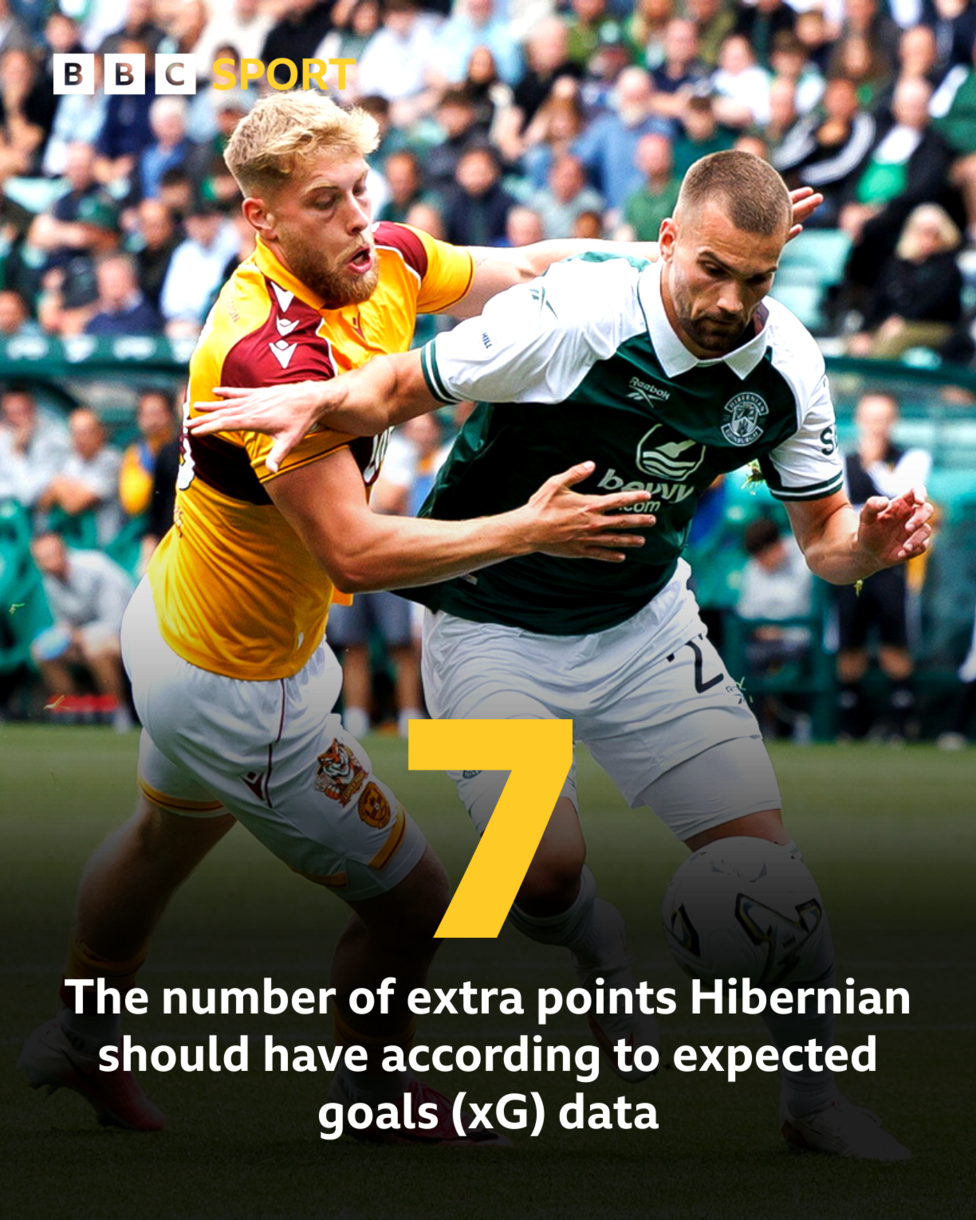
The data reveals Hibernian and Motherwell as the division's most significant underperformers. Hibernian would have been expected to accumulate seven additional points based on their underlying performance, while Motherwell trail their expected total by six points. Both clubs possess grounds for optimism that a correction is imminent. Conversely, Falkirk and Dundee have extracted four and three more points respectively than their underlying metrics would suggest, potentially indicating that a regression awaits them.
However, statistical models cannot capture intangible factors such as work rate, team cohesion, and the leadership qualities that John McGlynn at Falkirk and Steven Pressley at Dundee have clearly cultivated within their squads. The most significant difference between the underperforming Hibernian and Motherwell and the outperforming Dundee and Falkirk lies in chance conversion. The former pair occupy the bottom three for shot conversion, while the latter pair rank in the top four. The quality and confidence of strikers may represent the decisive factor in a league where margins are so tight.
What happens next?
The Scottish Premiership is shaping up to be a fiercely competitive battle across almost every segment of the table. The title race remains contested, the European qualification places are far from settled, and the relegation battle encompasses far more than the traditional bottom three. Most clubs remain within realistic striking distance of their objectives, meaning the coming weeks will prove decisive in determining which teams can sustain their early momentum and which will fade. The season promises to be a turbulent affair, with few certainties and constant shifts in fortune.