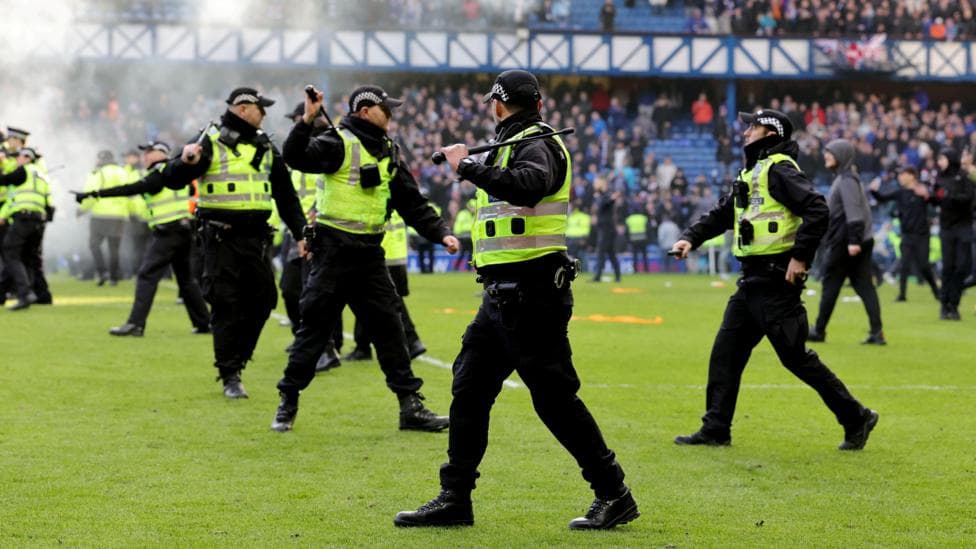
A Rangers supporter has been sentenced to 16 months in prison and handed an eight-year ban from football after encouraging spectators to storm the pitch during a Scottish Cup quarter-final defeat to Celtic at Ibrox. According to BBC News, Jordan Hadden's actions on 8 March contributed to disorder that authorities later found could have escalated into serious violence.
The 28-year-old from Tollcross in Glasgow waved fellow supporters onto the field after the match concluded, then threw a bottle in the direction of Celtic fans that narrowly missed striking a police officer. He pleaded guilty at Glasgow Sheriff Court to conducting himself in a disorderly manner, committing breach of the peace and culpable and reckless conduct.
The incident began when Celtic supporters initially entered the pitch from the Broomloan Road stand following the final whistle. Hadden, positioned in the Copeland Road stand on the opposite side of the stadium, overcame security barriers and moved onto the field near the goal area alongside other Rangers fans.
Prosecutor Abbas Ali outlined how Hadden then turned toward the crowd and repeatedly waved his arms to encourage Rangers supporters to join the pitch invasion. He subsequently crossed the field toward the Celtic fans and approached the police cordon at the 18-yard box, where he picked up an orange bottle and hurled it in their direction.
Ali told the court: "An unknown police officer was seen to take evasive action to avoid being struck with the bottle which narrowly avoided hitting the officer." Hadden then retreated toward the Copeland Road stand and disappeared into the large crowd, though he was later identified through CCTV footage.
Hadden was wearing a full black tracksuit, black cap, scarf and white-trimmed black trainers, with his face clearly visible on camera. His defence solicitor John McLaughlin argued that alcohol had impaired his recollection of events and that he had picked up the bottle on impulse rather than with deliberate intent to harm anyone.
McLaughlin told the court: "In the cold light of day, he knows his behaviour was extremely reckless and dangerous and could have caused an injury - he is fortunate no-one was struck." He added that Hadden had "got caught up in a fertile atmosphere" and had attended thousands of Rangers matches throughout his life.
What did the court determine?
Sheriff Lorraine Glancy KC imposed the sentence after finding that a custodial term was necessary both to deter similar conduct and to reflect public disapproval of violence at football matches. She stated: "Had the officer not seen the bottle and took evasive action, he could have been struck on the head with it."
The sheriff commended the police officers who worked to keep supporters separated during the incident, describing their actions as demonstrating "bravery and professionalism."
How serious was the disorder?
An independent review of the incident conducted by the Scottish FA found that the disorder posed a significant risk of escalation. According to STV News, the review led by Mark Blackbourne determined that the situation could have deteriorated into "life-threatening violence" during the four minutes and 28 seconds it took police to regain control of the pitch.
The review documented that the initial pitch invasion by Celtic supporters provoked a hostile response from Rangers fans, and that flares were thrown between the groups on six separate occasions during the disorder. Police Scotland's Operation Moonglint had made 37 arrests in connection with the disorder by the time the review was published.
What wider action has been taken?
Hadden's case is part of a broader enforcement response to disorder at Old Firm matches. In August 2026, two other Rangers supporters were banned from all UK football grounds for five years after being convicted of involvement in the same Scottish Cup quarter-final incident. Both Rangers and Celtic faced SFA disciplinary charges following the disorder, with hearings scheduled for 13 August 2026.
The incident reflects ongoing concerns about fan behaviour at high-profile Scottish football fixtures. The disorder on 8 March was not an isolated occurrence; in May 2026, 50 people were arrested following disorder at a Celtic title-clinching match, with additional arrests made during subsequent police operations.