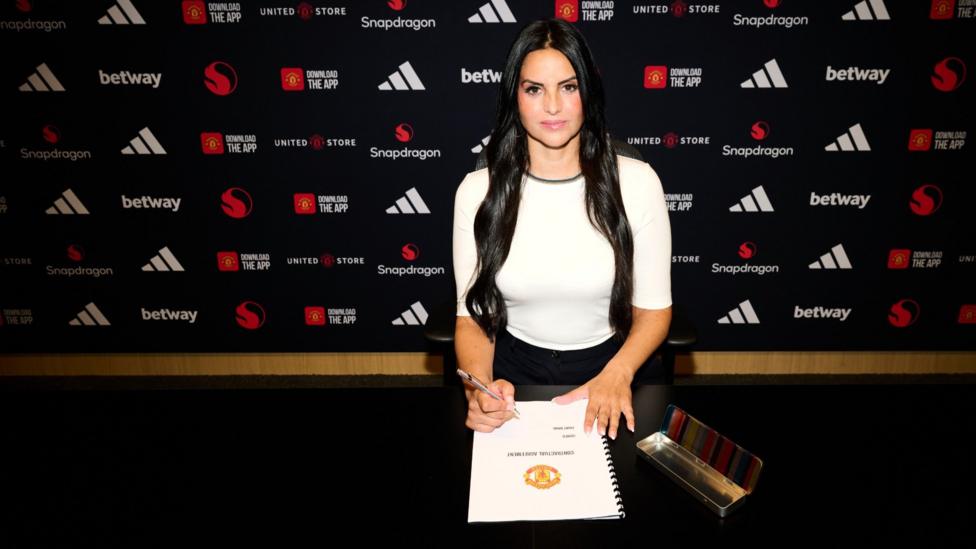
Manchester United have confirmed Eva Olid as their new women's manager on a two-year deal with an option for a further 12 months. The former Hearts boss replaces Marc Skinner, who left the role by mutual consent on Monday - a month before the start of the Women's Super League (WSL) season.
Olid, 40, spent five years at Hearts from 2021 to 2026 and opted to leave Edinburgh in the summer when her contract expired. She took Hearts from bottom of the table to the title, led them to their first Scottish Women's Premier League (SWPL) club last campaign, and also guided them to their first domestic final, where they lost to Rangers in the 2024 Scottish Cup.
“The opportunity to become head coach of Manchester United Women is a dream come true,” Olid said.
“There is already so much talent within our squad and I am excited to work with the players to support them to fulfil their immense potential.”
Sources at Manchester United had said one of the key requirements for Skinner's replacement was a coach with a history of developing players. It is four weeks on Friday until United begin their WSL season at London City Lionesses on 4 September.
Why is this an intriguing appointment?
Olid has signed a contract to keep her at Manchester United until 2028 with the option of an extra year. One of the most intriguing things about this appointment is that we know very little about Olid given she is untested in the WSL and in Europe.
The Spaniard was popular at Hearts and enjoyed success in the Scottish Premier League, though it is a step up to the weekly pressures of the WSL. United's direction has been clearly laid out - they want a coach who specialises in youth development and who can improve individual players on a weekly basis.
They believe Olid meets that criteria and will hope she brings a new style of football, no doubt influenced by her Spanish roots.
Her appointment was swift following Skinner's exit, with the club already well advanced in their recruitment process and Olid's contract signed within 24 hours.
Skinner's departure also raised further questions about United's ambition for its women's team, so scrutiny on Olid will be immediate.
She will have to deal with that pressure and expectation - part of which comes naturally as United manager - but also to appease a frustrated fanbase who have demanded more in recent years.
Her first job will be to galvanise a depleted squad this summer, embed youthful talent and prepare for the season opener at London City Lionesses, which will be a good marker of where United are at.

What can we learn from Olid's Hearts?
Hearts women were unusual champions. On their way to winning the SWPL title, they ranked second for build-up attacks but first for direct attacks, showing they could build both patiently and quickly.
They also saw plenty of the ball. Hearts averaged 56.8% possession, the fourth-highest figure in the league, suggesting they were often able to dictate matches rather than simply react to them.
Yet possession did not make them slow as only one team produced more shots from fast breaks. When opportunities arose, Hearts were quick to turn defence into attack.
That balance was reflected in the chances they created.
The Jambos produced 71 big chances during the season, the third-highest total in the division, while their xG per shot of 0.116 also ranked third.
In other words, they regularly fashioned good-quality opportunities rather than relying on efforts from poor positions.
Without the ball, Hearts were organised rather than overly aggressive. They ranked fifth for high turnovers and conceded only 35 big chances across the campaign, the fourth-fewest in the league.
Taken together, the numbers suggest a side capable of controlling games with the ball while remaining dangerous when opportunities to break appeared, a combination that helped power Hearts to the title.

Find interviews and extra content from the Women's Super League and beyond on the Women's Football Weekly feed
Get the latest WSL news on our dedicated page