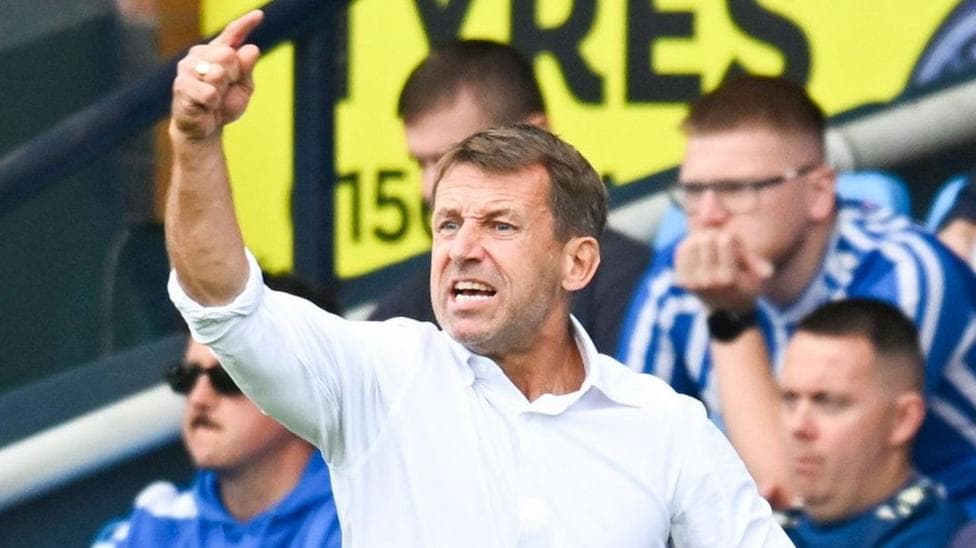
Neil McCann's Kilmarnock remain without a league point after suffering a fourth-goal defeat to Dundee United at Rugby Park on 29 August 2026, extending their winless start to three matches and deepening concerns about their defensive frailty.
The home crowd expressed their frustration by booing the team off at both half-time and full-time following the 4-0 loss, a scoreline that did not flatter the visitors. Despite the magnitude of the setback, McCann maintained composure in his post-match remarks while acknowledging the legitimacy of supporter anger.
I'm angry and I'm apologetic to the fans. It's very easy right now to be emotional about it. The guys know my feelings about the performance and I expect a reaction on Wednesday night against St Mirren. I'm not overly emotional right now. I had a wee chat to them in the dressing room. They know that they've let everybody down today and I've been a part of that. We've let everybody down connected with Kilmarnock but there's no better thing in sport than a quick game and we've all got an opportunity to put things right on Wednesday night.
McCann's determination to extract an immediate response reflects the severity of Kilmarnock's predicament. According to a BBC statistics preview, Kilmarnock were the only side without a point in the 2026-27 Premiership heading into the Dundee United fixture, a distinction they retain after the defeat.
How do the statistics reflect Kilmarnock's crisis?
The numbers paint an alarming picture for supporters seeking reassurance. After three matches without a win, Kilmarnock have conceded 13 goals—the worst defensive record of any team in the division this season. Their goal difference of minus nine matches the joint-worst opening three-game record by a Scottish top-flight side since 1998-99, a distinction shared with Aberdeen (2000), Dundee United (2004), Hamilton (2010) and Kilmarnock themselves in 2025.
The defensive vulnerabilities extend beyond raw goal tallies. McCann's team has faced 69 shots, more than any other Premiership side, and allowed 29 shots on target—also the highest in the league. Their expected goals against figure stands at 10.14, the worst in the division. Most troublingly, Kilmarnock have committed six errors leading directly to goals, four more than any other side.
One marginal positive emerges in their tackle statistics, where they rank ninth in the division with 36 tackles and 22 won, suggesting effort levels remain intact despite the defensive collapse.
What went wrong against Dundee United?
Kilmarnock's first-half performance was particularly damaging, with the team conceding three goals before the interval and effectively surrendering any realistic chance of a result. Goalkeeper Max Stryjek faced a difficult afternoon yet still produced several decent saves despite being beaten four times.
Defensive inexperience compounded the problems. Centre-half Cathal McCarthy made his Premiership debut and gave away a penalty, while fellow debutant Jonathan Meier was withdrawn at half-time. An early injury to established centre-half Robbie Deas further destabilised the backline at a moment when stability was essential.

Kilmarnock did create opportunities in attack but lacked the clinical finishing required to capitalise on them. The team's expansive approach, designed to generate attacking play, left them dangerously exposed at the back.
What tactical concerns have emerged?
Former Rangers, Hearts and Motherwell midfielder Andy Halliday identified structural weaknesses in Kilmarnock's shape as a contributing factor to their defensive struggles. Speaking to a national broadcaster's radio coverage, Halliday highlighted the vulnerability of the full-back positions.
I felt there was a lot of promise for Kilmarnock coming into this season, given that from when McCann came in to the end of the season, they rose to fourth in the form table. I don't think they look comfortable in their shape. I hated playing in a diamond. When you're the wide man in that, you're asked to do a power of work, in and out of possession. Quite often, you have to be the width when on the ball and then narrow when you're out of possession. The worry for me when I watch Kilmarnock is the way the full-backs operate. They're asked to do a really attacking job in possession, but out of possession they're one-v-one. They don't have Findlay Curtis or the like in front of them, with high energy, who can come back and double up. As much as they're struggling defensively, I don't think the shape is helping because they're exposed.
The absence of Rangers loanee Findlay Curtis, whose energetic pressing and defensive work rate had been instrumental in Kilmarnock's late-season surge last term, is keenly felt. Curtis's loan spell ended, and his replacement has yet to provide the same defensive cover for the full-backs.
How did Kilmarnock reach this point?
McCann arrived at Rugby Park in January as an unconventional choice to stabilise a struggling side. Working alongside assistant Billy Dodds and bolstered by Curtis's impact, he guided Kilmarnock to safety and then a remarkable transformation. The team won four consecutive league matches to finish the season, scoring 13 goals in that run and climbing to fourth in the form table.
That momentum has evaporated entirely. Defeats to St Johnstone (4-0), Celtic (5-0) and now Dundee United (4-0) represent a catastrophic reversal. The cumulative 13 goals conceded in three matches stands in stark contrast to the attacking verve displayed in the previous campaign's closing weeks.
Before the Dundee United match, a BBC preview on 27 August revealed McCann's ambitions to restore Rugby Park as a fortress and his assessment that the transfer window had been productive, though he acknowledged the squad needed time to develop cohesion. That timeline has compressed dramatically given the urgency of the situation.
What is the significance of the St Mirren fixture?
Kilmarnock's next assignment arrives on Wednesday when they travel to face St Mirren, a side enjoying a sharp upturn in form. St Mirren have won both opening Premiership fixtures without conceding, a dramatic improvement from last season's relegation play-off scare. Manager Craig McLeish has credited a return to basics for the improved form.
The fixture carries unmistakable pressure. While McCann framed it as an opportunity to respond, supporters and analysts alike view it as a match Kilmarnock cannot afford to lose if their season is not to spiral beyond recovery. A third consecutive defeat would intensify questions about whether the squad possesses the resilience and quality required to compete at the top level.
Key Facts
- Kilmarnock have zero points from three matches with a goal difference of minus nine, matching the joint-worst opening three games by a Scottish top-flight team since 1998-99
- The team has conceded 13 goals, the worst defensive record in the Premiership this season, and faced 69 shots—more than any other side
- Defensive debuts by Cathal McCarthy and Jonathan Meier, combined with an early injury to Robbie Deas, left the backline undermanned and inexperienced
- McCann's side rose to fourth in the form table in the closing weeks of last season but have now suffered three heavy defeats in the opening month of 2026-27
- The midweek fixture against St Mirren, who have won both their opening matches, represents a critical test of Kilmarnock's ability to recover