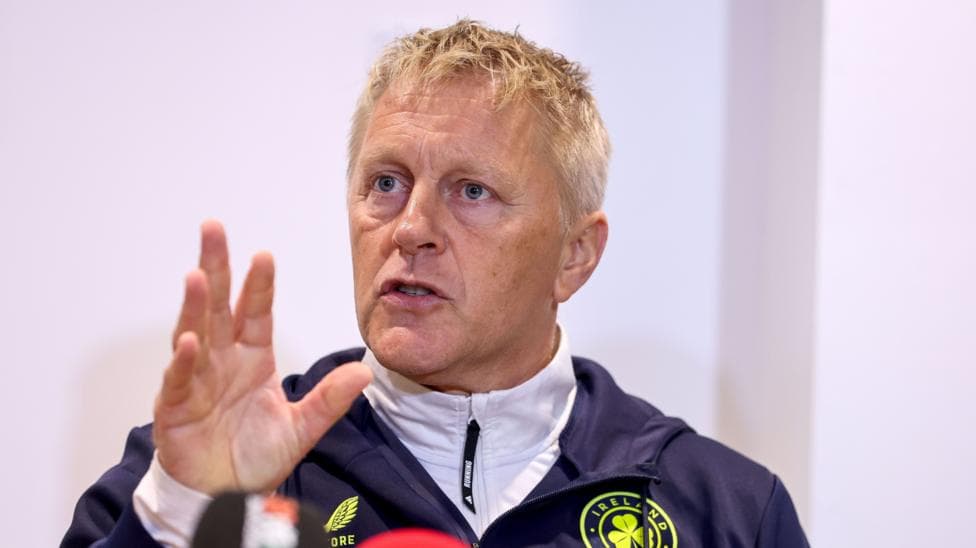
Republic of Ireland head coach Heimir Hallgrimsson has met with every member of his playing squad on a one-to-one basis to discuss the forthcoming Nations League matches against Israel, revealing that the group shares collective discomfort with the fixtures despite committing to fulfil them.
Speaking after naming his latest squad, Hallgrimsson explained his decision to address the sensitive matter through private conversations rather than a group setting.
"Because we shouldn't be doing this in a group talk,"he said.
"Obviously we have different opinions, different strength of opinions. I think it's best to say, without going into individuals, none of us feel comfortable playing in these games but once we have decided to play them, we all stick together and play as one."
The two Nations League encounters will take place at neutral venues following UEFA approval. According to a national broadcaster's report, Ireland's away fixture is scheduled for 27 September 2026 in Debrecen, Hungary, with a small allocation of Israel supporters permitted and no away allocation for Irish fans. The return match will be held on 4 October 2026 in Backa Topola, Serbia, behind closed doors with no tickets available for Irish supporters.
The FAI's decision to proceed with the fixtures has faced mounting opposition from campaign groups and prominent figures within Irish football. A 'Stop The Game' campaign organised by Irish Sport for Palestine has called for a boycott, receiving backing from former manager Brian Kerr and ex-player James McClean. During a friendly against Qatar in Dublin in May, the match was disrupted when tennis balls were thrown onto the pitch in protest.
At an extraordinary general meeting held on 8 July 2026, FAI delegates voted to endorse fulfilling the Israel fixtures. According to reporting from the time, the vote resulted in 75 delegates in favour, 32 opposed and three abstentions. The FAI board had previously warned that refusing to play the fixtures could result in
"significant and lasting harm"to Irish football and would not alter Israel's participation in UEFA competitions.
What prompted the individual conversations?
Hallgrimsson recognised that squad members hold varying perspectives on the political situation surrounding the fixtures. Rather than attempting to forge consensus in a team environment, he opted for private discussions to allow players to express their concerns without the dynamics of group pressure.
"Obviously we don't all share the same opinion. That's just human nature,"he added.

FAI director of football John Martin acknowledged earlier in the week that the fixtures had created a
"very uncomfortable situation for everyone"and stressed that players
"shouldn't be in a position where they get criticised."
What is the broader context?
The dispute over the Israel fixtures reflects deeper tensions within Irish football and society. In February 2026, the FAI had confirmed its intention to fulfil the Nations League matches after warning of possible disciplinary measures, including disqualification, if Ireland refused to play. In June 2026, Irish Sport for Palestine issued a legal warning threatening a judicial review over the fixtures.
The underlying conflict stems from the armed Palestinian group Hamas's attack on Israel on 7 October 2023, which killed approximately 1,200 people and resulted in 251 hostages being taken. Israel subsequently launched a large-scale military offensive in Gaza. According to United Nations assessments, the retaliation has resulted in more than 70,000 Palestinian deaths. Israel has consistently denied committing genocide or war crimes, maintaining that its actions in Gaza constitute justified self-defence.
What fixtures lie ahead?
Hallgrimsson's squad will begin their Nations League campaign with a visit to Kosovo on 24 September 2026, followed by the first Israel encounter in Hungary on 27 September. The team will then face Austria at home on 1 October before travelling to Serbia for the second Israel match on 4 October.
These fixtures mark the Republic of Ireland's first competitive action since their World Cup play-off semi-final defeat to the Czech Republic in March 2026, decided by a penalty shootout in Prague. Since that loss, the team has played four friendly matches, securing victories over Grenada and Qatar while drawing with North Macedonia and Canada.
Hallgrimsson emphasised the importance of maintaining focus on performance despite the political backdrop.
"We want to represent Ireland with the best games and performances that we can. That's the agreement with all of us,"he stated.