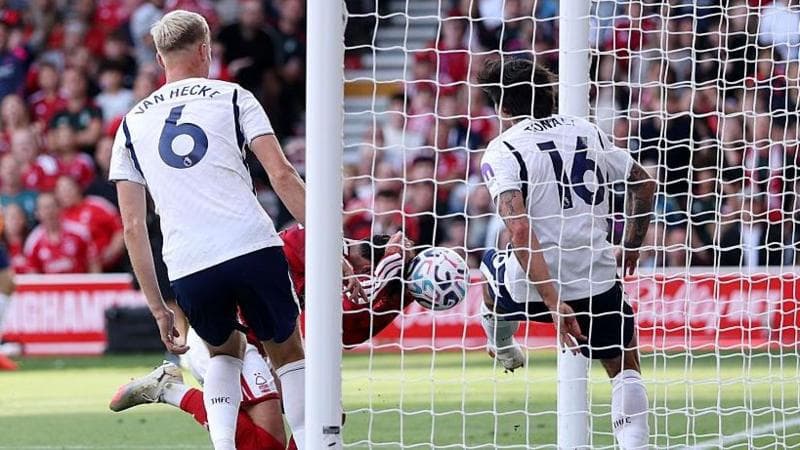
Nottingham Forest manager Oliver Glasner disputed the video assistant referee's decision to rule out Neco Williams' goal in their 0-0 draw with Tottenham Hotspur on Saturday, 5 September 2026, arguing that VAR lacked sufficient evidence to overturn the on-field decision.
Williams' second-half effort was disallowed after VAR determined the full-back had handled the ball before scoring from a scrambled situation in the Spurs box. The incident occurred in the 67th minute when Morgan Gibbs-White's low shot looped up off goalkeeper Kinsky and Sandro Tonali missed his clearance, leaving Williams to bundle the ball towards goal.
Initially, referee Craig Pawson awarded the goal. However, VAR official Peter Bankes intervened and recommended disallowance. Pawson announced on the pitch: "After review, the ball touches the hand of Nottingham Forest No.3 before the goal is scored. The final decision is a direct free-kick for Spurs."
What was Glasner's objection to the decision?
Glasner contended that the evidence did not meet the threshold required for VAR intervention.
"I watched five or six different angles and, to be fair, from one angle you can guess that the ball touched the arm because the shirt moves a little bit, but it's not clear is it the ball or [Sandro] Tonali on the goalline,"he said.
"I think the VAR can't intervene when he is guessing. It was not clear and obvious."
The Forest manager referenced pre-season guidance on VAR standards.
"We had a briefing before the season that the threshold for VAR intervention this year should be very high, which is why this is a wrong intervention. If it's not 100% clear, stick to the on-field decisions. This is the inconsistency today."He added that he told the referee after the match that he believed the goal should have stood.
What was Williams' account of the incident?
Williams denied that the ball struck his arm and maintained he had headed it in.
"It's a goal,"he told a national broadcaster.
"VAR is there when there is a clear and obvious error and for me that is not clear and obvious. I've seen the images and the replays and at not one moment did I think I handballed it. I headed it in between my arms."
"I knew straight away I've headed it down in between my arms. At a loss at that one. Disappointing."

What was the official explanation for the disallowance?
The Premier League Match Centre stated that VAR checked the referee's call of goal and determined that Williams handled the ball immediately before scoring, recommending that the goal be disallowed. Under the rules, if the ball strikes the arm of the goalscorer immediately before they score, the goal must be ruled out, regardless of intent.
Why is this decision so difficult to judge?
The core difficulty in handball decisions lies in determining whether the ball actually made contact with the arm, and this forms the crux of Forest's dispute. Williams maintains the ball came off his head and never touched his hand—evidence that would be unavailable to VAR officials reviewing footage.
Even technological advances such as ball-tracking chips, used at major tournaments, would not resolve this situation because Williams' head and hands were positioned so closely together that distinguishing between them on video is extremely challenging.
The handball ruling differs from subjective decisions such as potential penalties, which fall under the "clear and obvious error" standard. Instead, this is a factual determination—whether the ball definitively touched the goalscorer's arm. This factual standard can be viewed as a higher bar than clear and obvious, since it requires proof of a specific physical event rather than judgment of an incident's severity.
Glasner, Williams, and Forest supporters argue that no such definitive proof exists and that grounds for disallowance were therefore absent. However, these decisions ultimately depend on the judgment of the VAR official on duty. It is entirely plausible that another VAR on a different match day might conclude that the threshold of proof had not been met and would have allowed the goal to stand. This inconsistency remains one of the major frustrations with VAR implementation.
A comparable recent example illustrates this variability: Harry Maguire's goal against Ipswich the previous weekend was allowed despite a handball because his shot was heading wide before it was deflected, making it technically an own goal. In Williams' case, he was the actual goalscorer, meaning any contact with his arm automatically requires disallowance. The only circumstance that would have saved the goal would have been if the ball had fully crossed the goal line before it was kicked against Williams.
What is the broader context?
This incident occurs against the Premier League's published VAR approach that factual decisions such as handball by the goalscorer do not require an on-field review if the ball clearly hits the scorer's arm. However, the application of this principle—determining what constitutes "clearly" hitting the arm—remains contested.
Forest have been involved in prior high-profile VAR handball incidents involving Williams. In February 2026, Williams received a red card for a handball on the goal line during a match against Crystal Palace, an incident that also generated significant controversy. That suspension carries forward, leaving Williams unavailable for Forest's next Premier League fixture against Leeds United on Friday night.
Key Facts
- Williams' disallowed goal came in the 67th minute of a 0-0 draw on Saturday, 5 September 2026
- Referee Craig Pawson initially awarded the goal before VAR official Peter Bankes recommended disallowance
- Glasner argued the evidence did not meet the threshold for VAR intervention under pre-season guidance requiring a high bar for overturning on-field decisions
- Williams maintains he headed the ball in between his arms and the ball never touched his hand
- The decision highlights ongoing inconsistency in how VAR applies handball rules, particularly when determining factual contact between ball and arm