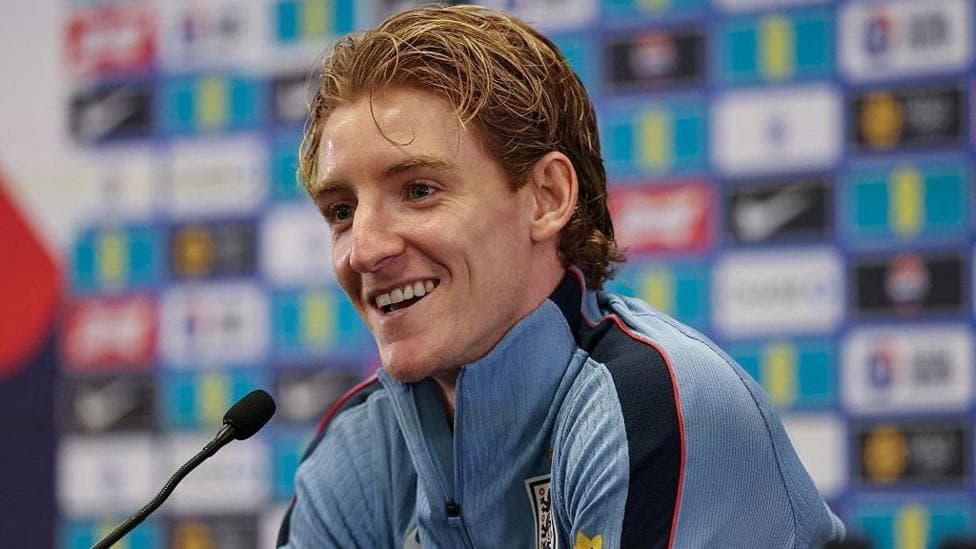
Anthony Gordon has argued that England should abandon attempts to replicate Spain's possession-based football and instead lean into the distinct qualities that define the English game. The Barcelona winger made his case as the England squad prepared for a UEFA Nations League encounter against world champions Spain on Saturday, 26 September 2026, at Wembley—their first competitive meeting since the World Cup.
Gordon's intervention comes in the aftermath of England's World Cup campaign, which ended with a semi-final loss to Argentina followed by a bronze medal victory over France. While the team achieved their best World Cup finish since 1966, the manner of their defeat to Argentina has prompted widespread debate about tactical direction and squad management.
The winger, who joined Barcelona from Newcastle for approximately €70 million plus €10 million in add-ons on a five-year deal, has gained firsthand insight into Spanish football since his summer transfer. Gordon became the second Englishman to sign permanently for Barcelona, following Gary Lineker in 1986, and his early performances have impressed. By mid-September, Gordon had made five appearances and provided four assists for the club, demonstrating a strong start in La Liga.
Why England should not try to play like Spain
Gordon contends that the fundamental differences between English and Spanish players make direct imitation counterproductive. Rather than attempting to teach English footballers the intricate possession patterns that define La Liga, he argues the national team should capitalise on the distinct strengths that set them apart.
"I'm speaking from a point of view where I feel like we are trying to replicate Spain. Because I'm in Spain, I know we have just as good players, but they have different qualities, so why are you trying to make those players the same as the Spanish players? Because the Spanish players lack the things that we have and vice versa."
Gordon emphasises that possession-based football is not embedded in English football culture in the way it is in Spain. He suggests that the Spanish approach to the game—their decision-making on the ball, their spatial awareness, their technical foundation—stems from how players are developed from a young age and cannot simply be grafted onto English talent.
"It's not in the English DNA. I'm not sure it's something that can be taught because now I think, playing in Spain, I can speak with an educated view on the way they keep the ball is different. I even look at some of the decisions they take on the ball sometimes and think I'm not sure how you've seen that. It's the way they're built. I don't know whether it is something that maybe we can't ever put a name to, but they're definitely built different."
Spain's dominance in recent tournaments underscores the challenge England faces. The Spanish won the World Cup by defeating Argentina, controlling 65 per cent of possession in the final and restricting opponents led by Lionel Messi to just two shots in 120 minutes, neither of which found the target. Yet Gordon argues that replicating this style is neither feasible nor necessary for England to succeed.
What happened in the Argentina semi-final?
England's World Cup campaign ended in disappointment when they fell to Argentina in the semi-final. Head coach Thomas Tuchel's decision to substitute Gordon and shift to a back five proved pivotal in the match's outcome. The tactical adjustment invited sustained pressure, allowing Enzo Fernandez to equalise before Lautaro Martinez scored a stoppage-time winner.
Gordon had opened the scoring in the semi-final, capping an impressive tournament for the 25-year-old winger. He started five of England's matches and also recorded four assists across the competition. His removal 17 minutes after putting England ahead surprised him, though he acknowledged that substitutions are routine for wingers.

"It makes me feel on top of the world, especially in that moment on that stage. I felt really good. But as a winger, to be honest, I come off most games. It's normal [for wingers]. Obviously that substitution was different but in that moment probably yeah, but in general as a winger I expect it a lot of the time."
Gordon described the emotional toll of the defeat, saying he had "never felt worse" after the match. However, he views the experience as potentially transformative for the squad's future approach.
"[The] scar doesn't have to be a negative one because it might lead us to victory in the next tournaments. We can't keep looking at other countries and trying to be like them, because we're not them - we're English and we have our own strengths which they don't have, so maybe we start playing the way we're good at."
How did England reach the semi-final?
England's path to the World Cup semi-final included a dramatic last-16 victory over Mexico at the Azteca Stadium. The team battled to a 3-2 win while playing with 10 men for over 35 minutes following Jarell Quansah's red card. Gordon suggests that the manner of this victory—demonstrating resilience and character under adversity—influenced the squad's mindset heading into the Argentina match.
The winger also noted a gap between England's training performances and their output in matches. He believes that had the team matched the standard they regularly achieved in preparation, they would have dominated their opponents throughout the tournament.
Did Gordon defend Tuchel's tactics?
Despite external criticism of Tuchel's "more safe and more defensive" approach in the Argentina semi-final, Gordon defended the manager's decision-making. He argued that responsibility for the defeat should be shared across the entire squad rather than placed on one individual.
"We shouldn't try and blame one man who's obviously trying his best and trying to win the cup for us all. As players, we could have done more to take the initiative to control the [Argentina] game. I think if we do that the manager doesn't make the decision [to use a back five]. For me, we had the best team, we had the best players on the pitch in that semi-final, and in the last 20 minutes we didn't play the best football. That's something the manager can't really affect from the sideline, so I think as a group everyone together should take responsibility."
Gordon's perspective reflects a broader acknowledgment within the squad that tactical adjustments alone cannot account for the semi-final loss. The players themselves must execute at the highest level regardless of formation or system.
What is England's recent tournament record?
England's recent major tournament performances have been marked by heartbreak at the final stages. The team has lost two consecutive European Championship finals and been eliminated by France and Argentina in the past two World Cups. These outcomes have prompted repeated questions about whether the squad possesses the technical ability to control possession against elite nations—a debate that Gordon's comments directly address.
The World Cup bronze medal finish represented England's best result in the competition since 1966, providing some consolation after the semi-final defeat. Yet the manner of the loss to Argentina has overshadowed this achievement and prompted soul-searching about the team's identity and approach.
What happens next for England?
England will face Spain in the UEFA Nations League on Saturday, 26 September 2026, at Wembley, with kickoff at 7:45 PM. The fixture provides an immediate opportunity to test Gordon's philosophy about playing to English strengths rather than attempting to replicate Spanish methods. Spain will follow this match with a fixture against Croatia on 29 September 2026, continuing their own Nations League campaign.
Gordon's inclusion in the England squad for these Nations League games reflects his status as a key player for the national team. His performances at Barcelona and his willingness to articulate a clear vision for England's tactical future suggest he will play a central role in the team's next chapter.