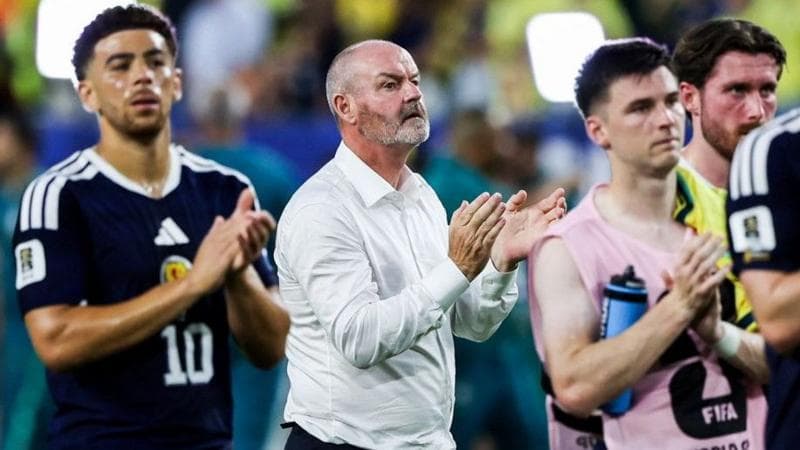
Steve Clarke says he had to press the Scottish Football Association into providing him with a new contract as national head coach shortly before the World Cup finals this summer because he sensed the governing body was uncertain about his future.
The 63-year-old maintains, however, that he had always intended to step down should he fail to guide Scotland beyond the group stage for the first time. According to reports from the tournament, Clarke told his players of his decision to resign at 7 p.m. local time in Charlotte immediately after Scotland's elimination was confirmed.
Speaking publicly for the first time since the tournament in the Americas, Clarke was interviewed by former Chelsea and Scotland team-mate Pat Nevin at a Spartans Community Foundation dinner in Edinburgh. When asked about his departure from the role despite the four-year contract he signed on the eve of the tournament, he explained his reasoning.
It was never really a change of mind. I am quite a complex person. I wanted to control my narrative.
Clarke outlined the timeline of his negotiations with the SFA. By March, he had not received an offer of a new deal, which prompted him to take action.
Obviously we got to March and I hadn't been offered a new contract, which I thought was pretty strange. You start to think are they hedging their bets a little bit, waiting on the tournament in the summer. So I did a little bit in the media in March to give the SFA a little shove. We negotiated non-stop from the beginning of April really to the middle of May, just before the Curacao game.
The negotiations were tense, with Clarke making his position clear to the governing body.
And I said to them if we don't agree a new contract before we go to the World Cup then I will say I am leaving the job. They panicked a little bit and gave me the new contract. It was like drawing teeth trying to get it over the line. But we got it over the line anyway.
According to reports, Clarke's resignation came only 31 days after signing the new deal. Despite securing the contract, Clarke had already made a private decision about his future.

But I always knew in my head that if we did not get out of the group stage then I would probably leave. The only way I would have stayed on is if they had been three fantastic games and they went against you.
How Scotland's tournament unfolded
Scotland's campaign in the Americas produced mixed results. The team defeated Haiti 1-0 but suffered a 1-0 loss to Morocco before a 3-0 defeat to Brazil left them dependent on unlikely results elsewhere to progress as one of the better third-place sides.
Clarke recalled the agonising wait that followed the Brazil match, describing it as the longest period of his time in the role.
We had to stay for four or five days [in Charlotte], the longest four or five days ever just sitting and waiting, knowing you are going home because the goal difference was not good enough. I knew we needed four points. I got hammered in the media for saying that. Somebody hammered me for saying, 'nah, that's us, we are going home'. But I was right.
The elimination marked the end of a seven-year tenure during which Clarke had returned Scotland to the World Cup for the first time in 28 years and delivered consecutive European Championship appearances.
What Clarke observed about the squad
Following the Brazil match, Clarke spoke with several senior players and came away with a clear sense of what the team needed moving forward.
He believed the squad required fresh leadership if they are to make history by reaching the knockout stage at Euro 2028. This assessment informed his decision to step aside and allow new direction to take hold.
The transition to new leadership
Clarke spoke to his successor, Sebastien Pocognoli, last week to offer his support as the new head coach begins his tenure. He expressed optimism about Scotland's prospects under the new regime, particularly given the format of the upcoming qualifying campaign.
I believe even Scotland cannot fail to qualify given two spots in the finals will be reserved for the best-ranked host who have not qualified as a group winner or runner-up.
The Scottish FA is now close to finalising the appointment of Clarke's successor, with Scotland's next competitive fixtures beginning on 26 September with an away Nations League match against Slovenia. The governing body is expected to complete the managerial appointment before that fixture block begins.
Key Facts
- Clarke signed a new four-year contract running to 2030 in May, just weeks before the World Cup began
- Scotland finished bottom of their group with one win and two losses, failing to advance from a section containing Brazil, Morocco and Haiti
- Clarke's resignation came approximately one month after signing the new deal, ending his seven-year reign as national head coach
- The SFA faced scrutiny over the timing of the contract extension, which was awarded before rather than after the tournament
- Scotland's next competitive action begins on 26 September with a Nations League fixture away to Slovenia