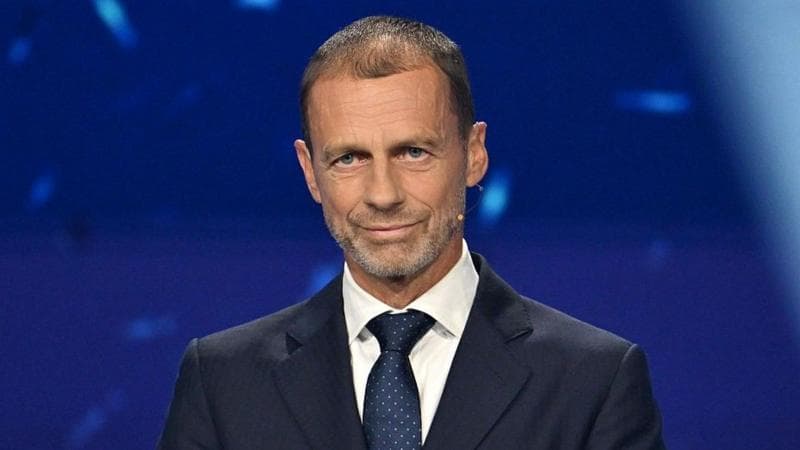
Aleksander Ceferin, president of Uefa, has announced he will seek a fourth consecutive term leading European football's governing body, reversing his earlier position that he would not pursue re-election.
Ceferin disclosed his decision at a gathering of all 55 national association representatives in Berlin. His announcement comes as Uefa intensifies efforts to reform world football's administration and find a candidate capable of challenging Fifa president Gianni Infantino when the global body holds its presidential election on 18 March 2027 in Rabat, Morocco.
The 58-year-old Slovenian had previously stated in February 2024 that he would not seek another term, a position he maintained even as controversy surrounded Uefa's decision to alter its statutes and permit him to run for a fourth mandate. However, expectations had grown steadily that he would reverse course, particularly following Uefa's campaign to oust Infantino.
"I want to thank the national associations for their trust," Ceferin said. "We have faced extraordinary challenges over the past years, and we have faced them as one team. There is still important work ahead, and I have therefore accepted their request. My ambition remains the same: to keep European football united, make our game stronger and leave Uefa ready for the next generation."
Ceferin has made clear he will not stand as a candidate against Infantino himself. Instead, he remains committed to identifying and supporting a figure who can unite the global football community and challenge the incumbent when voting takes place.
Concacaf leader rules out Fifa bid
A significant development in the search for an Infantino challenger emerged when Concacaf president Victor Montagliani informed colleagues he will seek another four-year term leading the North and Central American confederation next year, effectively removing himself from consideration as a Fifa presidential candidate. This narrows the field of potential challengers and leaves Uefa's reform movement searching for an alternative figure capable of mounting a credible campaign.
To date, former Tottenham Hotspur defender Ramon Vega has indicated his intention to run for the Fifa presidency, though his viability remains uncertain. Vega must secure at least five letters of support from member associations to qualify for the ballot, and it remains unclear whether he can achieve this threshold.
Uefa's comprehensive reform agenda
During the Berlin meeting, Uefa and 54 of its national associations—with Azerbaijan abstaining—endorsed a detailed reform framework for Fifa. This 14-point plan addresses what Uefa views as fundamental structural deficiencies in world football's governance.
Uefa emphasised that institutional restructuring alone will prove insufficient. The confederation stated that Fifa requires new leadership characterised by a figure who commands respect across all regions, possesses deep roots within football, and demonstrates an unwavering commitment to development, reform, integrity and independence.
"Institutional reform will not, on its own, be enough," Uefa said. "Fifa also needs new leadership: a respected and unifying figure, deeply rooted in football, with the vision and experience to lead, the ability to command confidence across regions and an unequivocal commitment to development, reform, integrity and independence."
What changes does Uefa propose?
Uefa's reform proposals centre on restructuring Fifa's institutional governance to curtail the president's unilateral authority. The plan would require unanimous Bureau approval for modifications to the international match calendar or Fifa competitions, significantly limiting executive discretion in these areas.
The proposals also mandate the removal of presidential and executive interference from ethics and disciplinary oversight bodies, establishing greater independence for these critical functions. Uefa insists that Fifa resources must not be deployed for personal or electoral purposes, a provision clearly aimed at preventing the incumbent from leveraging organisational assets during re-election campaigns.
Financial support for member associations forms another pillar of the reform agenda. Uefa's plan calls for at least $10 million in additional funding for each of Fifa's 211 member associations, a measure designed to strengthen the global game's foundations and reduce financial dependence on the central governing body.
Background to Ceferin's candidacy
Ceferin was first elected Uefa president in 2016. His decision to pursue a fourth term represents a significant reversal from his public statements made less than a year ago. The shift became possible following Uefa's 2024 Congress in Paris, which changed presidential term-limit rules and made Ceferin eligible to seek another term, though these changes proved controversial within European football circles.
Infantino's position has been strengthened by his decision to abandon the Fifa Forward Enterprise proposal, which would have involved selling stakes in the governing body's competitions to private investors. Widespread opposition from confederations and member associations forced the withdrawal of this initiative, removing a significant source of friction.
What happens next
Uefa's 55 national associations are scheduled to convene again before 17 November 2026 to advance discussions on Fifa reform and the direction of global football governance. This timeline aligns with the deadline for candidate submissions to the Fifa presidential election, which falls on 18 November 2026, giving potential challengers limited time to secure the necessary support and formally enter the race.
The election itself will take place on 18 March 2027 in Morocco, providing the global football community with an opportunity to reshape Fifa's leadership and governance structures.