Craig Bellamy's Wales squad has managed just one victory across their eight matches in 2026, a record that deepened on 6 October when they succumbed to a Nations League defeat against Denmark at the Cardiff City Stadium. The loss came despite an encouraging performance against Norway on 3 October, leaving Bellamy to question whether the newly restructured international calendar has unfairly disadvantaged his injury-depleted side. Wales have now failed to keep a clean sheet in any of their past nine matches.
Denmark secured victory through a 75th-minute penalty converted by Rasmus Højlund, extending Wales' difficult run to three defeats in four games played across a compressed 10-day period. The result marked Denmark's second victory over Wales in the group stage, having beaten the Welsh 2-0 in Copenhagen the previous weekend, completing a double over their opponents.
The Wales manager expressed frustration with the expanded international window format, which has consolidated what were traditionally separate September and October breaks into a single four-match block. Bellamy argued that this structure disproportionately affects smaller nations while benefiting the elite teams with deeper squads.
How has the new schedule impacted Wales?
The four-match window has created significant challenges for Wales, particularly given their current injury crisis. Bellamy pointed out that his squad has been without Karl Darlow, Joe Rodon, Dylan Lawlor and Harry Wilson for the entire camp, while David Brooks departed after the opening defeat to Portugal. Dan James was deemed insufficiently fit to face Denmark and remained on the bench, and Ben Davies required withdrawal late in the match despite arguably needing rest.
Bellamy articulated his opposition to the new format, stating:
"Physically, I completely agree with the ones who don't like [the new window]. It makes no sense. Four games at this type of level… for the other nations, we know who they are because I was in the room when they all voted for it. I was one of the ones who wasn't [voting for it], because we know it's a complete disadvantage to us."
The Wales head coach elaborated on how the expanded schedule particularly penalises nations with limited squad depth.
"If we have a few injuries, which we had more than one or two, they miss four games. We can deal with two, do you understand? And then the squad will get really tested. The intensity of the squad, the athleticism, really I think [the four-game break] is designed for the elites. [They can] say, we can go, we can go, we can turn over these games really, really quickly and we can change, we can change [the team] like for like because we have the numbers. So, it puts a real stress on a lot of us."
Traditionally, international sides have competed in six matches across three separate windows during September, October and November, with each window containing two fixtures. The 2026 campaign represents the first time the September and October breaks have been merged into a single extended period. The new format will continue into Euro 2028 qualifying, meaning Wales must adapt to the structure for the remainder of their campaign.
The impact extended beyond the pitch, with attendance concerns at the Denmark match raising questions about fan engagement. The additional fixtures were intended to create momentum during the window, but the combined effect of travel costs and fixture congestion appeared to dampen attendance and revenue.
What went wrong against Denmark?
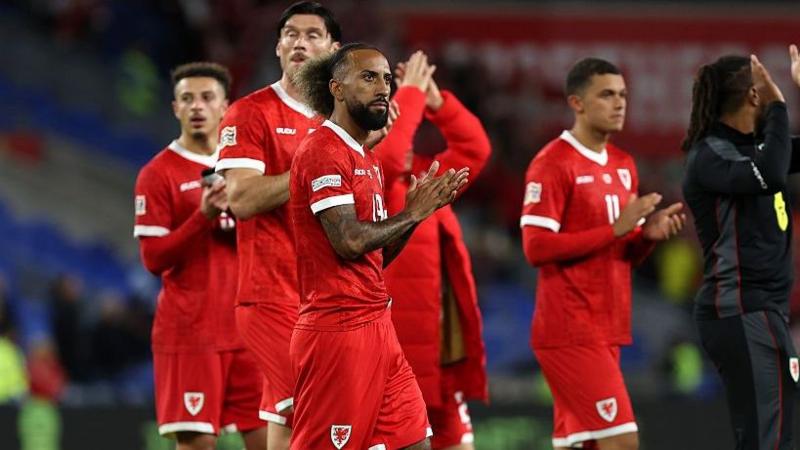
Wales struggled to generate attacking momentum against a physically imposing Danish side. After taking the initiative in Thursday's victory over Norway, the team found themselves unable to establish the same intensity or territorial control against Denmark.
Bellamy reflected on the performance:
"On Thursday [against Norway] we were on the front foot so we're able to shorten distance. Today, we just couldn't work it well enough, couldn't get the energy up enough to be able to have a bigger say in the game."
Goalkeeper Danny Ward produced two outstanding saves to keep Wales level, denying both Højlund and Gustav Isaksen before the decisive moment. However, Ward's misplaced pass in the 75th minute proved costly. The loose ball reached Isaksen in Wales' penalty area, and Ward's subsequent foul on the Danish forward resulted in a penalty that Højlund converted.
Despite the error, Bellamy credited Ward's overall contribution to keeping his team competitive.
"Obviously it's the decisive moment, but he made two incredible saves before that. I thought Denmark with the physicality were able to just crank it a little bit. You see their runs are really menacing, so I felt they were knocking on the door. He did incredibly well to keep it 0-0 to that time."
What is the issue with squad depth?
Wales' limited options on the bench have become a critical weakness at League A level. The absence of key players due to injury has forced Bellamy to rely on players from lower divisions when changes are needed. Former Wales striker Iwan Roberts highlighted the challenge: "I look at the players who came off the bench; Wes Burns plays in League One, Mark Harris plays in League One and Josh Sheehan has played for years in League One. That is the problem: when the starting 11 is not working, Craig Bellamy looks over his shoulder, and it's not nice to say, but he's looking at League One players to try to make the difference."
The situation was compounded when David Brooks, who has not started a league game for Bournemouth this season, was forced to withdraw midway through the camp due to injury. Questions have also been raised about Bellamy's substitution decisions, particularly his delayed introduction of Kieffer Moore and his decision not to bring Dan James on as a substitute despite the winger's impressive performance against Norway, where he scored Wales' opener and won the free kick for Neco Williams' second goal.
Who has impressed during the window?
Ethan Ampadu has emerged as a standout performer during the four-match period. The Leeds United captain demonstrated growing maturity and consistency, making his mark on games in ways that suggest he has reached a new level in his development. Former Wales striker Sam Vokes praised his performances, noting that Ampadu delivers "eight out of 10 every game" and "gives everything." Fellow former striker Nathan Blake described him as a "dream" player, while Robert Earnshaw suggested there are further levels to come, comparing his trajectory to that of Harry Wilson.
Harry Wilson's absence has been keenly felt, however. No player has scored more Wales goals since Bellamy took charge than Wilson, and his injury meant Wales failed to score in three of their opening four League A matches. Former Wales frontman John Hartson called for more composure from other attackers such as Brennan Johnson, Kieffer Moore and Lewis Koumas, suggesting they need to slow their play and trust their positioning at this elite level.
Where does Wales stand in the group?
Despite the defeat, Wales' position in Group A4 improved following results elsewhere in the group. Wales moved to third place after Norway lost 2-1 to Portugal, leaving Wales and Norway level on three points but Wales ahead on head-to-head record. The Welsh earned promotion to League A by topping their League B group unbeaten during the 2024-25 campaign, making this Nations League assignment their first at the elite level.
Wales' prospects of avoiding relegation remain in their own hands. According to historical data, teams that finish bottom of a League A group have averaged 2.92 points after six games across the previous three Nations League campaigns combined. Wales already have three points with two matches remaining. Teams finishing third in League A groups have averaged 6.42 points from six games over the same period, suggesting Wales would realistically need one more win or possibly two draws to secure third place.
Even if Wales finish fourth, the format provides a safety net: only the two worst-ranked bottom sides are automatically relegated to League B, with the other two heading into a play-off against a League B runner-up. With Serbia, Turkey and Czech Republic yet to register a point, they may already have secured their participation in March play-offs, with Bosnia-Herzegovina, Ukraine, Scotland and Kosovo among the potential opponents.
What happens next for Wales?
Wales will travel to face Norway on 14 November in their next Group A4 fixture, before completing the campaign with a home match against Portugal three days later. These final two games will determine whether Bellamy's side can salvage a respectable finish in their first season at League A level, despite the challenges posed by injuries and the demanding new international schedule. A strong finish would also improve Wales' seeding for the Euro 2028 qualifying draw, with the tournament to be hosted on home soil.
Key Facts
- Wales have accumulated three points from their opening four Nations League matches in Group A4
- The newly expanded four-match international window combines what were previously separate September and October breaks
- Wales are currently without five key players due to injury, significantly impacting squad rotation options
- Danny Ward's penalty concession came after a misplaced pass, though he had made two crucial saves earlier in the match
- Wales earned promotion to League A by finishing unbeaten atop League B in 2024-25
- Wales have failed to keep a clean sheet in their past nine matches
- Ethan Ampadu has delivered consistently strong performances during the four-match window