Scotland secured their first victory under head coach Sebastien Pocognoli with a commanding 2-0 Nations League performance against North Macedonia in Skopje on 3 October 2026, a result that marks a significant turning point after earlier draws and defeats in the campaign. The win provides renewed hope of topping Nations League group B1, or at least finishing second, following a 0-0 draw with Slovenia and a 3-0 home defeat to Switzerland in his opening matches. According to official records, Scotland moved to three points in the group standings following the victory.
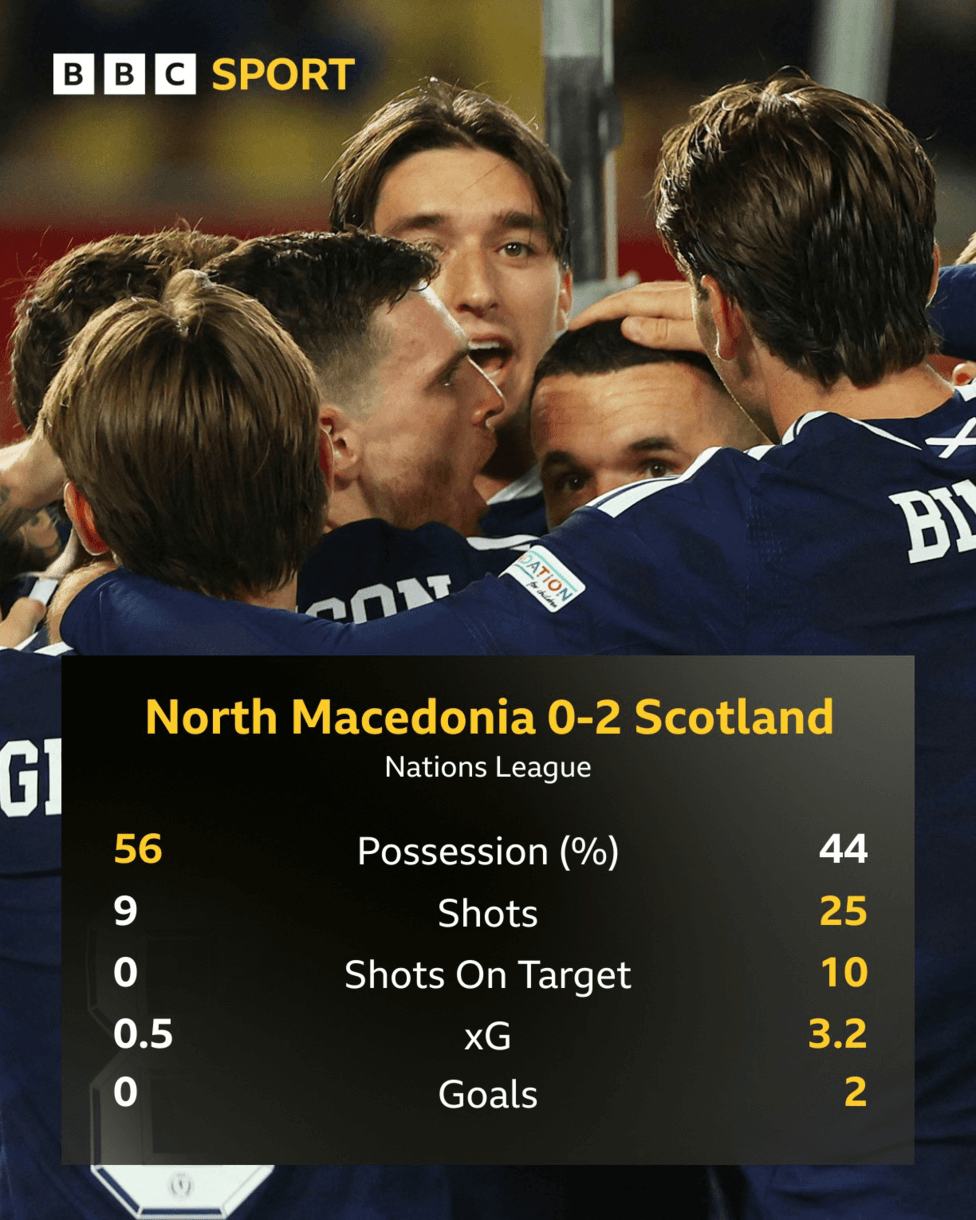
The scoreline barely reflects the gulf in class between the two sides. Scotland recorded 25 shots to nine, with 10 on target compared to North Macedonia's zero. Before Scott McKenna's late dismissal, Scotland had touched the ball 37 times inside the North Macedonia penalty area, while the hosts managed just two incursions into Scotland's box. The performance was a rout in all but name, played on a poor pitch in a largely soulless stadium, though the visiting supporters created an energetic atmosphere throughout.
This was a particularly significant evening for Andy Robertson, who earned his 100th Scotland cap. The captain set the tone from the opening moments, attempting four shots in his first 13 minutes—a tally he had never achieved in a full 90-minute match across his previous 99 appearances. His energy and urgency infected the entire team, establishing the tempo that would dominate the encounter. Robertson's willingness to drive forward and attempt shots—something rarely seen in his previous 99 caps—reflected the attacking intent Pocognoli has instilled in the team.
How did Scotland break the deadlock?
Kieron Bowie opened the scoring in the seventh minute with a well-taken finish, ending a 422-minute scoring drought after receiving an assist from Billy Gilmour. The goal settled any early nerves and allowed Scotland to play with the freedom their dominance warranted. Bowie's footwork deceived a defender before his accuracy beat the goalkeeper, demonstrating the clinical finishing that has been lacking in recent matches. His first Scotland goal is likely to secure the Sassuolo striker's place in the starting line-up for upcoming fixtures.
The second goal arrived from the penalty spot, with John McGinn converting to reach 22 Scotland goals, drawing level with Lawrie Reilly on the all-time national team scoring list. The penalty itself had an unusual journey: Scotland's initial penalty award for a foul on Ben Gannon-Doak was overturned following a VAR review, but a subsequent handball by Bojan Miovski resulted in a second penalty being awarded, which McGinn dispatched with authority. McGinn's strike carried particular significance after some indifferent recent performances had prompted mild questioning of his impact, and it silenced doubts while restoring confidence in the Aston Villa midfielder.
What was the significance of Robertson's milestone?
Robertson's 100th cap represents a major career achievement and places him within two appearances of Kenny Dalglish's Scotland record. The Tottenham Hotspur left-back's performance on the night was one of his most straightforward, yet his early aggression set the standard for what would follow. His willingness to drive forward and attempt shots reflected the attacking intent Pocognoli has instilled in the team, and he is surely assured of taking another step closer to Dalglish's cap record despite the fresh legs of Sassuolo's Josh Doig waiting in the wings.
How did the new players perform?
Luis Binks, Stephen Welsh and substitute Robbie Ure all experienced the satisfaction of winning for their country, with Binks and Welsh appearing comfortable in Scotland's defensive setup. Stoke City centre-back Luke Graham made his Scotland debut after coming on late in the match, adding another fresh face to Pocognoli's evolving squad. Both Binks and Welsh enhanced their reputations in Skopje, and Luke Graham did not look out of place either as he made his debut from the bench.
Ben Gannon-Doak emerged as one of the standout performers, turning North Macedonia inside out with his pace and involvement. The 20-year-old created numerous opportunities and tormented the home defence throughout, though he squandered several chances that might have added further goals. His raw materials are exhilarating—his speed, his number of touches, his ability to create chances—yet he lacked the sharpness and ruthlessness that comes with regular playing time. At Bournemouth, he has managed only limited minutes: two against Liverpool, 19 against Real Sociedad, eight against Brentford, one minute each against Newcastle and Manchester City, with his only start this season coming in a League Cup tie against Lincoln. The lack of consistent football at club level is affecting his development, and a loan move in January could prove beneficial if Bournemouth permits it. Given his ability to combine tracking back in defence with rampaging down the wing, it would be a surprise if the Bournemouth winger was not utilised in that role again for upcoming fixtures.
What role did Billy Gilmour play?
Billy Gilmour demonstrated his complete range as a midfielder, functioning effectively both as a tempo-setter when dropping deep and as a dangerous passer when moving forward. His involvement in Bowie's opening goal illustrated his importance to Scotland's attacking play, and his performance suggested he is operating at the peak of his powers. The question of whether he functions best as a six or an eight appears increasingly irrelevant—he is proving himself capable of excelling in both roles. It would be a major surprise if Pocognoli chose to disrupt the midfield diamond that has shone bright in the first three games, with Napoli's Billy Gilmour and Bologna's Lewis Ferguson forming the base of that setup.
What does this mean for Pocognoli's tenure?
The victory lifts a significant burden from Pocognoli's shoulders. The persistent talk of searching for goals and the creeping negativity that accompanied his opening matches have been replaced by a lighter atmosphere. He now has three points to build upon, following a strong second-half performance against Slovenia a week earlier. Scotland demonstrated exciting, entertaining football, though they also showed frustration through occasional lack of execution. They created chance upon chance but did not convert at the rate their dominance deserved—a shortcoming that may improve as confidence grows and the team develops further.
Pocognoli has assembled new players and implemented an aggressive football philosophy that is beginning to generate genuine buzz. North Macedonia were hopeless opponents, but that hardly diminishes the achievement; they were put away comfortably and without fuss. The manager will again be forced into at least one change after the red card shown to Scott McKenna near the closing stages in Skopje, with Al-Ettifaq's Jack Hendry, free of his own suspension, likely to make a swift return to the defensive line.
How did supporters react to the performance?
Fan reaction to the victory was mixed, reflecting differing assessments of Scotland's display. Many supporters praised the attacking intent and dominance, with some describing it as a refreshing change from the cautious approach of the previous regime. One supporter noted the team's willingness to be on the front foot, while another highlighted the comfort shown by the defensive pairing of Welsh and Binks.
However, others expressed frustration at the failure to convert more chances against a weak opponent. Several fans argued that Scotland should have scored significantly more goals given the number of opportunities created, with one noting that converting only two goals from such dominance remained a concern ahead of tougher tests. Some questioned whether the performance could be properly judged against such poor opposition, suggesting that Scotland would be exposed against stronger teams. Concerns were also raised about defensive lapses, particularly the pass that led to McKenna's sending off, and the finishing quality of several attacking players.
What happens next for Scotland?
Scotland will host Slovenia at Hampden Park on Tuesday, 6 October 2026, at 19:45 UK time, with one of the original four group matches remaining in this Nations League series. Slovenia arrive at Hampden following their own narrow 2-1 defeat away to group leaders Switzerland. The visit to Skopje has provided promising signs, but considerable work remains to establish Pocognoli's new era as a genuine force. The foundation has been laid; now Scotland must build upon it.
Key Facts
- Scotland dominated possession and chances, recording 25 shots to North Macedonia's nine, with 10 on target to zero
- Kieron Bowie's seventh-minute opener ended a 422-minute scoring drought, while John McGinn's penalty brought him level with Lawrie Reilly on 22 Scotland goals
- Andy Robertson earned his 100th cap, moving within two appearances of Kenny Dalglish's national record
- Ben Gannon-Doak impressed despite limited club minutes, though he squandered several clear opportunities
- Scotland's next fixture is against Slovenia at Hampden Park on Tuesday, 6 October 2026 at 19:45 UK time