A star team rather than a team of stars shone on Finals Day, as Northamptonshire beat Somerset and then Hampshire in the final to win the Blast. The holders prevailed by 14 runs after two contrasting semi-finals and a tense decider at Edgbaston.
How did Somerset build early momentum?
Momentum matters in sport, as the first innings of the first semi-final showed. Somerset had finished the T20 season strongly, clinching a quarter-final after a few and then carrying the elan of Craig Overton’s extraordinary rescue act at Headingley into Edgbaston.
His first ball may have been clipped for four by Ricardo Vasconcelos, but the wind seemed to be in Somerset’s sails as they appeared to conjure wickets at will for the next 19.1 overs and Northamptonshire limped to 143 all out.
By contrast, Northamptonshire had done their best work in the early season and had lost twice to Somerset late in the group stage. Their innings never established any momentum, with too many shots caught well inside the ropes, suggesting a failure to commit fully to shots. The holders had a very good chance to progress to the final.
How did David Willey change the semi-final?
Sometimes the tactics, the psychological states of the players and the data can be analysed in granular detail. Sometimes, though, a moment of inspiration turns a match, a semi-final, maybe a tournament.
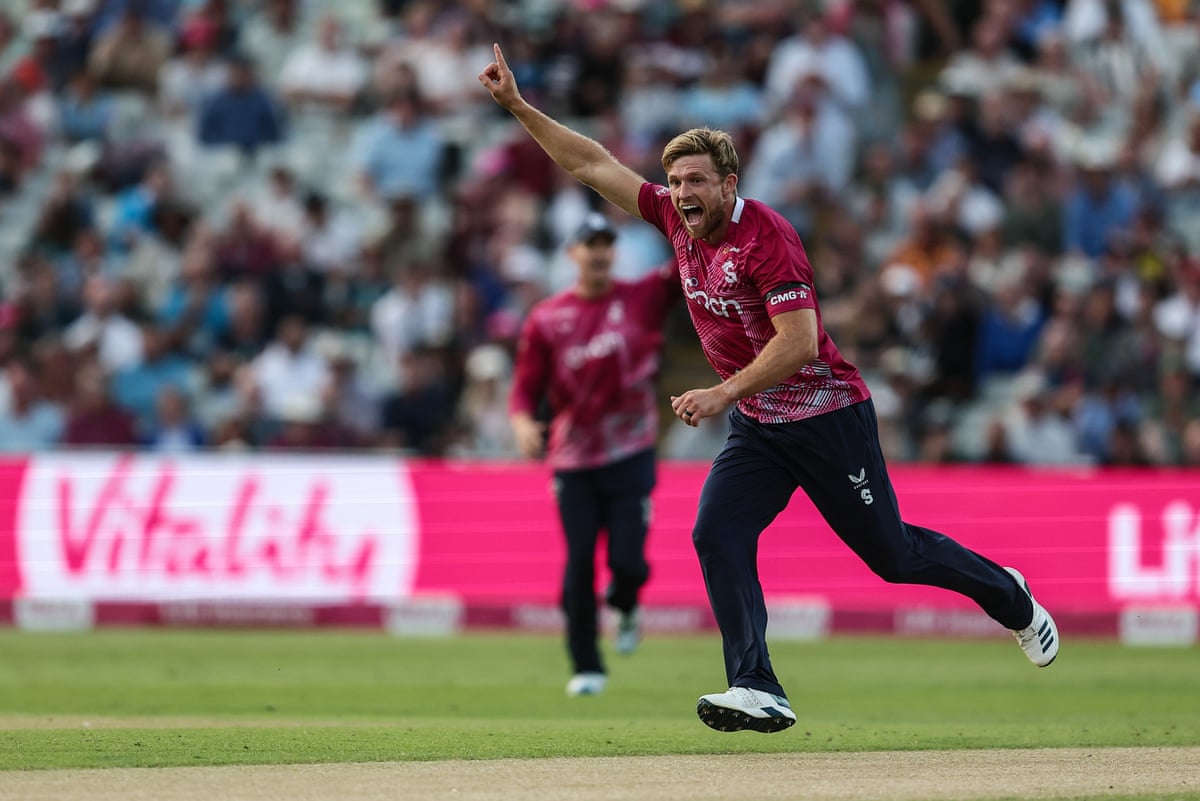
Practising boundary relay catches is commonplace before play and is not quite the kind of stop-the-press event it was in the early days of T20 cricket. But when Overton launched Ben Sanderson back over his head, it felt like Somerset’s gamechanger was changing the game. David Willey thought otherwise.
At 36, and playing in his 385th T20 match, Willey ran flat-out round the boundary, flew all but horizontally at the ball, released it while in midair with all his momentum going away from the boundary, and Saif Zaib caught the relay low down.
It did not seal the victory on its own, because Northants had been punching back from their first ball in the field, but it was the point the match turned. Somerset would rue a chance spurned, having needed 75 runs, three down at the halfway stage.
How did Hampshire set up the second semi-final?
James Vince is as classy a white-ball batter as there is in the domestic game, and he showed that in leading Hampshire to a strong score in their semi-final against Nottinghamshire.
The teams in the second semi-final had 40 overs to study the pitch, assess a par score and plan a strategy. Better still if your most experienced and wisest tactician is in the middle fine-tuning matters as the innings progresses. As opener, Vince was able to do that.
He played as though he had a target of 180 in mind and that allowed Joe Weatherley to tee off at the other end, his captain there to reassure him that he was doing the right thing. Their partnership of 126 contained much of the day’s most fluent strokeplay.

Of course, had Nottinghamshire caught their fair share of catches, things would have been different — but when is that not so? Credit Hampshire for that too, because they put fielders under pressure from ball one.
Why did Joe Clarke’s dismissal matter so much?
Even in cricket’s shortest format, and therefore most formulaic, the cliches do not always hold true.
At 102 for two in the 13th over, Nottinghamshire were behind the rate required to reach the 188 they needed to qualify for the final, but “you can always catch up with wickets in hand”. Cue a very bad time for Joe Clarke, cruising on 64 off 42, to get out, caught in the deep.
That exposed Notts’ phalanx of all-rounders, numbers four to 11 boasting just two white-ball centuries between them. Above 12 an over against the experience of Hampshire’s trio of 36-year-old bowlers — Chris Wood, Liam Dawson and James Fuller — proved, unsurprisingly, too big an ask and Hampshire had an hour or so to prepare for the final.
How did Northamptonshire recover in the final?
Sent in to bat, Northamptonshire lost both their gun Australian batters before eight overs were through, but a tight-knit team — the best through the group stage — with strong leaders usually finds someone who will stand up to the challenge. Vasconcelos, as solid a county pro as you will find, did exactly that, facing just under half the deliveries in making 88, well over half his team’s total of 169.
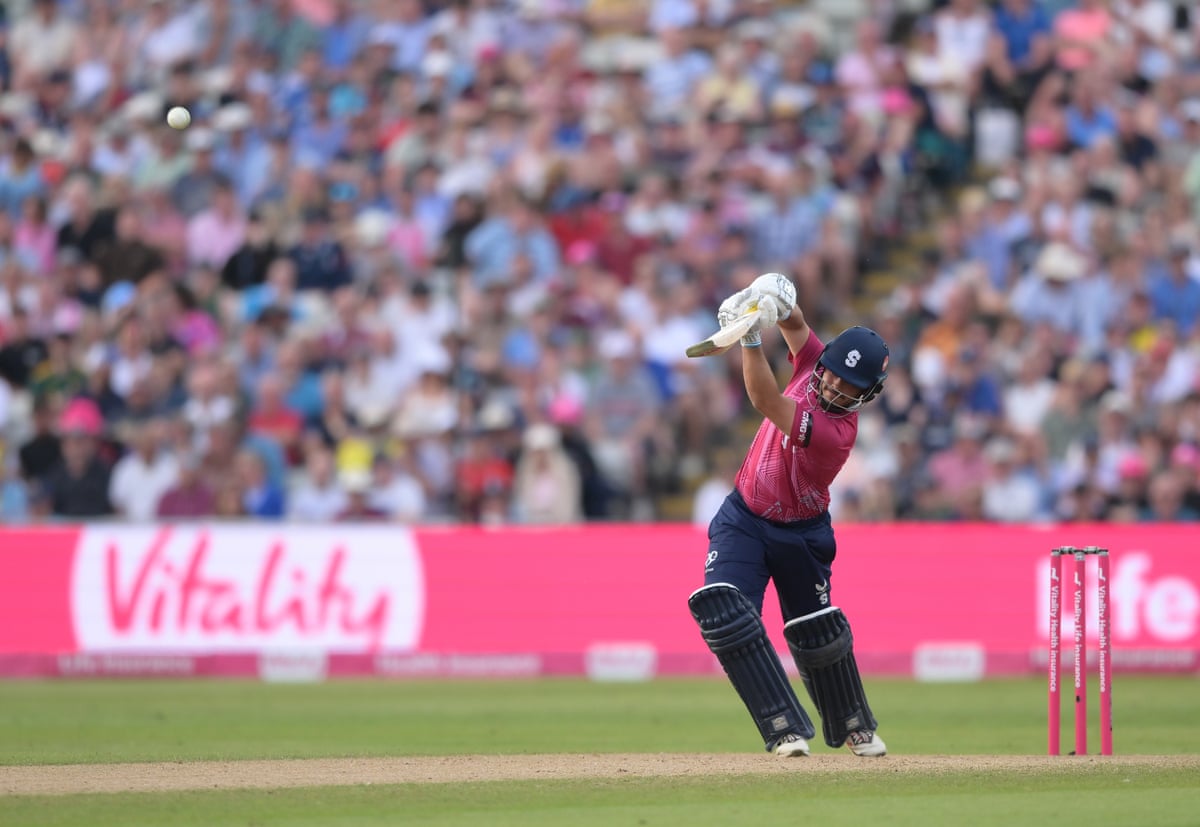
That it was not more was largely thanks to Sonny Baker, who charged in full of enthusiasm and bowled fast and unpredictably — not a bad combination for T20. Unlike a lot of cricketers who talk about the grind of the county season with long faces, he loves every second of it.
Compared with the IPL, almost a different sport these days, a target of 170 appears thin, but not at Edgbaston, chasing with a trophy on the line. The Steelbacks would certainly have settled for asking the Hawks to soar that high before a ball was bowled.
How did Northamptonshire finish the final?
Weatherley, enjoying a super day out comprising two half-centuries, and Dawson were taking the game away from Northants, both set with 41 required from the last four overs. They would get over that line four times out of five from there.
Needing a wicket, Willey tossed the ball to Luke Procter, the veteran who had been hammered for a chastening six boundaries in an over earlier in the day. He went two, six, one and Northamptonshire’s spines needed stiffening, as the game slid further away.
Off his fourth ball, as so often happens in pressure situations, a run-out turned the match, Procter fielding off his own bowling and throwing down the stumps at the non-striker’s end to maroon Dawson. Weatherley was still there but running out of partners, as a clatter of wickets saw Northamptonshire seal the victory by 14 runs.
They were worthy winners indeed.