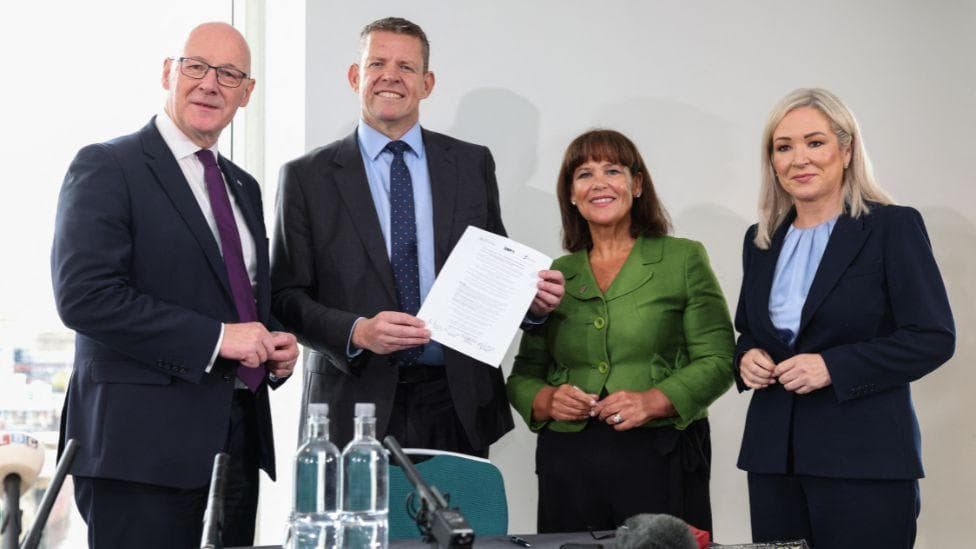
First Minister John Swinney has declared his intention to hold a second Scottish independence referendum by 2031, following a summit in Cardiff where nationalist leaders from Scotland, Wales and Northern Ireland signed a joint declaration asserting that Westminster's authority is waning. The gathering brought together Swinney, Plaid Cymru leader Rhun ap Iorwerth, Sinn Féin president Mary Lou McDonald and Sinn Féin vice-president Michelle O'Neill to coordinate on constitutional self-determination across the three devolved nations.
At a news conference following the meeting, Swinney predicted that Labour leader Andy Burnham would become the last prime minister of the United Kingdom. He emphasised that Scots deserve the opportunity to decide their constitutional future during the current Holyrood term, which concludes in 2031.
The four leaders met on 14 September 2026 at the St David's Hotel in Cardiff Bay, gathering in their capacities as party leaders rather than as formal heads of government. According to reporting on the summit, the meeting broadened into a comprehensive joint declaration covering economy, energy, Europe and self-determination, with the leaders calling on the UK government to "prepare, plan and facilitate constitutional change" across Wales, Scotland and Northern Ireland.
What does the joint declaration say?
The four leaders stated in their joint declaration that
there could be no clearer sign that Westminster's time is coming to an end. They affirmed that
each of our nations has the right to determine its own future, through democratic means and in accordance with the wishes of its people. The leaders further agreed that there must be
no obstacles to the people of our countries expressing their right to self-determination.
This alignment represents a rare convergence of pro-independence leadership across the three devolved administrations, with all three represented by parties that support leaving the United Kingdom. The meeting was framed as strengthening cooperation on self-determination, while also linking constitutional questions to European and international cooperation.
Why does Swinney believe the timing is right?
Swinney argued that the moment for a second referendum has arrived, citing several factors. The Scottish Parliament now contains the largest number of pro-independence MSPs in its history. Together with the Scottish Greens, there are 73 pro-independence MSPs in total—an increase of one from the previous parliament—despite the SNP losing seats in May's election. Their combined share of the vote stood at approximately 41%.
The First Minister also pointed to recent opinion polling suggesting a small majority in favour of independence, and what he characterised as the mood expressed by Scottish voters in May's elections. He stated:
The people of Scotland, if given the choice of independence in a referendum, will take that choice, because all of the information that we see in front of us about the trends in opinion polling indicate that's the preference of the people of Scotland.
Swinney claimed the
moment has now comefor a second referendum and has previously suggested that a vote could be held as soon as 2028. However, significant legal and political obstacles remain regarding the mechanism through which such a referendum could be achieved.

What are the constitutional barriers?
The path to a second independence referendum faces substantial hurdles. In 2022, the Supreme Court of the United Kingdom ruled that the Scottish Parliament could not hold another referendum without the explicit consent of Westminster. Prime Minister Burnham has made clear that such consent will not be forthcoming, stating that a referendum remains
off limitsand that any future vote would require
majority public supportas a precondition.
Burnham's position reflects Labour's manifesto commitment opposing Scottish independence and another referendum. His spokesman emphasised that the Prime Minister was
committed to delivering change across all four nations of the United Kingdom and believes strongly in the union. The spokesman added that the UK government would focus on
easing pressures on household finances, and delivering greater economic security, rather than engaging in constitutional debates or further referendums.
The Labour leader has argued that the 2014 independence referendum was based on a shared agreement between the Scottish and UK governments that holding one was appropriate. He contends that no such consensus exists today, making another vote incompatible with the constitutional settlement that governed the previous poll.
What do the other nationalist leaders say?
Rhun ap Iorwerth, the Welsh First Minister, called for a fundamental redesign of the UK constitutional framework, envisioning independent nations working together in a new arrangement. He stated that the
current status quo is not tenable.
Michelle O'Neill, the Northern Irish First Minister, declared that party leaders had agreed that
Westminster does not and will never serve our people well. She insisted that constitutional change was
very much on the tabledespite Burnham's recent statements to the contrary. Swinney reinforced this message, stating:
We will each individually be responsible for our own journeys but we are absolutely united by that principle of self-determination.
What is the historical context?
Scotland voted in 2014 to remain part of the United Kingdom by a margin of 55% to 45%. Pressure from the SNP for a second vote intensified following the 2016 Brexit referendum, with then-First Minister Nicola Sturgeon arguing that the UK's departure from the European Union constituted a material change in circumstances that justified another independence poll. However, successive prime ministers—both Conservative and now Labour—have refused to permit another referendum.
The 2014 referendum was held under a legal framework agreed between the Scottish Government and the UK Government, with both administrations accepting that the vote should take place. The absence of such agreement today represents a fundamental difference from the circumstances that enabled the previous poll.
What happens next?
Swinney was reported to have a series of further engagements with the Welsh Government around the time of the Cardiff visit, suggesting that bilateral cooperation between the Scottish and Welsh administrations on constitutional matters may intensify. The leaders' joint declaration signed on 14 September 2026 is expected to form the basis for ongoing coordination on self-determination and related policy areas across the three devolved nations.
Key Facts
- John Swinney aims to hold a second Scottish independence referendum by 2031, the end of the current Holyrood term
- The Scottish Parliament contains 73 pro-independence MSPs—the highest number in its history—though their combined vote share fell to 41% in May 2026
- The UK Supreme Court ruled in 2022 that Scotland cannot hold a referendum without Westminster's consent, which Prime Minister Burnham has refused to grant
- Recent opinion polling suggests a small majority of Scots favour independence, according to Swinney
- The Cardiff summit on 14 September 2026 brought together nationalist leaders from Scotland, Wales and Northern Ireland to coordinate on constitutional change