
Sheri Ingram was in her early twenties and fresh from university when she and her then-boyfriend hired builder Lee Slocombe to renovate a home in the south Wales valleys. The project would cost them approximately £14,000 and leave them financially devastated. Now 35, Ingram can identify the warning signs she missed: Slocombe offered cut-rate work because he claimed to have leftover materials, then requested upfront payment for additional supplies.
"At the time, we believed him,"Ingram recalls. The couple had budgeted roughly £8,000 for work that included removing a supporting wall and constructing an extension with a balcony.
The renovation quickly spiralled into chaos. Slocombe stripped the property to its skeleton—pulling up floorboards, removing floor joists he claimed had wood rot, dismantling the staircase, taking down walls, and removing the ceiling. The first floor was temporarily supported by metal poles while rubble accumulated in the garden. Each discovery of new problems brought fresh requests for money. When Slocombe's initial demands exhausted their savings, Ingram's then-boyfriend borrowed an additional £6,000 from family members.
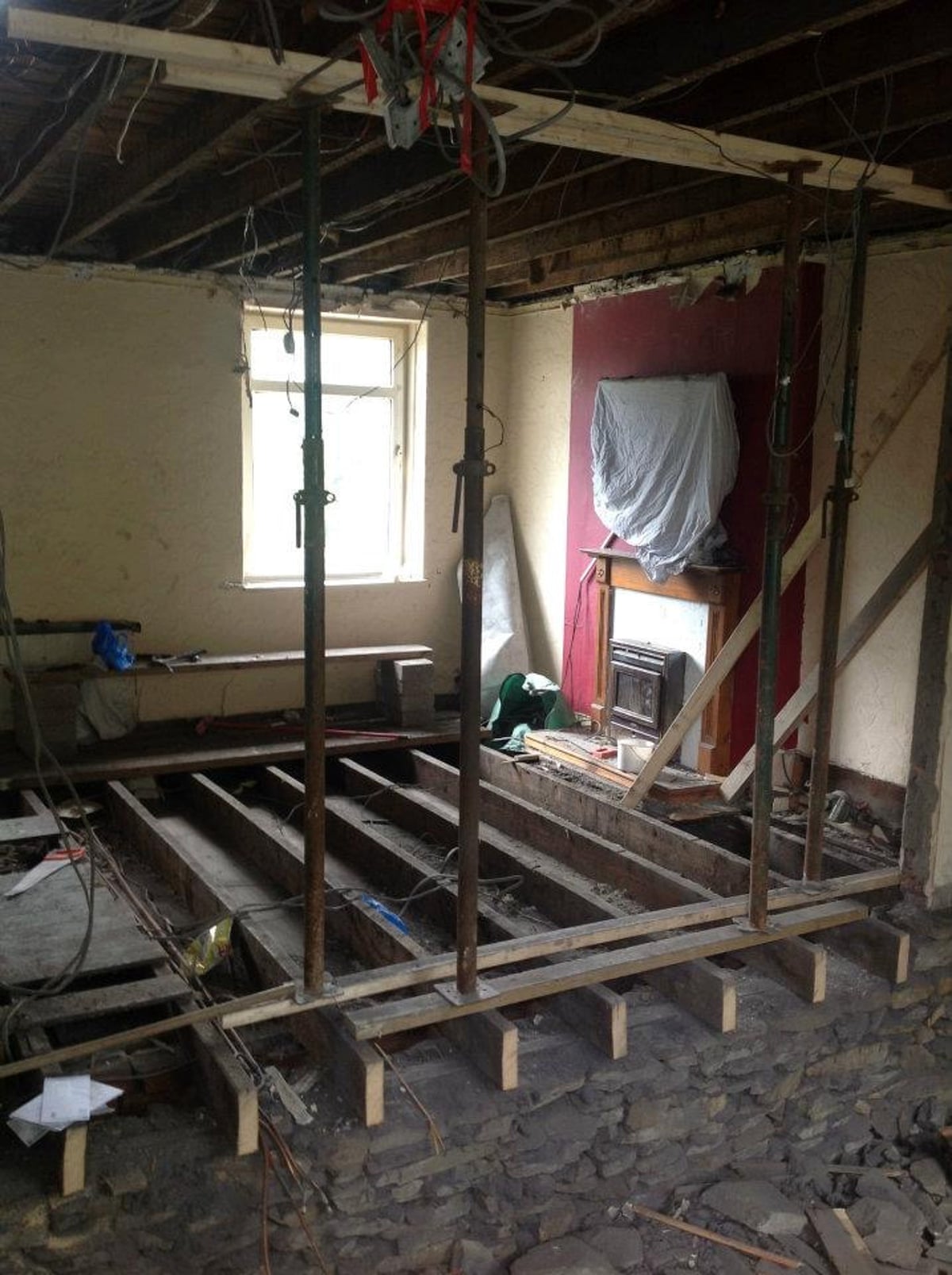
Slocombe offered shifting explanations for where the money had gone, claiming he expected a medical payout for an injury sustained on another job that would cover repayment. He even appeared one day wearing a sling, saying he needed weeks off to recover. After approximately six weeks, he vanished entirely.
Ingram's experience reflects a widespread problem affecting millions of homeowners. According to a July 2026 Citizens Advice report, approximately 4.8 million households experienced problems with home repair jobs in the previous 18 months, ranging from unfinished or unsafe work to disputes with traders. About 1.7 million were forced to pay additional money to fix substandard earlier work or had been overcharged, losing an average of £750 each. For one in ten victims, the extra cost exceeded £5,000.

Complaints about cowboy builders have nearly doubled since 2022, with households making around 37,000 complaints about home maintenance and improvements in 2025. According to industry research, 5,177 potential scam cases were identified among 38,356 complaints during 2025, with 831 potential scam cases recorded by 28 February 2026.
In response to this crisis, the government has introduced a multi-layered protection scheme. According to property sector reporting, the government-backed homeowner protection package launched in September 2026, alongside a trusted-traders register and a payment system tied to project milestones. The scheme represents the most comprehensive attempt yet to shield consumers from unscrupulous operators.
How does the new payment system work?
The Trusted Payment app, endorsed by the Chartered Trading Standards Institute and developed by Trusted Payments Limited in partnership with TrustMark, the government-endorsed quality scheme, creates what its director James Walker describes as a
"fair contract between trade and consumer."The system operates through milestone-based payments rather than lump sums, introducing critical safeguards at each stage.
Milestone payments are delayed by 24 hours, giving consumers time to cancel if they feel pressured into approving work. Payments for completed work are held in escrow by the Dispute Resolution Ombudsman until the job is finished to both parties' satisfaction. Projects costing more than £2,500 are covered by a two-year warranty. Traders who fail to follow ombudsman decisions face removal from the app.

Walker explains the philosophy behind the approach:
"We are not going to stop a rogue trader going out … but we are providing a trusted mechanism so you know if you use this process you are protected."According to reporting on the scheme's launch, Trusted Payment went live on 1 September 2026, with more than 100,000 traders expected to gain access by the end of that month. The system aims to create a
"trusted network for consumers"while helping reputable tradespeople win more business.

What happened to other victims?
Paul Boielle, 82, hopes the new protections will spare others from his ordeal. He noticed a problem with a corner of his roof when three men knocked on his door shortly after his wife's funeral. Caught off-guard and vulnerable during his grief, he engaged with them when they claimed to be working in the area and offered roofing services.
"They said they were doing work in the area and asked if I needed any roofing work. He showed them the problem. Before I knew it, they'd taken the tiles off."
Among the men was roofer David Vincent from Orpington, London, who was later sentenced to 28 months in prison after pleading guilty to fraud by false representation and engaging in unfair commercial practices. Vincent and his associates told Boielle the damage was far more severe than initially apparent, recommending a complete roof replacement at £30,000—roughly double what the work should have cost. Boielle paid a £5,000 deposit.
The work proceeded with remarkable speed. Roofers removed solar panels and tiles, re-felted the roof, and replaced everything within 48 hours. Boielle's son and neighbours grew suspicious of the rushed completion and contacted Trading Standards. An investigation by Hertfordshire council's Trading Standards service determined that Vincent had grossly overcharged Boielle, executed the work to a poor standard, and failed to provide information about cancellation rights.
The problems persisted long after the team departed. Tiles were crooked and incorrect capping tiles had been installed. Correcting the defects consumed most of the following year.
What are the limitations of the new scheme?
Despite the government's optimism, industry figures have raised concerns about the approach. Rico Wojtulewicz, head of policy and market insight at the National Federation of Builders, warns that many reputable builders may simply decline to participate in Trusted Payments because they are already busy and maintain strong reputations.
"We don't think this is the best approach,"he says.
Wojtulewicz advocates for an alternative framework.
"We believe every building should have a digital building passport – effectively a logbook recording all significant work, and who did it. If it subsequently fails, or is found to be substandard, that should be recorded against the builder responsible. It would shine a light on companies that consistently do poor-quality work."This approach would create a permanent record tied to individual builders, making it harder for repeat offenders to operate under new identities or with fresh customer bases unaware of their history.
What happens next?
According to housing sector guidance, the Approved Code was scheduled to become fully live by the end of September 2026, with full implementation expected by December 2026. The government-backed scheme rolled out through September 2026, allowing traders to during that month. The register of trusted traders, which was scheduled to go live in July 2026, now forms the foundation of the broader protection framework.
For victims like Ingram and Boielle, these measures arrive too late to recover their losses. Yet their experiences have catalysed action. The scale of the problem—affecting millions of households and generating tens of thousands of complaints annually—has forced policymakers to act. Whether the combination of a trusted-trader register, escrow-based payments, and ombudsman oversight will prove sufficient to deter rogue operators remains to be seen. What is certain is that homeowners undertaking renovation work now have more tools to protect themselves than those who came before them.