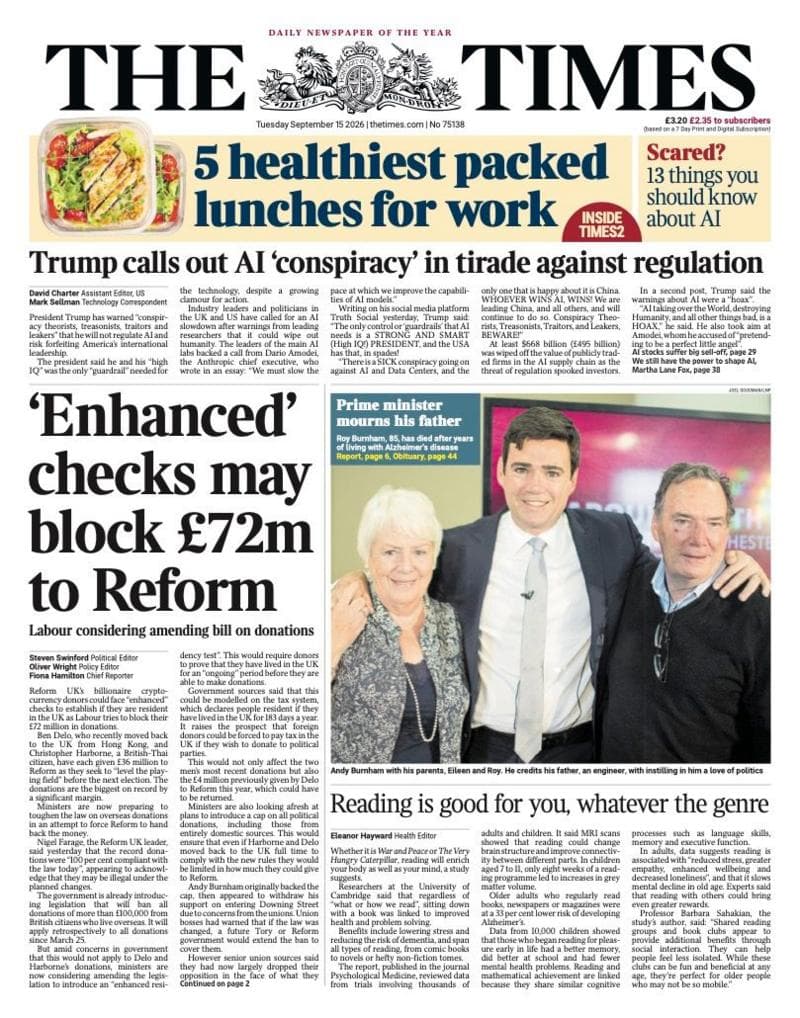
The House of Lords is debating changes to political donation laws following Reform UK's receipt of £72 million from two British billionaires within 48 hours, reigniting fundamental questions about how political parties should be funded and what constitutes a legitimate donation. Reform leader Nigel Farage has acknowledged uncertainty about whether the donations will survive the government's proposed retrospective restrictions, while the government and opposition figures have intensified calls for stricter limits on individual donations to political parties.
The donations came from Ben Delo and Christopher Harborne, both British nationals and cryptocurrency billionaires. According to Reuters, each pledged £36 million to Reform UK in less than 48 hours, making Delo's contribution a record single donation to a British political party. Both men have recently returned to the UK after living abroad—Delo in Hong Kong and Harborne in Thailand.
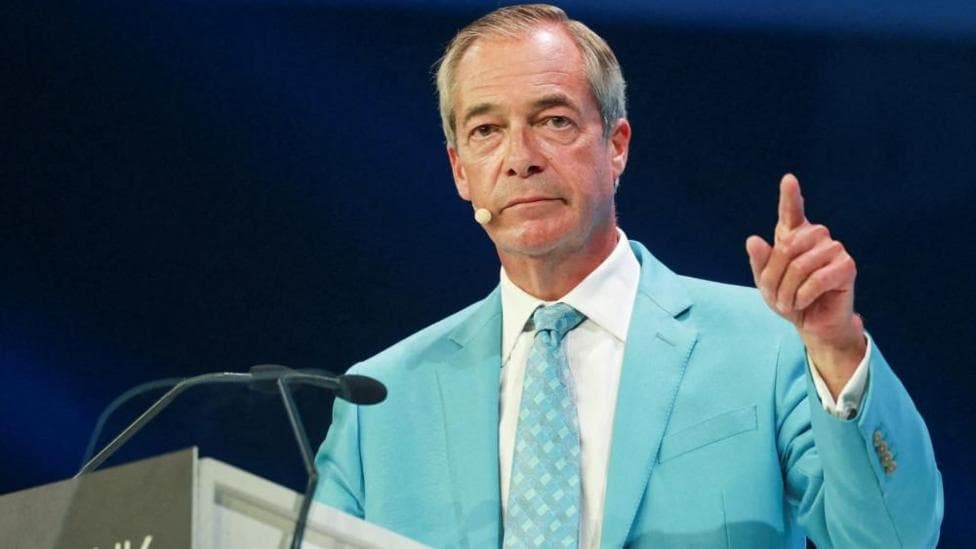
The government is advancing legislation to introduce a £100,000 cap on donations from British expatriates and those who have recently relocated to the UK, with the measure set to apply retroactively from 25 March 2026. In his first interview since the donations became public, Farage stated unequivocally that
both these donations are 100% compliant with the law today, of that there is no question whatsoever. However, when asked whether the donations would remain legal under the government's proposed framework, he became more cautious, saying
retrospectively declaring donations illegal—that simply cannot beand
you cannot confiscate money that has been given legally within the law as it stands.
This represents a shift from Reform's earlier public position. Robert Jenrick, Reform's economic spokesman, had stated that the donations were
entirely in line with the law as it is, and as far as we know, the law as it's going to be in the future. Farage's more cautious language suggests uncertainty about whether the party will ultimately retain the full amount, particularly given that the government has not yet finalised key details of the proposed residency requirements.
Farage strongly objected to the government's plan to make the new law retrospective, arguing that
if a government was allowed to do this, you know what would happen? There'd be a response the other way. We or the Conservatives would say, right, if you're going to stop legitimate donors like this, we will then say to the trade unions, you can't give money. And if you do that, you have collapsed the whole political system. He argued that such a move would force taxpayers to fund political parties instead. He said the donations would allow Reform to
catch up with the other big partiesand enable them to
professionalise.
What are the proposed rules and how would they work?
Under the government's proposed framework, a £100,000 annual cap would be applied on an aggregate basis across all regulated recipients within a calendar year, rather than as a separate limit for each party or candidate. According to government guidance on the proposed changes, any donation exceeding the cap would need to be returned within 30 days of receipt. The Electoral Commission has confirmed that any donation above £500 from an impermissible source must be declared and returned within 30 days.
The government has also introduced a minimum residency period requiring those who relocate to the UK to remain subject to the cap until they have been resident for a full calendar year following their return. According to the government's response to the Rycroft review, individuals moving to the UK from 6 July 2026 who were not registered as overseas electors would also face the £100,000 cap and residency restrictions.
A key uncertainty remains unresolved: the government has not yet decided precisely what "residency" would mean legally. Communities Minister Baroness Taylor told the Lords that Brits returning from abroad and wanting to donate without limit
must demonstrate a genuine and ongoing connection to the United Kingdomand that the government is
considering how we will strengthen the residency requirements, including ensuring that the length of time spent in the UK aligns with broader government policy. Possible definitions could include being on the electoral roll at a UK address or being resident in the UK for tax purposes, but these have not been formally specified.
Lord Wills, a Labour peer, has signalled his intention to amend the bill to extend donation caps to those living within the UK, not only overseas residents. Housing Secretary Angela Rayner confirmed that the rule changes would operate retrospectively, meaning anyone whose donations breach the new limits would be required to return the excess funds. However, she declined to comment specifically on whether the Delo and Harborne donations would be affected, stating she did not
understandtheir individual circumstances.
Why is this debate happening now?
The Rycroft review, conducted by former civil servant Philip Rycroft, was established to counter foreign influence in UK politics. The government announced its intention to introduce the £100,000 cap on 25 March 2026 as part of a broader effort to tighten regulations on political funding. The timing of Reform's substantial donations has intensified pressure on Parliament to act swiftly on these measures.
Education Minister Georgia Gould told the BBC that the government was
really worried about the big money that is coming into politics... and sometimes money from overseas that is shaping politics rather than the ordinary voters. Sir Philip Rycroft himself said examining domestic donations had not been within the remit of his review, but that there was a case for capping all donations, whether from British citizens living in the UK or overseas.
I don't see any reason why we should have these mega sums of money coming into British politics, he said, though he acknowledged that the government's decision to retrospectively ban certain donations was
going to be controversial.

Reform UK has rejected the proposed restrictions. The party accused Labour of attempting to
rig the system, arguing that the government and its union allies cannot win elections through legitimate means. Richard Tice, Reform's deputy leader, declined to say when the two donors returned to the UK, and has accused Labour of using retrospective law with
dictatorshiptactics to block the donations.
What broader questions do these donations raise?
The £72 million windfall has transformed the debate at Westminster about politics and money, raising several fundamental questions that extend beyond the immediate legal dispute. Should there be a limit on the proportion of a party's funding that can come from a single individual? Should there be a limit on what donors based in the UK can give per year, as well as a cap on donations from Brits abroad?
Sharon Graham, general secretary of Unite the Union—one of Labour's largest financial backers—has publicly supported donation limits and suggested a domestic cap somewhere between £500,000 and £1 million per year. She distinguished between union contributions from ordinary members and the scale of recent billionaire gifts, stating that
billionaires splashing out millionsdiffers fundamentally from
everyday workers giving 10p a week to a political fund. She has called on the government to go further and put a cap on individual donations made by UK residents.
Trade Unions Congress general secretary Paul Nowak delivered a more forceful critique at the TUC's annual conference. He said there was no similarity between
care workers chipping in a few quid a year through their union and a party bought and paid for by billionaires. He described Reform as a
party for saleand their donations as
a crisis for our democracy, arguing that
we cannot allow our political system to be captured by corporate interests. Nowak called for a permanent ban on cryptocurrency donations, overseas donations, and foreign-funded political advertising, and stated that people should not be allowed to donate to political parties in the UK if they are not paying taxes in the country.
Nowak also claimed there was a direct link between Reform UK and the white supremacist movement in the US, stating:
There is a direct political thread, a nasty politics, that links Nigel Farage, Rupert Lowe, and Tommy Robinson, with Donald Trump, Maga and the US white supremacist movement. It starts with demonising migrants. It flies flags, not as an expression of national pride, but to intimidate. It fans the literal flames that set fire to hostels and libraries. And it ends up with proto-fascist mobs roaming our streets in balaclavas, targeting brave volunteers in lifeboats. Since 2020, Labour has received almost £43 million from trade unions, who raise their money through individual workers' membership fees.
Some argue that a domestic cap would compel parties to find their funding via lots of small donations rather than fewer giant ones. But it could also prompt some to call for state funding of political parties—that is, taxpayers picking up the tab—which may not prove widely popular. The government has also indicated interest in spending limits in addition to donation limits between elections, on top of the existing limits that apply just before elections.
What do other parties say?
Conservative shadow foreign secretary Tom Tugendhat said it was important to ensure
we do not end up with a sort of Americanisation of politics where money just sort of runs free. Liberal Democrat Cabinet Office spokeswoman Lisa Smart called for emergency legislation to cap campaign donations and spending. The Green Party urged Labour to
find its spine and support a tight cap.
Who are the donors?
Ben Delo, a cryptocurrency investor, informed the Telegraph in April that he was relocating from Hong Kong. Christopher Harborne, who has been based in Thailand, registered to vote in the UK according to reporting by a national news outlet in June. Both individuals have since returned to the UK, with Delo understood to have been resident in the country since the previous year. It is not currently clear exactly when Delo and Harborne returned to the UK, and Reform has declined to provide specific details about their residency dates. This lack of clarity is significant because the government's residency requirements—once finalised—may determine whether the donations ultimately remain legal.
What is Farage's current standing?
Farage's public approval has declined significantly amid the donation controversy. According to YouGov polling, Farage's unfavourability rating has hit a 10-year high, with almost seven in ten Britons (69%) saying they have an unfavourable opinion of him. Nearly six in ten Britons (57%) view him very unfavourably, a higher negative rating than any of the other four major party leaders. Just a quarter of Britons (24%) have a favourable opinion of the Reform leader, leaving him with a net favourability rating of -45 in September 2026, down from -31 a year earlier. The polling was carried out before the two £36 million donations were announced.
What is the broader context?
Reform UK had already been under scrutiny before the Delo and Harborne donations. The Metropolitan Police launched an inquiry into alleged overseas donations and polling linked to Reform UK after a Channel 4 broadcast on 3 September 2026. Reform UK suspended two senior officials after an undercover investigation alleged they discussed ways to get around foreign-donation laws. Additionally, Reform UK's donations in the April-June 2026 quarter fell to £5.3 million, its lowest level in 12 months, after a cap on overseas funding took effect.
Farage has threatened that a Reform government would cut off party funding from the trade unions if the government went ahead with trying to limit his capacity to raise money from Delo and Harborne. Labour received £5 million from affiliated unions in 2025 and £12 million in 2024, the year of the last general election.
What happens next?
The bill returns to the House of Lords next week for further scrutiny and possible amendments before it can become law. MPs have already backed measures including the overseas-donation cap and a ban on funding through cryptocurrency, but the legislation still requires approval from the Lords before it can proceed. The government has established a new taskforce dedicated to tackling the issue of major donors and has previously stated its determination to address what it describes as the problem of
mega-donorsin UK politics. Downing Street has indicated that the plans in the representation of the people bill are not
the limit of our ambition for reform, and the Electoral Commission has been asked to review spending limits for parties at general elections, which ministers believe are
too high. The commission has been asked to provide recommendations
by July 2027 at the latest, and sooner if possible.