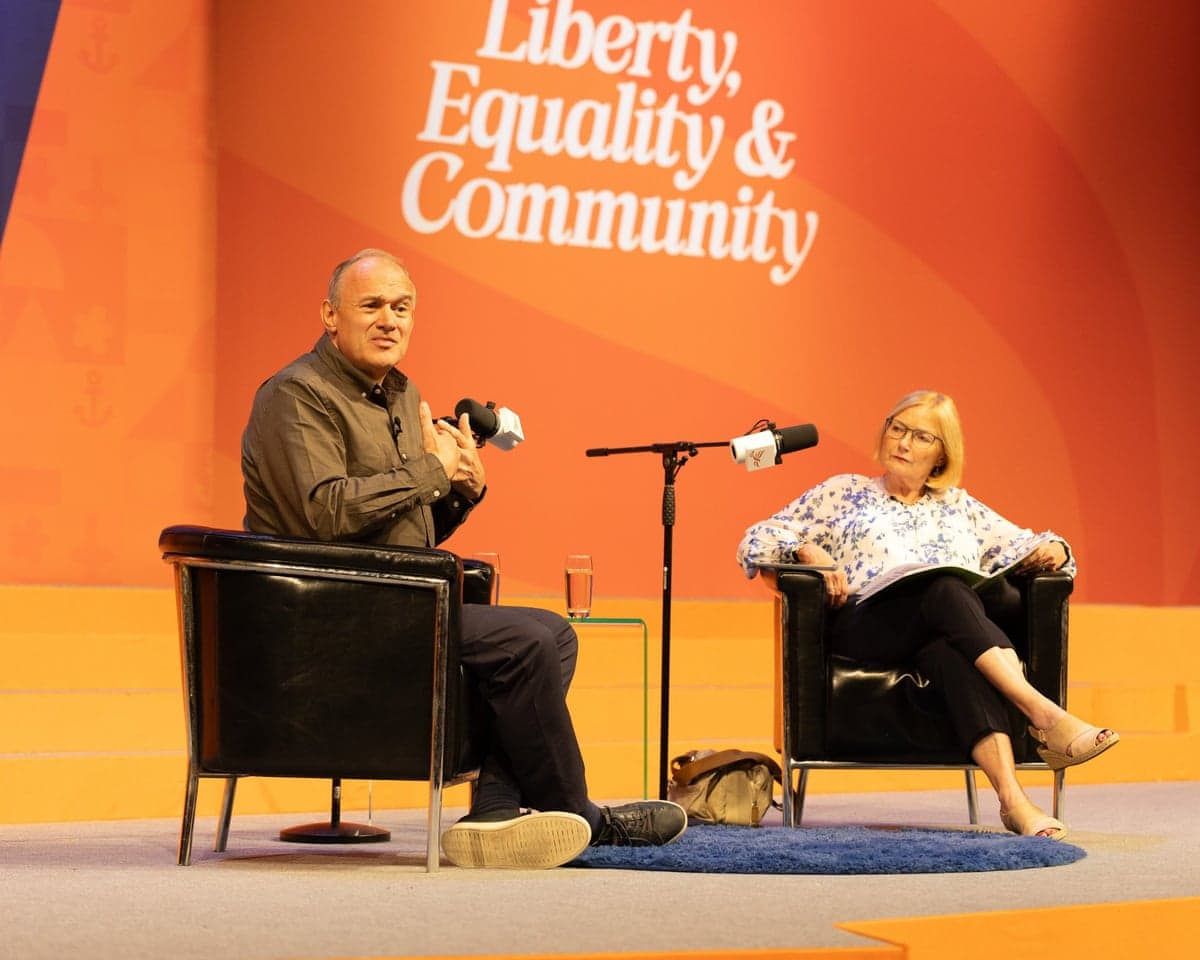
The Liberal Democrats have rejected official guidance issued by the equalities watchdog on how organisations should implement a supreme court ruling on transgender people, describing it as "discriminatory and unworkable". The motion, passed overwhelmingly at the party's annual conference in Brighton on 21 September 2026, makes the Lib Dems the first of the three largest parties in parliament to formally call for a replacement approach. The Greens have previously taken this position.
The formal code of practice released by the Equality and Human Rights Commission (EHRC) in May 2026 was designed to guide service providers on how to balance the rights of transgender people against the requirement for some facilities to remain single-sex. The guidance has drawn substantial criticism for functioning as a practical barrier to transgender people accessing many public spaces, by stipulating that single-sex toilets and changing rooms must exclude transgender men and women unless gender-neutral alternatives are consistently available.
According to reporting on the conference debate, members had selected the motion as an emergency item in advance of the debate, with the vote scheduled for Monday afternoon at approximately 5.10pm on 21 September. The motion stated that trans women are women and trans men are men, and committed the party to campaigning for a new EHRC code that is "inclusive, workable and ensures everybody can safely access public facilities and providers are protected from legal risk".
The conference motion characterised the EHRC's code as "discriminatory and unworkable", arguing it "places an undue burden on service providers". Beyond rejecting the current guidance, the motion calls for a revised code and the establishment of a dedicated cross-party parliamentary committee tasked with reviewing how the law should be reformed to better protect transgender people's rights.
What arguments were made in support?
Party member Lucas North, who proposed the motion, condemned the EHRC guidance and highlighted a documented rise in anti-transgender hate crimes. North stated that women's rights and transgender rights need not be framed as opposing forces in what they characterised as a manufactured culture war.
Rebecca Jones, another speaker backing the motion, described her experience as a transgender woman.
You now fear using public spaces. You fear anyone that looks at you too much in case they hate trans people enough that they put you at risk. All whilst your government repeats the words 'dignity' and 'respect', whilst doing everything in their power to ensure trans people do not have them.Jones added that she was
tired of being a culture war prop.

What objections were raised?
Opposition to the motion came from within the party itself. Mark Johnston, a councillor from Reigate in Surrey, argued that the motion would divert the party from the "realism" necessary to prevent Nigel Farage from becoming Prime Minister. Johnston contended that this realism required accepting the supreme court's determination from the previous year as final:
Are we going back to our constituencies to prepare for government, or are we going back to our bedrooms to prepare for irrelevance?
Zoe Hollowood, a party activist, urged the conference to accept the supreme court ruling, warning that passing the motion would send a message to women that
they are second-class citizens. Hollowood characterised the policy as disconnected from both public opinion and public priorities.
How did the party leadership respond?
Earlier on the day of the vote, party leader Ed Davey told a national broadcaster that he broadly supported the motion, describing the EHRC guidance as not "fit for purpose". The mood in the conference hall was strongly in favour of the motion, which passed easily on a show of hands.
According to reporting from 22 September, the Lib Dems formally adopted party policy to restore transgender rights after members backed the replacement of the EHRC guidance. The conference timetable had explicitly listed the debate as part of a broader agenda item titled "Restoring Trans Rights" during the Brighton conference, which ran from 19–22 September 2026.
What is the broader context?
The EHRC guidance implements a supreme court ruling that single-sex toilets, changing rooms, hospital wards and refuges must be used on the basis of biological sex. The code came into force earlier in 2026 and has sparked significant debate across the political spectrum. The Lib Dem conference motion represents an escalation of party opposition to the guidance, positioning the party distinctly on this issue ahead of potential future elections.
The decision also comes amid broader tensions within the left-leaning parties on transgender rights. Earlier in September, several major unions announced they would boycott Labour's Women's Conference after the party barred transgender women from the main hall in Liverpool, creating a dispute over equalities law and party policy.
What happens next?
Ed Davey's keynote conference speech was scheduled for the evening following the motion debate, providing the leadership with an opportunity to elaborate on the party's position. The Brighton conference continued through Tuesday 22 September 2026, with further policy discussions and leadership events scheduled before the conference concluded.