

The Law Society is to convene a Special General Meeting after 50 members wrote in to demand a debate over chief executive David Lavery's decision to provide a character reference for his cousin, a former schoolteacher convicted of indecent assault against pupils. Members are expected to vote on several motions, including one calling for Lavery's resignation, with the meeting due to be held within the next four weeks.
The controversy stems from a character reference Lavery gave to a court on behalf of William Lloyd-Lavery, a former teacher who was sentenced in April. According to a report from a national broadcaster, Lloyd-Lavery was convicted on six counts of indecent assault involving four girls aged between 13 and 14, and was sentenced to two years in prison.
What happened to William Lloyd-Lavery and how was the case first brought to light?
Two of Lloyd-Lavery's victims, Nicola Bannon and Lynne Darcy, had never met before coming forward separately with allegations dating back to the 1970s, before joining forces to help secure his conviction, as previously reported in our coverage of the case. Both women have since urged other survivors of abuse to come forward and pursue justice through the courts.
Why was David Lavery removed as a human rights commissioner?
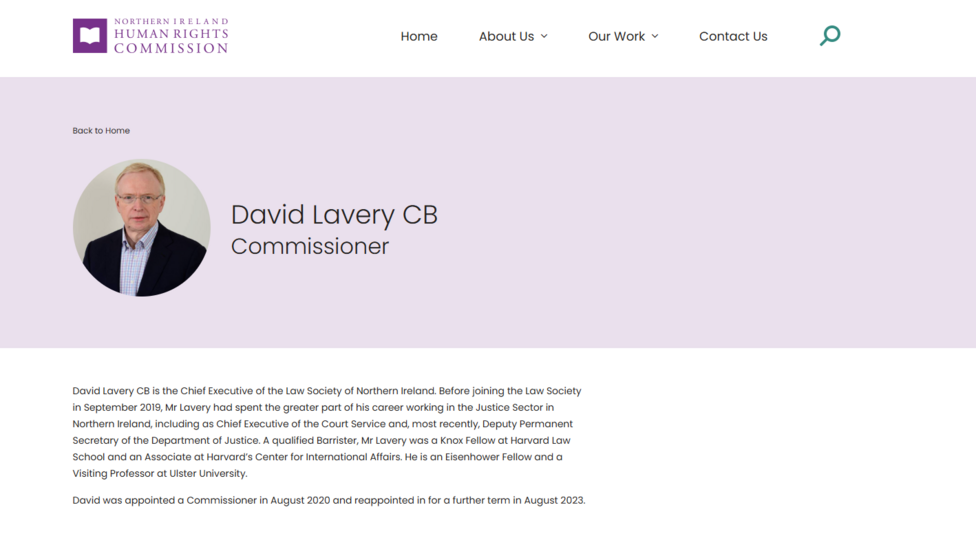
Lavery was dismissed last week from his separate role as a Northern Ireland human rights commissioner after an independent investigation by the Northern Ireland Human Rights Commission concluded he had breached its Code of Governance and was capable of bringing the commission into disrepute, according to the same broadcaster's report. The Secretary of State removed him from that post with immediate effect following the findings.
In a statement issued last week, Lavery apologised for his actions:

I profoundly regret that and I am committed to doing all I can to address it in the time ahead.
He had earlier acknowledged what he described as a \"serious error in judgement on my part in providing a character reference for my cousin and particularly for any hurt and distress that I caused the victims in this case.\"
The Law Society, meanwhile, said last week that it had \"undertaken an internal process\" but declined to comment further, citing the \"confidential nature of that process.\"
How have members and victims reacted to the Law Society's handling of the matter?
Solicitor Jonathan McKeown of JMK Solicitors, one of the members who requested the special meeting, said an independent investigation was needed to restore confidence in the organisation, and that he would accept whatever outcome resulted from it. Speaking to a BBC Radio Ulster breakfast programme, McKeown said:
The wider membership and the public now doubt the adequacy of what happened in relation into the investigation into Mr Lavery.
He argued the Law Society had failed to be sufficiently open about how it reached its decision, noting that the organisation's usual strength as a regulator — its ability to handle sensitive matters privately — worked against it in this instance because the issue touched on its public responsibilities.
The things that make the Law Society actually quite a good regulator is their ability to keep things in house and to keep them secret because they're dealing with sensitive information. The problem with this is this particular issue strays into their public functions and whether or not the public can have confidence and if the membership don't even know how the society came up with the decision, the membership can't reassure the public either.
McKeown further suggested the organisation had appeared more concerned with protecting its own reputation and internal processes than with engaging promptly with victims. He said the focus of criticism had shifted away from Lavery himself toward the conduct of the Law Society's senior leadership.
The issue for me is not what happened at the time. [Lavery] could have come out and publicly apologised, publicly reinstated the position and publicly ensured that he had regained the trust. I would be fully supportive of that.
The problem here is that people did not see the contrition from Mr Lavery... and now they're not seeing the contrition from the society.
Criticism has also come from beyond the legal profession. Nicola Bannon and Ulster Unionist Party leader Jon Burrows have separately called for Lavery to step down from the Law Society altogether, as detailed in our earlier report on those calls. Separately, according to the Belfast Telegraph, one of Lloyd-Lavery's victims said the Law Society's apology was \"well past its time\" and called for immediate reform of how character references are used in sentencing for sex offenders.
What happens next?
The Special General Meeting is expected to be convened within the next four weeks, giving members the chance to debate the motions and vote on whether Lavery should remain in his post. It remains unclear how the Law Society will respond publicly before then, given its stated preference to keep the internal process confidential.
Key Facts
- William Lloyd-Lavery was convicted on six counts of indecent assault involving four girls aged 13 to 14 and was sentenced in April to two years in prison.
- David Lavery, Law Society chief executive, gave a character reference for Lloyd-Lavery, his cousin, and apologised for a \"serious error in judgement.\"
- Lavery was removed last week as a Northern Ireland human rights commissioner after an independent investigation found he had breached the commission's Code of Governance.
- Fifty Law Society members requested a Special General Meeting, expected within four weeks, to debate motions including a call for Lavery's resignation.
- Victims and public figures, including Ulster Unionist Party leader Jon Burrows, have called for reform and for Lavery to resign.


