

Prolonged hot, dry weather across England has exposed traces of long-buried gardens and structures at historic sites including the Bishop's Palace in Wells, Glastonbury Abbey and Longleat House. The scorched grass has revealed formal garden layouts dating back to the 17th and 18th centuries, along with medieval drainage systems and the remains of old buildings, offering rare glimpses into each site's earlier history.
The effect occurs because grass growing over old flowerbeds, stonework or foundations tends to have shallower roots, causing it to dry out and discolour faster than the surrounding lawn. This creates visible contrasts in the grass that outline features long hidden beneath the surface.
What has been found at the Bishop's Palace in Wells?
James Cross, head gardener at the Bishop's Palace in Somerset, said drone footage had revealed signs of a formal garden in an area where staff had not previously suspected anything lay beneath the surface. He believes the markings correspond to a Dutch-style garden likely laid out around the middle of the 1700s.
They're showing up almost certainly Dutch-style gardens that were popular here, or at least laid out here, probably [in] the middle of the 1700s.
Cross described the vanished garden as featuring gravel pathways and hedging arranged in a highly symmetrical, formal design. He noted that visitors have responded with enthusiasm to the newly visible outlines.
It has been fascinating to find those Dutch-style gardens showing up in a spot that we didn't think there was actually anything.


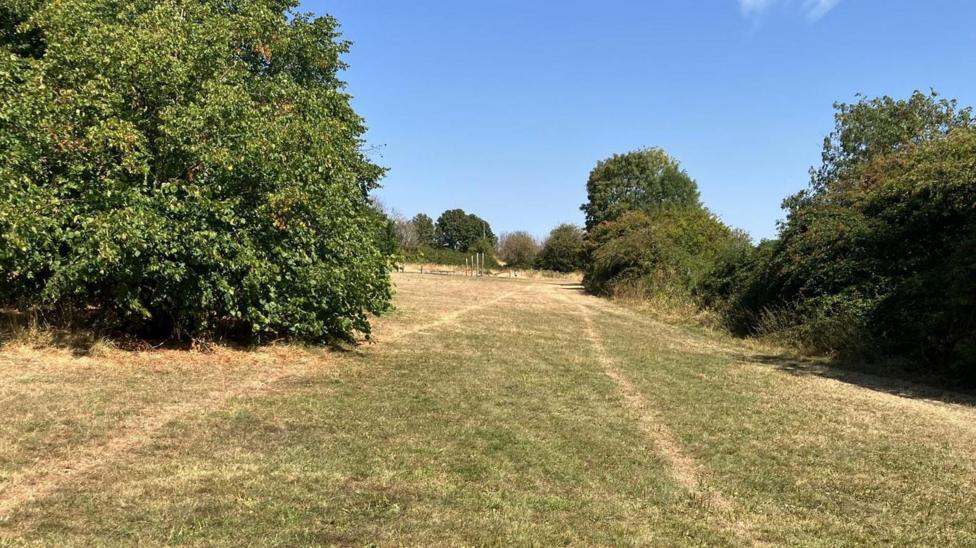
Why are medieval drainage lines visible in Stoke Park?
In Stoke Park, Bristol, faint lines stretching across a field have reappeared, marking the route of a drainage system historians trace back to the medieval period, when monks farmed the land. Steve England, an outdoor educator, horticulturist and historian, explained that monks dug trenches roughly a foot deep and packed them with crushed limestone to channel rainwater away from the fields.
They dug a trench, and they lined it about a foot deep with crushed limestone stones, basically gravel.
When it rains, all the rain is going to go into the little trenches and be filtered off somewhere, so it was drying up the land.
England said the buried stones absorb more heat than the surrounding soil, which kills the grass roots directly above them and makes the old trench lines stand out clearly from above.
This is what makes Stoke Park one of the more special places in Bristol - it's the fact that there's layer upon layer upon layer of history.
What has emerged at Glastonbury Abbey?
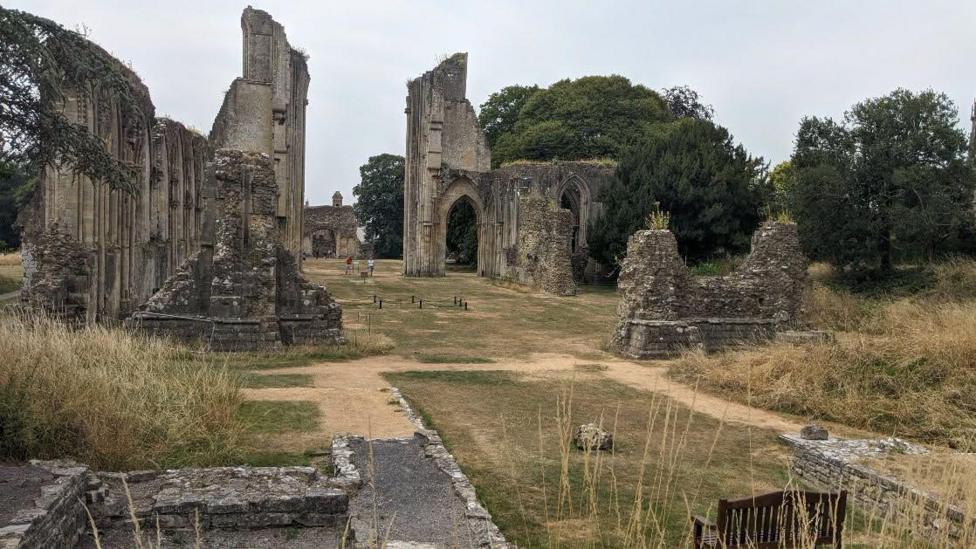
At Glastonbury Abbey, dried-out patches of grass have exposed the outlines of old foundations, stone columns and areas affected by earlier excavation work. Lucy Newman, the abbey's collections manager, said this year's markings have been unusually distinct.
This year in particular, they've been really sharp and really clear.
So it helps our visitors get an understanding of which bits of the Abbey [remain]... we've got a few bits and pieces where we've still got tall walls, but not very many, [so] it just gives that little bit of extra information on the ground.
What was discovered at Longleat House?
At Longleat in Wiltshire, the dry conditions have revealed the path of a


