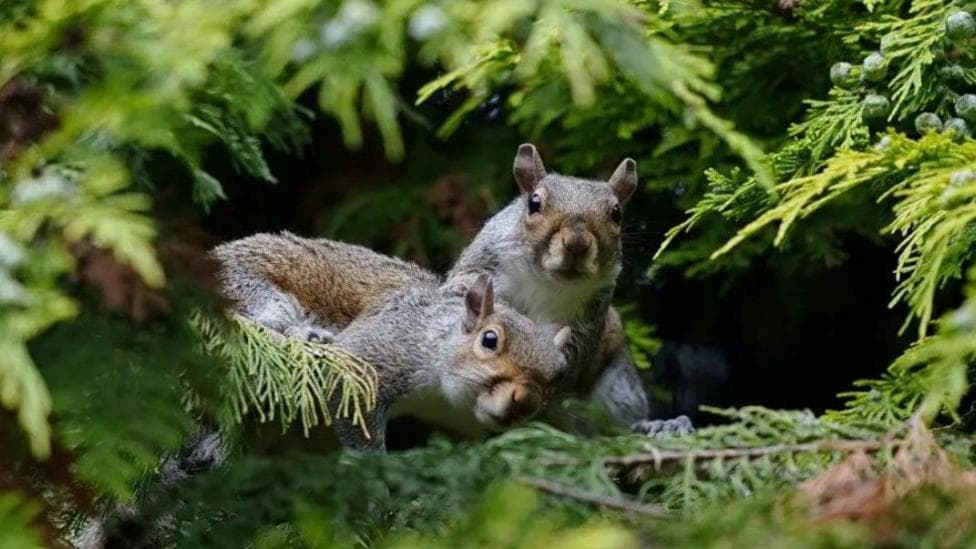
Native red squirrel populations across the United Kingdom have experienced a catastrophic decline over the past 150 years, plummeting from approximately 3.5 million to fewer than 300,000 today. The primary culprit is the grey squirrel, an invasive species introduced from North America that now numbers between 2.5 million and 2.7 million, according to Graham Paskett from the Red Squirrel Survival Trust. These competing populations cannot coexist, and conservationists warn that without urgent intervention, red squirrels could vanish from mainland England within 25 years.
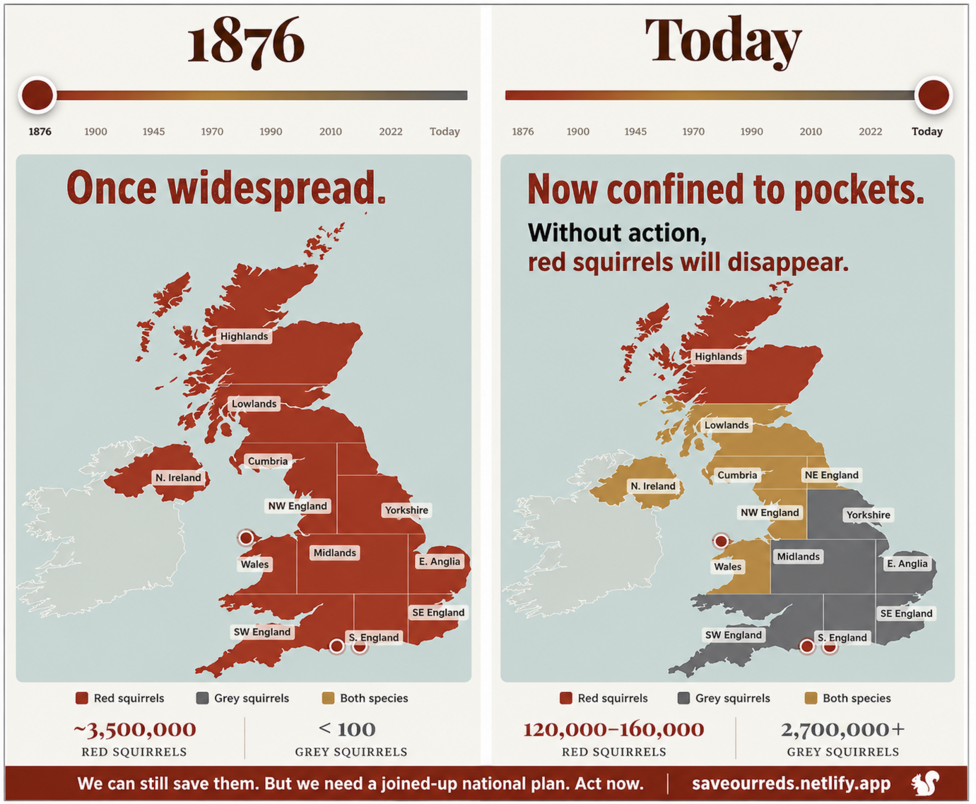
The situation has become particularly acute in England, where red squirrel numbers have contracted to alarming levels. The Woodland Trust estimates only 39,000 remain, though the Save Our Reds campaign suggests the figure may be as low as 15,000, including those in designated conservation areas such as Formby on Merseyside. According to recent reporting, the UK-wide population stands at between 120,000 and 160,000 individuals, with England accounting for the smallest share.
When did the grey squirrel invasion begin?
The documented introduction of grey squirrels to Britain traces back 150 years, when a Victorian banker named Thomas V. Brocklehurst released a pair he had brought from the United States into Henbury Park near Macclesfield in Cheshire. This single act of what was then considered aesthetic interest—Brocklehurst apparently believed the animals would look charming in his garden—set in motion an ecological crisis that would reshape Britain's woodland fauna. The initial importers could scarcely have anticipated the profound and lasting consequences of their decision.
Why can red and grey squirrels not share the same habitat?
Red and grey squirrels cannot coexist in the same location for two interconnected reasons. First, greys outcompete reds for food and habitat through sheer physical dominance and foraging efficiency. While they do not physically attack red squirrels, their presence creates constant pressure that displaces the native species. Jackie Foott of the British Red Squirrel conservation group explained that reds and greys "cannot coexist in the same location and that to protect the reds you have to 'get rid of the greys.'"
The second threat is far more sinister: grey squirrels carry squirrel pox virus, a pathogen that proves fatal to red squirrels.
The grey squirrel is a pest, non-native, invasive species, Foott stated, adding that
greys have squirrel pox - it doesn't affect them but they transmit it to red squirrels and it's fatal for them. It's a horrible disease and causes them ulcers and blindness.This viral transmission represents an almost insurmountable biological barrier to red squirrel survival in areas where greys have established themselves.
What economic damage do grey squirrels cause?
Beyond their impact on red squirrels, grey squirrels inflict substantial damage to Britain's forests and agricultural infrastructure. Foott noted that
people don't realise just how much damage they are doing to trees, crops and properties - they cause at least £40m damage to forests and forestry services each year.According to Natural England's England Red Squirrel Recovery Strategy, the annual damage figure in England and Wales alone reaches approximately £37 million, making grey squirrel management not merely a conservation priority but an economic necessity for landowners and forestry services.
What control methods are currently available?
Conservationists and land managers currently rely on lethal control as the primary tool for managing grey squirrel populations. Shooting and trapping remain the most widely deployed methods, though these approaches require sustained effort and coordination across fragmented landscapes. Foott acknowledged that
fertility control isn't available now - and has the effect of affecting other species, including reds, and that
gene therapy is probably at least 10 years away.For now, lethal control represents the only immediately effective option.

However, a promising alternative may emerge within the next five years. Paskett revealed that the Red Squirrel Survival Trust is jointly funding a field trial with the government's Animal and Plant Health Agency to test oral contraceptives delivered via specially designed hoppers. Because grey squirrels typically weigh around 500 grams—approximately double the weight of red squirrels—only they can access the contraceptive mechanism. If successful, this approach could allow landowners and forest rangers to voluntarily participate in a non-lethal population management scheme.
A further conservation tool gaining recognition is the reintroduction of pine martens, a native predator that evolved alongside red squirrels. Foott explained that
they do eat red squirrels but the reds know to quickly get out of their way and will send out the alarm signal to the rest of the colony. The greys are a little bit stupid and will say 'hello, I haven't seen you before' and the pine marten will get them!This ecological approach leverages natural predator-prey relationships to selectively target the invasive species.
What is the government's response?
Government action has intensified in response to the escalating crisis. On 29 January 2026, the Department for Environment, Food and Rural Affairs (Defra) and the Forestry Commission published a five-year grey squirrel policy statement for England designed to reduce harm to both red squirrels and woodlands. Natural England's recovery strategy concluded that large-scale coordinated grey squirrel suppression offers the best chance of red squirrel recovery, and that under a do-nothing scenario reds could disappear from mainland England within 25 years.
The strategy encompasses multiple approaches: increasing woodland habitat suitable for red squirrels, removing grey squirrels in areas where reds survive, and exploring contraceptive vaccines as a longer-term solution. The policy statement is intended to guide coordinated action over the next five years, with participation from conservation groups, landowners, and forest managers.
Red squirrel populations are now fragmented and primarily confined to the north of England, Scotland, and Ireland. In Scotland, the Saving Our Reds campaign received £1.9 million in August 2026 to continue conservation work for another two years, reflecting the scale of investment required to prevent extinction.
What happens next?
Multiple initiatives are underway to stabilise and recover red squirrel populations over the coming years. The Red Squirrel Recovery Network is pursuing a five-year project focused on habitat improvement, fertility control development, and volunteer-led population monitoring. A cross-border Red Squirrel Recovery Programme has secured funding for the next five years to build strongholds through habitat restoration and coordinated grey squirrel control across regions where both species currently exist.
The contraceptive hopper field trial is expected to begin later in 2026 or early in 2027, with results potentially available within five years. If successful, this non-lethal approach could transform grey squirrel management and offer a more publicly acceptable alternative to shooting and trapping. Until then, experienced British Red Squirrel volunteers continue working with farmers and landowners to suppress grey populations near remaining red colonies, a labour-intensive effort that underscores the commitment required to prevent the loss of Britain's native squirrel.