

About 200 military personnel, including soldiers from the 10 Queen's Own Gurkha Logistic Regiment, have been deployed to assist South Wales Fire and Rescue Service as crews continue what officials describe as a prolonged battle against multiple wildfires. Chief Fire Officer Fin Monahan said his service was under severe strain and expressed gratitude to seven other fire services and the armed forces for their assistance.
The military request was formally classed as Military Aid to the Civil Authorities, providing additional logistical and defensive tactical support after an extended hot spell placed heavy operational demand on emergency services, according to a regional broadcaster's report and Nation.Cymru. The UK government said a further 100 Armed Forces personnel would be sent to major incident areas as part of a broader national wildfire response, according to the UK government.
Why was the military called in?
Monahan said bringing in the armed forces was treated as a serious decision by both the UK and Welsh governments, but the extra resource had become necessary given the scale of the fires.
Monahan told the BBC the UK and Welsh governments took "a very serious step" in bringing in the military but the "extra capacity" was needed.
He explained that his firefighters possess specialist skills for tackling wildfires, and that military support allowed those skills to be directed precisely where they were most needed.
He said his firefighters have "very specialist skills" to tackle wildfires with military assistance enabling him to "focus all of that in the right place".
What have the soldiers been doing?
Troops have focused mainly on logistical tasks, including distributing water and helping build physical barriers to slow the spread of fire, freeing firefighters to concentrate on frontline suppression work.
Monahan described the soldiers as "doing an utterly phenomenal job digging trenches and also helping us build fire breaks".
"That has liberated lots of our firefighters to go and do their more specialist skills of firefighting."
The Gurkha regiment received support from 22 Engineer Regiment, the Royal Logistics Corps and army helicopters, with the Ministry of Defence noting that troops assisted with reaching remote terrain as well as logistics and water distribution, according to a national newspaper report and a national broadcaster's report.
Where are the fires burning?
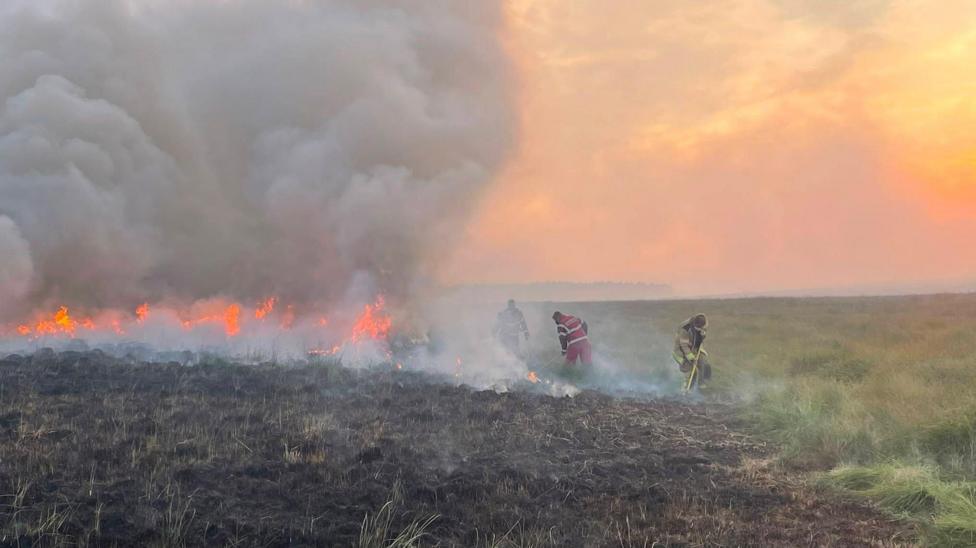
On Sunday, crews were tackling roughly 14 separate fires across south Wales. Mid and West Wales Fire and Rescue Service said teams were dealing with blazes at Rhandirmwyn and Ammanford in Carmarthenshire, and at Hay-on-Wye and Brecon in Powys.

Additional incidents were attended in Gorseinon, Swansea, and in Tenby, Pembrokeshire, along with a smoke-related call-out in Llanelli, Carmarthenshire.
How has the water supply been managed?
Monahan explained that the Welsh water system was already under strain, so military logistics units have been transporting large volumes of water from unaffected areas into the fire zones to avoid overloading local supplies.
"The Welsh water system is under pressure, so they're moving vast quantities of water from areas that we have it into areas where we're fighting the fire, so that we don't put too much pressure on the water system," he said.
"That's something people probably aren't aware of."
What have political and community reactions been?
Chris Bryant, MP for Rhondda and Ogmore, described a fire in Treherbert as severe and thanked firefighting crews sent from London to help contain it.
"Thankfully, there are fire engines from all over the UK and two helicopters have been in place all afternoon. I'm immensely impressed by the fire workers. But this can't be our new normal," he said, in a post on X on Saturday.
Monahan also credited the Royal Logistics Corps and Royal Engineers with keeping crews supplied with water throughout the operation.
Was the public warning system effective?
Monahan said the national emergency alert sent to mobile phones across England and Wales on Friday had been essential, though he voiced frustration that some members of the public still failed to grasp the risks involved.
"Even after that transmission, I stopped and found someone who was burning tyres underneath a tree. This is irresponsible behaviour," he said.
Separately, the UK government confirmed a temporary nationwide ban on disposable barbecues as part of its wider wildfire response, alongside the emergency alert warning of a very high national wildfire risk, according to the UK government.
What led to this level of response?
Fire chiefs said the request for military assistance followed an extended period of hot, dry weather that placed sustained operational pressure on services across Wales, according to a regional broadcaster's report. Earlier in the week, the First Minister of Wales said a multi-agency summit would be held to strengthen wildfire prevention and resilience, including consideration of specialist capabilities such as helicopters and further Ministry of Defence support, according to a government statement.
What happens next?
The Welsh Government said it stands ready to fund further military support operations should they be required, suggesting additional deployment decisions may follow depending on how conditions develop, according to Nation.Cymru. The First Minister said findings from the planned multi-agency summit would be shared with partners across the UK, pointing towards further resilience planning in the coming weeks, according to a government statement.
Key Facts
- About 200 military personnel, mainly from the Queen's Own Gurkha Logistic Regiment, are supporting fire crews in south Wales.
- Roughly 14 separate wildfires were being tackled across south Wales on Sunday, including in Carmarthenshire, Powys, Swansea and Pembrokeshire.
- 22 Engineer Regiment, the Royal Logistics Corps and army helicopters have provided additional logistical support.
- A UK-wide emergency alert was sent to mobile phones on Friday, alongside a temporary nationwide ban on disposable barbecues.
- The Welsh Government says it is prepared to fund further military support if conditions require it.


