

A national wildfire emergency alert sent to mobile phones across England and Wales on 14 August 2026 has triggered a political dispute after the Welsh-language version arrived on handsets in Wales roughly ten minutes ahead of the English translation.
According to the UK government, the alert was issued on a rolling basis from around 7pm and warned of a very high national wildfire risk, urging people to avoid disposable barbecues, firepits, garden incinerators and fireworks. The warning came as fire crews battled blazes across both nations, with South Wales and Mid and West Wales Fire Services having already declared major incidents.
Why did the alert go out in Welsh first?
Under the Welsh Language Act, the UK government is legally required to send such alerts in Welsh before English, and it aims to issue bilingual messages wherever possible. The Welsh Language (Wales) Measure 2011 remains in force and underpins this requirement. The government did not respond directly to the criticism but pointed to this legal obligation as the reason for the sequencing.
What did politicians say about the timing?
Reform UK's Laura Anne Jones, a Senedd member for South Wales East, questioned the wisdom of prioritising Welsh in a genuine emergency, arguing that speed should come first when public safety is at stake.
These alerts are welcome, when necessary, but Welsh first? And then 10mins later the English version? Really? When there is a severe national alert!?
No offence, but most people in Wales will be severely injured by the time they have google translated the alert!
Jones called for future alerts to be sent bilingually in a single combined message rather than two separate versions.
Conservative Senedd member for Vale of Glamorgan, Andrew RT Davies, went further, insisting the law itself needs to change so that emergency communications are always issued in English first.
The law must be changed to ensure emergency alerts and other important announcements are always made in English first.
Over 80% of people in Wales don't speak Welsh. Common sense must prevail.
Not everyone agreed with that assessment. Former international rugby union referee Nigel Owens defended the current approach, noting that the gap between the two versions was in fact no more than ten seconds, not minutes.

just how it should be as it is in every other country who are proud and using their native language.
How severe are the wildfires themselves?
The political disagreement unfolded against a backdrop of serious fire activity across Wales. A major incident was declared near Llandovery in Carmarthenshire, where dozens of homes were evacuated and roads were shut. Residents living near another blaze in south Wales described being frightened by the encroaching fires.
Military personnel and an Army helicopter were deployed to assist firefighters tackling a blaze in Cwmavon, in the Afan valley. Separately, a fire broke out on a mountain near Pleasant Heights in Porth, which police say was started deliberately; four 14-year-old boys from Porth have since been arrested on suspicion of arson and released on police bail. A further fire was reported above Cwm, Ebbw Vale, on the Friday evening.
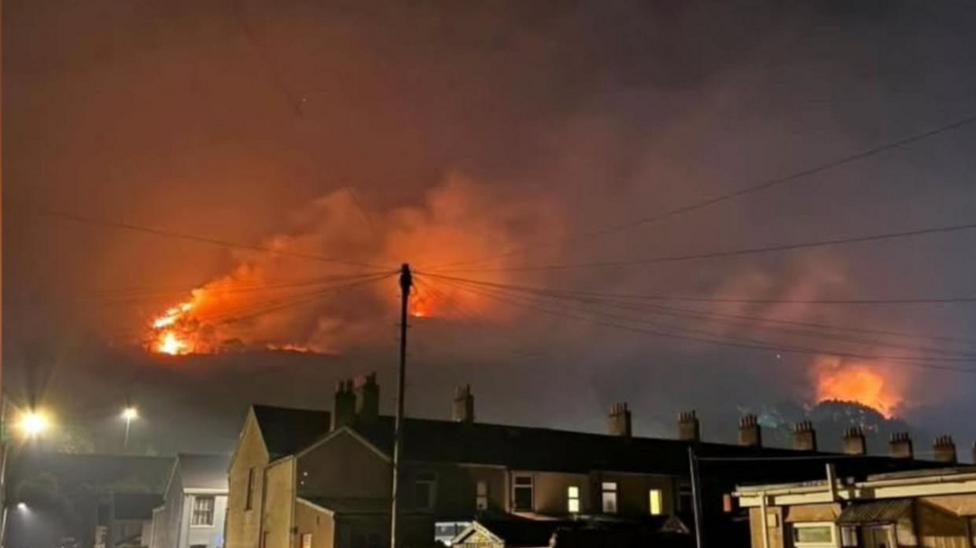
According to an official wildfire update, the blaze near Llangynidr Reservoir close to Ebbw Vale remained under control while crews worked to extinguish remaining hotspots and prevent it reigniting.
What extra support has the government provided?
Beyond the phone alert, the UK government's wider response included emergency funding for fire and rescue services, according to its own announcement. Around 100 military personnel were deployed to support firefighting efforts in South Wales, and a temporary nationwide ban on the sale of disposable barbecues was introduced as part of the same package.
The Mid and West Wales Fire and Rescue Service said crews were dealing with several significant incidents across the region on the evening of 13 August 2026, and it asked members of the public not to fly drones near the fires, warning that they can interfere with helicopter operations supporting the response.
What caused the wildfire risk to become so severe?
The Welsh government said the elevated danger stemmed from a sustained spell of extremely hot, dry weather that had already sparked multiple wildfire incidents across Wales before the alert was issued. Separately, live coverage from a national broadcaster reported that the alert had been requested directly by fire and rescue services, who wanted the public warned not to light fires given the very high nationwide risk.
What happens next?
The Welsh government has said it will continue coordinating with fire and rescue services and maintaining military support for as long as the wildfire risk stays very high. Fire services in Mid and West Wales are continuing to monitor ongoing incidents and suppress remaining hotspots to prevent flare-ups.
Key Facts
- The wildfire alert was sent to phones across England and Wales from around 7pm on 14 August 2026.
- Welsh-language alerts are legally required to be sent first under the Welsh Language Act, with the government citing roughly a ten-second gap before the English version, though politicians disputed the actual delay.
- Around 100 military personnel were deployed to support firefighting in South Wales, alongside emergency funding and a temporary ban on disposable barbecue sales.
- Four 14-year-old boys from Porth were arrested on suspicion of arson over a deliberately-lit fire near Pleasant Heights and released on police bail.
- A major incident remains in effect near Llandovery, Carmarthenshire, with dozens of homes evacuated.


