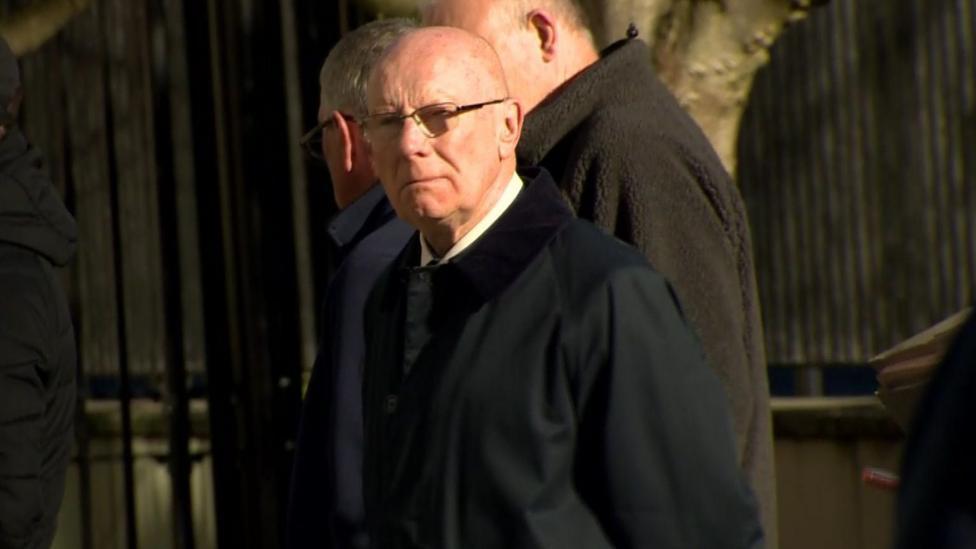
The retired police officer who led the investigation into the 1998 Omagh bombing has told an official inquiry that he believes a covert agent was involved in carrying out the attack. Retired PSNI Chief Superintendent Norman Baxter gave evidence to the inquiry sitting in Belfast on Thursday, stating his conviction that one of those who transported the bomb to the County Tyrone town was working as an intelligence source. According to BBC News, Baxter served as the senior investigating officer from May 2002 until his retirement in November 2008.
The bombing on 15 August 1998 killed 29 people, including a woman who was pregnant with twins, making it the deadliest single atrocity of the Troubles. The Real IRA claimed responsibility three days after the explosion, apologising to civilian victims and claiming its targets had been commercial premises. To date, no one has been convicted of the murders in a criminal court, though in 2009 Michael McKevitt, Liam Campbell, Colm Murphy and Seamus Daly were ordered to pay a combined £1.6m in damages to the relatives—a ruling that faced subsequent appeals.
During his testimony, Baxter stated with emphasis:
I believe, just for total clarity, that one of the people who brought the bomb to Omagh on the day was an agent.He also told the inquiry that he believes crucial information about the bombing was
deliberately hiddenfrom investigators, which
preventedthose involved from being identified. Using a metaphor about the investigation's scope, he explained:
After the bomb exploded the chief constable said no stone would be left unturned and I'm sure he genuinely believed that. The problem was that people had hid some of the stones. So the investigators couldn't find the stones to look under. Not accidentally, deliberately hidden to prevent the investigators finding out.
Baxter highlighted what he saw as systemic failures in how the investigation was managed.
At an organisational level, there was a failure to ensure that all the stones that were to be unturned, were still you know, available to be looked at.His concerns about information being withheld have taken on added significance as the inquiry progresses. On 9 November, former RUC Chief Constable Ronnie Flanagan told the inquiry he was unaware of reductions in the Omagh investigation's hours and staffing, though RTE News reported that evidence included a November 1998 log showing further cuts to the team.
Appointment to a 'poisoned chalice'
Baxter described his appointment as senior investigating officer as a
poisoned chalice, noting that he had joined the Royal Ulster Constabulary in 1980 and served 22 years in the police but only two and a half years as a detective when selected for the role. He suggested the assignment reflected an unfortunate allocation:
I was the one who lived west of the province, and I was the one who probably, and I don't mean this with any disrespect to the families, but one probably drew the short straw in terms of the allocation of it.
He was told at the time that he would be
closingthe investigation as it transitioned into a maintenance phase, with the expectation that
by the time I assumed the role....there would be no proactive investigations required.Baxter also told the hearing that he considered himself the
least qualifiedsenior investigating officer to hold the position.
Lack of formal detective training
At his appointment, Baxter had received no formal training as a detective. He attended a one-week course only after taking up the role, describing his formal preparation as
absentbut noting he had
life learned, life experienceto draw upon. His workload expanded significantly over the years as he took on additional responsibilities, leaving him with progressively less time to dedicate to the Omagh inquiry. During the period he served as Omagh SIO, he was simultaneously managing other substantial investigative duties.
Could the bombing have been prevented?
In 2009, Baxter gave evidence to the Northern Ireland Affairs Committee about the investigation, making a stark observation about the pattern of attacks:
I think it is inconceivable that in mainland UK, if you had a series of bombs happening every week or two weeks, that there would not have been arrests and that there would have been government intervention to ensure this group was disrupted.He confirmed to the inquiry that he still stands by that assessment.
Baxter expressed his belief that the suspects identified in connection with the bombing had been active terrorists for many years, including in the period leading up to the Omagh attack. Had those individuals been disrupted, he told the inquiry, there was a
high level of probability Omagh could have been prevented.This assessment aligns with earlier testimony heard by the inquiry; BBC News previously reported that inquiry counsel said evidence would examine a warning from a senior Garda officer that a bomb was heading north the day before the attack, and a Newry operation intended to secure the Banbridge corridor.
The inquiry's broader investigation is examining multiple aspects of the bombing and the official response. The inquiry's terms of reference include examining alleged intelligence passed by agent Kevin Fulton between June and August 1998, intelligence gathered through GCHQ monitoring, and whether authorities could have prevented the bombing. An earlier phase of the inquiry had identified 27 individuals as key figures linked to the attack, though the inquiry emphasised that identification does not necessarily indicate they are suspects.
What happens next
The inquiry's published schedule indicates its next sitting will take place on Monday 9 November, with the Week 5 Chapter Three hearing schedule due to be published on 6 November. The third phase of the inquiry began on 21 September 2026 and is scheduled to run for at least five weeks, hearing witness testimony about the circumstances of the 1998 attack.