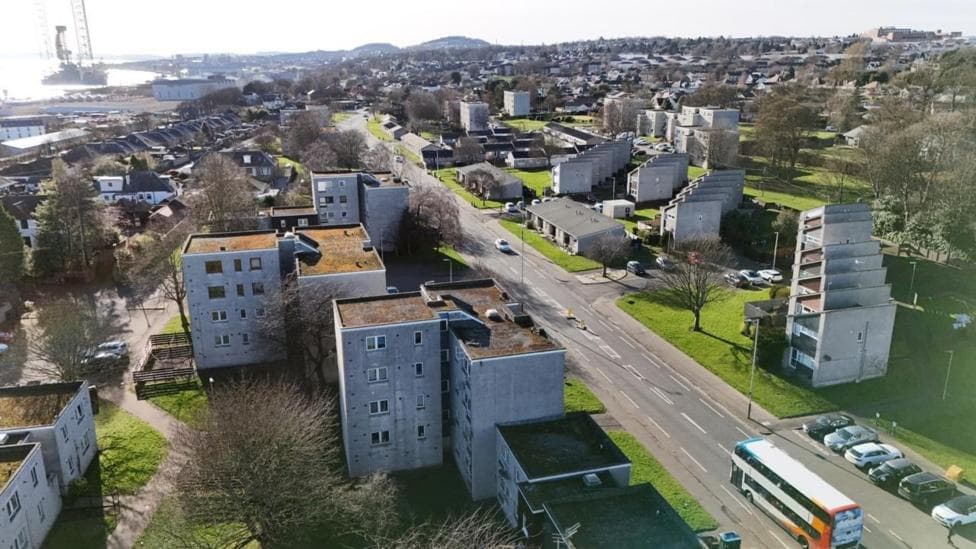
Dundee City Council has given approval to a £21m repair programme targeting homes affected by reinforced autoclaved aerated concrete (RAAC), a material that poses significant structural risks. The scheme will address council-owned properties and buildings where the local authority holds a financial interest, with the council committing to seek financial support from both the UK and Scottish governments to assist private homeowners. According to BBC News, almost 1,000 homes in the city contain the defective material—the highest concentration anywhere in Scotland.
The repair plan encompasses 783 properties across Dundee: 546 council-owned and 237 privately owned. Of these, 171 cottages and 175 top-floor flats face the most direct impact from roof work or potential temporary relocation. The projected cost of £21.654m will be spread over five years, concluding in 2030/31.
RAAC was widely used in flat roofing, floors and walls between the 1950s and 1990s as a cheaper, faster-to-produce alternative to standard concrete. The material is aerated—resembling the structure of an Aero chocolate bar—which makes it lighter and quicker to install. However, this same characteristic creates a fundamental weakness: the bubbles allow moisture to penetrate the material, leading to structural degradation. The Health and Safety Executive (HSE) has warned that RAAC is now beyond its intended lifespan of approximately 30 years and could
collapse with little or no notice.
Unlike traditional reinforced concrete, RAAC behaves differently structurally and is particularly vulnerable when exposed to water. The protective coatings applied to RAAC—such as bitumen on roofing panels—can themselves degrade over time, removing a critical barrier against moisture ingress.
How will the repairs work?
The council's solution involves installing a support structure beneath the RAAC using plywood, timber joists and, where necessary, steel beams, rendering the RAAC structurally redundant. This approach allows the defective material to remain in place while transferring its load to new, reliable supports.
What support is available for private homeowners?
The council has stated it cannot offer direct financial assistance to private property owners affected by RAAC. The authority has formally requested help from the Scottish Government, but was informed that no additional funding is currently available. The council continues to advocate for a dedicated funding mechanism to support homeowners who cannot afford repairs independently.
What is the timeline for repairs?
Dundee's approach builds on earlier progress. The council approved a £500,000 pilot scheme in the previous year, which installed new roof structures beneath RAAC in five vacant properties to test the support-and-redundancy method. If the full scheme receives final approval, the first phase is scheduled to commence in January 2027, with work beginning at 48 properties on Whitfield Avenue and Kirk Street, including four privately owned homes.
Why is Dundee particularly affected?
Craigie Drive is among five areas in Dundee where RAAC has been identified in significant numbers. The city's concentration of nearly 1,000 affected homes reflects the widespread use of RAAC in Scottish construction during the post-war decades, when cost and speed of construction were prioritised over long-term durability.
The RAAC crisis extends beyond Dundee. Across Scotland and the UK, thousands of properties contain the material, prompting demolition and repair programmes in multiple locations. In Aberdeen, demolition began on more than 500 properties containing RAAC as part of a phased programme estimated to exceed £150m. In Greenock, seven blocks of flats face demolition due to unsafe RAAC, though residents have expressed concerns about the lack of clarity regarding timescales and support arrangements.
Key Facts
- Almost 1,000 homes in Dundee contain RAAC—the highest number in any Scottish local authority area
- RAAC has a design lifespan of approximately 30 years and is susceptible to structural failure when exposed to moisture
- The repair scheme will cost £21.654m over five years and cover 783 properties, with 171 cottages and 175 top-floor flats most directly affected
- The council cannot provide financial support to private homeowners and has requested dedicated funding from the Scottish Government
- Repairs will use support structures of plywood, timber joists and steel beams to make RAAC structurally redundant