

A record share of 18-year-olds in the UK have secured university places this year, but the sharpest rise in acceptances was at the most selective, "higher-tariff" institutions, including many Russell Group universities, according to figures from the Universities and Colleges Admissions Service (Ucas). Acceptances at these higher-tariff universities climbed by 5.5% compared with last year, while medium-tariff institutions saw a 3.8% rise and lower-tariff universities recorded a 1.7% fall.
The pattern has prompted questions about whether elite universities are filling their courses even when applicants fall short of the grades they were originally offered, at a time when the higher education sector is under sustained financial pressure.
What do the numbers show?
Ucas data confirms that higher-tariff universities posted the largest year-on-year increase in acceptances of any tier, at 5.5%, well ahead of medium-tariff providers on 3.8%. Lower-tariff universities were the only group to see acceptances fall, down 1.7% on the previous year. The divergence has fuelled debate about whether the most selective institutions are becoming more flexible with entry requirements to fill places.
Why are top universities accepting more students?
Nick Hillman, chief executive of the Higher Education Policy Institute (Hepi), argued that selective universities were absorbing a disproportionate share of strong applicants, describing the trend as institutions "hoovering up all the crumbs" when it came to top students, even those who narrowly missed their offers.
"Universities are like every other institution, they want to be bigger and better next year," said Nick Hillman, chief executive of Hepi. "If you can recruit good students, why wouldn't you?"
Hillman said that admitting more students allowed universities to keep less popular courses, such as modern languages, running and helped stave off staff redundancies. He added that a significant drop in international student numbers, who are largely postgraduates paying higher fees, meant universities were redirecting resources towards domestic undergraduates instead.
Is the Russell Group lowering its standards?
The Russell Group rejected suggestions that rising acceptance numbers reflected weaker entry standards, insisting its members remain highly selective while congratulating the 2026 cohort of new students.
"While there is always some flexibility in admissions decisions, this should not be confused with lowering standards. Our universities will only admit students who show evidence of being able to succeed on the course."
Duncan Ivison, president and vice chancellor of the University of Manchester, said applicants had worked hard to earn the places they received.
"We're not cutting our standards," he said. "We want our students not just to pass, but really flourish and do well. You can't admit students who aren't going to be able to take advantage of the opportunity that universities are offering."
The University of Manchester reported receiving more than 100,000 applications for the first time this year, a 13% increase, with roughly 8,000 further conversations expected to take place through Clearing on results day alone. For scale, the University of Manchester currently enrols around 46,305 students in total, according to a university enrolment comparison, including roughly 10,025 international first-degree students, per the Complete University Guide's international student figures. University College London, another large Russell Group institution, enrols about 51,315 students in total, including 12,245 international first-degree students, according to the same sources.

How are students experiencing results day?
For Stephen, an A-level student at Carmel College in St Helens, results day brought an unexpected turnaround after New College, Oxford, confirmed his place to study law despite him missing the grades in his original offer.
"When I opened my slip, I was initially really disappointed. I'd been made an offer of three As. I came out with ABB," he said. "Then it was miraculous, I opened my Ucas form and I'd had my place confirmed. I'm absolutely over the moon."
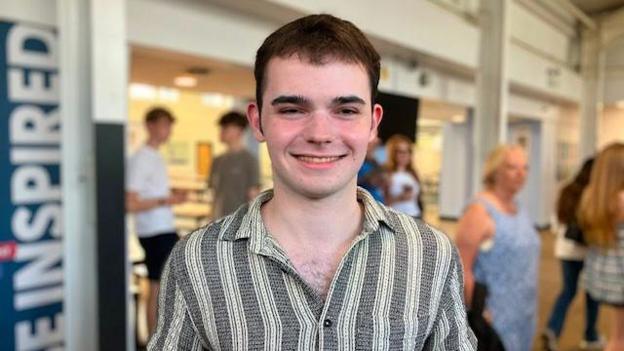
Niamh, who studies at the same college, had a similar experience. She had set her heart on studying midwifery at Edge Hill University in Ormskirk, Lancashire, but was initially turned down at the application stage over her grades. She had been preparing to try again through Clearing when the university offered her a place about a month ago. She said she was "really happy" and hoped to "empower women" and "leave an imprint on their lives" through her future career.

What do university leaders say?
Universities UK, which represents 142 institutions, pushed back on the idea that the shift in acceptances was simply a case of top universities grabbing as many students as possible by relaxing grade requirements. Chief executive Vivienne Stern said the grade profiles being accepted were largely consistent with previous years.
"more or less identical to the pattern in previous years"
Stern said there were many legitimate reasons why offer requirements might vary, including some courses being under-d, and that the sector's financial difficulties may have amplified scrutiny of admissions without changing the underlying pattern. She pointed to "checks and balances" built into the system.
"The important thing is we've got a system which regulates universities on outcomes," she said. "You can recruit a student, but we're going to hold you to account. It's not in the interest to recruit a student who is not well equipped to succeed."
Not every institution is seeing rising intakes, however. A report from Times Higher Education found that some providers saw intakes fall by as much as a third in the latest Ucas figures, underlining how unevenly the recruitment gains have been spread across the sector. For broader context, the UK's largest single institution by enrolment remains the Open University, with 133,265 students, according to a comparison of UK universities by enrolment, far outstripping any campus-based Russell Group member.
How does this fit into the wider picture on university costs?
The debate over admissions comes just days after A-level, T-level and BTec results were released across England, Wales and Northern Ireland on 13 August 2026, amid growing discussion of technical qualifications and record vocational entries. It also follows separate reporting that average student debt among English graduates fell to £47,730 in 2026 as new, lower-interest Plan 5 loans entered repayment, even as tuition fees and living costs continue to rise, questions that have shaped scrutiny of whether expanding intakes at selective universities represent good value for students.
What happens next?
Hillman said universities were likely "breathing a sigh of relief" at the strong acceptance numbers, but cautioned that the real test of how well-matched students are to their courses would only become clear once the new academic term begins and outcomes such as continuation and completion rates start to emerge.
Key Facts
- Higher-tariff university acceptances rose 5.5% year-on-year in 2026, compared with 3.8% for medium-tariff and a 1.7% fall for lower-tariff institutions.
- The Russell Group says admissions retain "flexibility" but insists standards have not been lowered.
- The University of Manchester received more than 100,000 applications for the first time, up 13%, with about 8,000 further Clearing conversations expected on results day.
- Some providers saw intakes fall by as much as a third, according to Times Higher Education reporting on the latest Ucas data.
- Average English graduate debt fell to £47,730 in 2026 as new Plan 5 loan terms took effect.


