Labour is enjoying a “Burnham bounce” after Andy Burnham became prime minister almost a fortnight ago, with opinion polls and a convincing Greater Manchester mayoral by-election victory both pointing to an improvement in the party’s position. Polling in the last week has put Labour in the mid 20s, its highest level since the beginning of last year, but Reform remains narrowly ahead or close enough to keep Labour from feeling confident about a general election.
The latest figures suggest the boost is real, but not transformative. Labour is still well short of the 35% it won at the 2024 general election, and Reform’s recent fall appears to owe at least as much to its own problems as to Labour’s recovery.
What is behind the new PM effect?
The idea that a new prime minister can lift a party’s standing is well established, and the current “Burnham bounce” is far from unprecedented. Recent mid-term changes of prime minister have usually been followed by a rise in support for the governing party, even if the effect has often been temporary.
“It is not unusual for a new prime minister to enjoy a poll bounce”
Support for Labour rose by seven points after Gordon Brown replaced Tony Blair in 2007, while the Conservatives saw a six-point bounce when Boris Johnson took over from Theresa May in 2019. The only exception among recent changes was Liz Truss’ arrival in Downing Street in 2022, which was overshadowed shortly afterwards by the death of Queen Elizabeth II.
The scale of the challenge Burnham inherited also matters. When Sir Keir Starmer resigned, Labour was on 19%, the lowest poll rating handed over by any prime minister leaving mid-term, and even below the 23% left by Liz Truss when she stepped down after just 45 days in office.
That made some kind of short-term rebound highly likely once Burnham replaced the deeply unpopular Sir Keir. Even so, Labour’s current average remains the lowest ever recorded for a newly installed mid-term prime minister, and the party is still far behind the relatively low 35% it achieved at the 2024 general election.
How significant was the Greater Manchester by-election result?
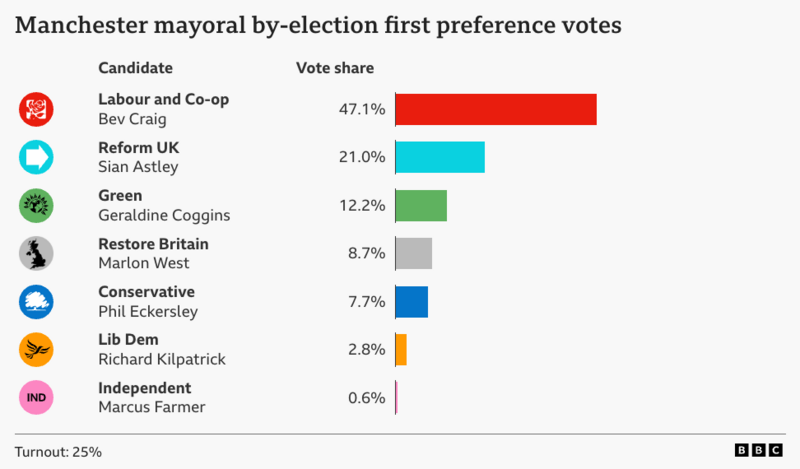
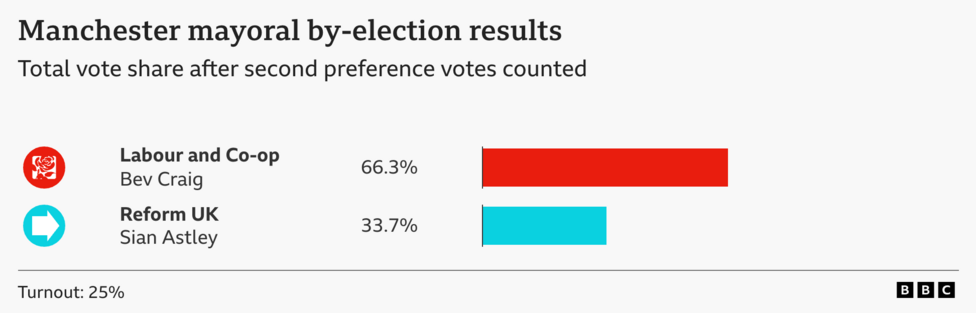
Labour’s victory in Thursday’s Greater Manchester Mayoral by-election was convincing, even if the numbers were lower than the party’s strongest recent performances. Labour’s 47% share of the first preference vote was well down on the 63% Andy Burnham won in the last mayoral contest shortly before the 2024 general election.
But the result was still a marked improvement on recent local and national performance. It almost doubled the 24% Labour recorded across the region in May’s local elections, and it was also four points higher than Labour’s tally locally in the 2024 general election. On that basis, it was a stronger outcome than current national polling would have suggested.
Why is Reform under pressure?
Reform’s problems are a major reason Labour has been able to move ahead in some polls. Burnham has ruled out an early election, which is not surprising given Labour’s position is still only marginally stronger than Reform’s.
Reform’s loss of first place in the polls for the first time in more than a year seems to reflect its own difficulties more than a dramatic surge for Labour. The party has been dogged by questions in recent weeks about whether some of its funding came from legal sources, and whether Nigel Farage should have declared to the Commons’ authorities some of the funding he received before becoming an MP.
After those allegations, Farage announced on 7 July that he was standing down and would put himself before voters again in a by-election in his Clacton constituency, scheduled for 13 August.
This move appears to have backfired. Before Farage’s announcement, Reform’s average polling stood at 27%; in the polls conducted immediately afterwards, it dropped by three points to 24%, where it remains and which is its lowest level for 15 months. Farage’s own personal poll ratings are now the weakest they have been since he returned as Reform’s leader during the 2024 election campaign.

In the Manchester by-election, Reform’s share of the first preference vote was nine points down on its performance across the region in May’s local elections. As in the Makerfield by-election, the party also appears to have been affected by the progress made by Rupert Lowe’s breakaway group, Restore Britain, which won nearly 9% of the Manchester vote and outpolled the Conservatives.
Without Reform’s difficulties, the “Burnham bounce” would probably not have been enough to put Labour ahead in the national polls.
How have the Greens been affected?
The main source of Labour’s improvement has been the recovery of voters from the Greens and the Liberal Democrats, both of whom have fallen by two points since Burnham’s uncontested victory in the Labour leadership contest. The Greens have been hit particularly hard, because much of their improved support in recent months came from disappointed Labour voters from 2024.
The Greens are now on 11%, which is as much as four points lower than where they were when Sir Keir announced he was leaving. The scale of Labour’s recovery among these voters is clear: when he resigned, 14% of Labour’s 2024 voters said they would now back the Greens, but that figure has since fallen to 9%.
Winning back former Labour voters has generally been a central feature of the Burnham bounce. Overall, 67% of those who voted Labour in 2024 now say they would vote for the party again, compared with 57% when Sir Keir said he was leaving Downing Street.
Following Farage’s difficulties, Labour is also losing fewer of its 2024 voters to Reform. However, the Conservatives are in the same position, despite historically losing far more support to Reform than Labour has during this parliament. Rather than suffering from a Burnham bounce, Kemi Badenoch’s party has moved up to 20% in the polls for the first time since last spring.
Burnham’s arrival has given Labour fresh hope, but the party still has to prove it can win back the working-class pro-Brexit voters that Labour once regarded as its core support and who now form the heart of Reform’s base. To do that, and to put Labour on track for victory in 2029, Burnham will need to deliver on the policy challenges facing his government, which remain as formidable as those that confronted Sir Keir.
In the end, Labour’s prospects at the next election will depend on whether voters believe that what Burnham has said he will do is actually being delivered.
John Curtice is Professor of Politics, Strathclyde University, and Senior Fellow, National Centre for Social Research and The UK in a Changing Europe
More from InDepth
Why Andy Burnham will find it so tricky to unite Britain
Burnham's 'Manchesterism' got him to No 10 - but will it work for the UK?
Our exclusive behind-the-scenes access at No 10 as Andy Burnham became PM
BBC InDepth is the home on the website and app for the best analysis, with fresh perspectives that challenge assumptions and deep reporting on the biggest issues of the day. Emma Barnett and John Simpson bring their pick of the most thought-provoking deep reads and analysis, every Saturday. for the newsletter here

Get in touch
Are you personally affected by the issues raised in this story?