

A power failure lasting just 90 seconds at Network Rail's operations centre in Manchester triggered widespread disruption for rail passengers across the North West of England, exposing how a single point of failure can ripple across the national network. Although the outage was resolved almost instantly, backup systems failed to activate as intended, leaving signalling equipment damaged and forcing trains to a standstill for far longer than the initial incident itself.
According to the Telegraph, the underlying cause was a transformer fault in the Ardwick area of Manchester, which knocked out power to roughly 5,000 homes in addition to the Rail Operating Centre itself. The Telegraph also reports that the centre sits near Ashburys station, and that the resulting disruption stretched into a second day, with National Rail cautioning that cancellations and altered journeys would likely continue until at least midday Friday.
What actually happened at the operations centre?
The fault struck at a facility that functions as the nerve centre for train movements across a large swathe of northern England. Network Rail's operating centres house the equipment that allows trains to run safely nationwide, and the Manchester site is responsible for coordinating rail traffic throughout much of the North West. When the local power supply failed, the centre's backup system was expected to take over seamlessly — but it did not respond quickly enough, according to the company.
Chris Wright, Network Rail's north-west route director, said the organisation was still working to establish precisely what had gone wrong.
"We didn't experience a 90-second interruption," he told the BBC, insisting the company's systems were back online sooner.
He added that certain communications systems had behaved unexpectedly and subsequently needed to be reconfigured or replaced.
"We've got to work really hard very quickly now to understand why that's the case," he added.
Because the fault affected signalling — the equivalent of the railway's traffic-light system — trains were forced to stop running. While control systems could be rebooted relatively quickly, some of the physical equipment governing signalling had been damaged and required replacement parts, extending the repair time considerably. Given how heavily used parts of the North West network are, and the number of trains and crews left stranded in the wrong locations, the knock-on effects proved substantial.
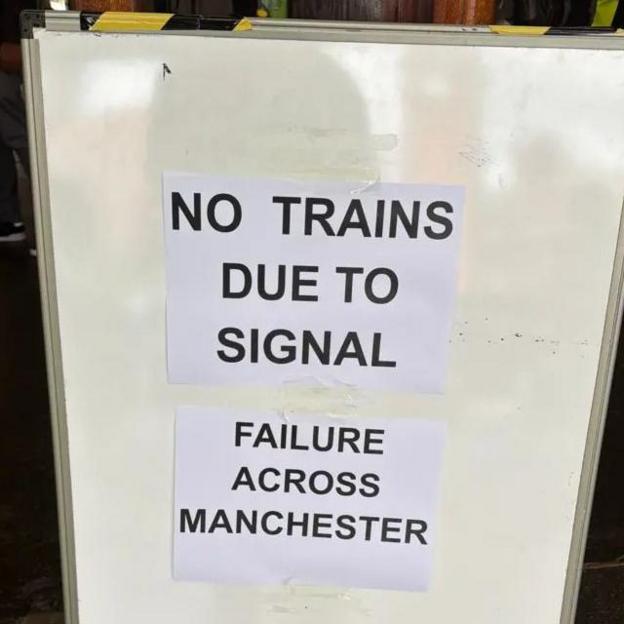
How long did the disruption last?
Network Rail said its engineers worked through the night following the fault, and that by the next morning most services had resumed, although some disruption lingered. Separately, the Telegraph reported that National Rail expected knock-on delays and cancellations to persist until roughly midday Friday before the network returned fully to normal — meaning the effects of a 90-second power blip stretched across two full days of travel disruption.
Network Rail has issued an apology to affected customers and launched a formal investigation into the incident. Company bosses say engineers are working to build additional resilience into the signalling systems in an effort to prevent a repeat occurrence.

Why did such a short outage cause such a big problem?
Network Rail has spent recent years consolidating its infrastructure into 12 Rail Operating Centres across Great Britain, replacing what had previously been hundreds of separate, localised signal boxes. These centres were designed as high-tech hubs that centralise control over large sections of track, offering efficiency gains over the older, more fragmented system. Manchester's Rail Operating Centre opened in 2014 as part of this modernisation drive.
Rail industry experts argue that this consolidation carries an inherent trade-off: while it streamlines day-to-day operations, it also means that a fault at any single centre can disable a much larger portion of the network than would have been possible under the old system. Rail writer Christian Wolmar summarised the dilemma this way.
"If one thing goes wrong, it can wipe out, as we saw, quite a lot of the network," he said, adding: "So really they've got to start thinking about both resilience, but also whether the centralisation of all the signalling and communications into a very small number of places is the right thing to do."
Is this linked to other recent rail problems?
There is no direct evidence connecting this specific outage to other issues that have recently affected passengers, such as speed restrictions and infrastructure failures brought on by extreme heat. Nonetheless, the incident is unlikely to reassure a travelling public already frustrated by years of patchy operator performance, industrial action and rising fares — even though regulated fares have been frozen in England this year.
This is not the first time a technical fault has caused significant rail disruption in Britain this year. In May 2026, a radio communication fault disrupted services across South England, including routes to London Victoria and the West Coastway line, as detailed in our earlier coverage of that incident. A similar dynamic played out on a larger scale in Germany in June 2026, when Deutsche Bahn was forced to suspend all national services after a failure in its digital railway radio network, as reported in our coverage of the German rail network disruption.
Rail engineer and commentator Gareth Dennis linked the Manchester incident to broader funding and staffing pressures facing Network Rail, questioning whether the organisation has enough personnel to properly maintain critical infrastructure.
"Are their staff suitably resourced? Are there enough staff to be ensuring that things like those checks of that supply are happening?" he asked.
How is Network Rail funded, and what's changing?
Network Rail operates under five-year government funding settlements, with the current period having begun in 2024. The government has committed £44.1 billion for the 2024-29 cycle of the organisation's strategic business plan — an increase of £3 billion over the previous five-year settlement. Despite the increase, rising costs driven by inflation and a growing frequency of extreme weather events have placed the budget under significant strain.
When the new business plan was unveiled, former Network Rail chief executive Andrew Haines acknowledged that the constrained budget would require funding to stretch further than it ever had before. The government's current rail strategy involves bringing passenger operators that remain outside public ownership under state control — a process that has already partly occurred under previous Conservative governments — before merging train operations and infrastructure management into a single new body, Great British Railways.
Under this plan, Network Rail is expected to be dissolved as a standalone entity. In anticipation of that shift, joint management structures have already been established in some regions, including the South West. The broader question of how much public money should go toward supporting passenger services versus infrastructure investment remains contentious, particularly as government budgets remain tightly constrained.

What happens next?
Network Rail says its engineers will continue investigating the root cause of the failure and will keep working to strengthen the resilience of signalling systems to guard against a similar breakdown in future, according to the Telegraph. National Rail had projected that residual disruption would clear by around midday Friday, restoring services to their normal timetable after two disrupted days.
Key Facts
- A 90-second power failure hit Network Rail's Manchester Rail Operating Centre, near Ashburys station, just before 14:00 BST on a Thursday.
- The fault stemmed from a transformer problem in Ardwick, Manchester, which also cut power to about 5,000 homes, according to the Telegraph.
- Backup power systems failed to engage quickly enough, damaging signalling equipment and causing disruption across at least eight rail operators.
- Disruption stretched into a second day, with National Rail expecting normal services to resume by midday Friday.
- Network Rail has apologised, launched an investigation, and pledged to add resilience to its signalling infrastructure.


