Approximately 60 migrants who endured more than 30 hours aboard a small boat crossing the English Channel were redirected to Dover by water on Tuesday evening, according to Caroline Dinenage, the Conservative MP for Gosport. The decision came after initial reports suggested the vessel would arrive in the Hampshire town, triggering a significant gathering of anti-migrant protesters at the local marina.
The dinghy had departed from the Normandy coast on Monday morning, reportedly leaving from Jobourg, marking one of the longest small-boat crossings on record. The French coastguard, which monitored the vessel throughout its journey, reported that the approximately 60 people aboard were in "precarious conditions" and had refused assistance, stating they were "determined to take all risks to reach" the UK.
British rescue operations began on Tuesday after the crossing had been under way for 36 hours. The Royal National Lifeboat Institution (RNLI) was tasked by HM Coastguard just after 11:00 BST to assist with the vessel. The lifeboat service stated it was asked to remove people from the dinghy "out of concern for their safety and their deteriorating health" before Border Force vessels could reach the scene. The UK's Maritime and Coastguard Agency indicated that those rescued would be transferred to Border Security Command.
The French coastguard's account placed migrants on the boat for more than 33 hours, while the RNLI's timeline suggested the crossing had extended to 36 hours by the time British rescue boats arrived. Reports confirmed the group comprised approximately 60 migrants, consistent with French authorities' initial assessment.
Why did protests erupt in Gosport?
The Home Office initially communicated to Dinenage that it was becoming "increasingly likely" the migrants would be brought to the Portsmouth area, acknowledging such a decision would be "far from ideal". The department stated that any decision to bring a vessel ashore there would only be taken "where operationally necessary and following careful consideration of all available options".

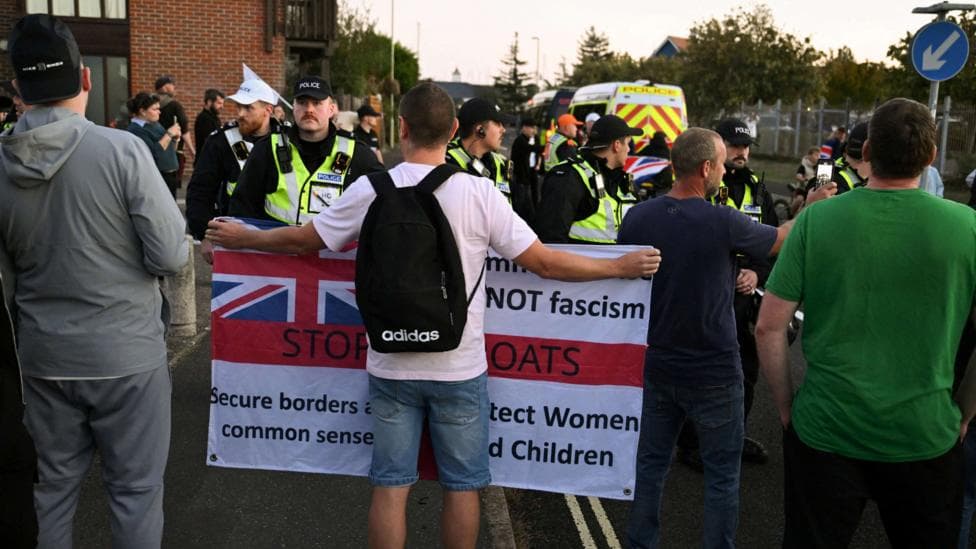
This announcement prompted hundreds of protesters, along with police, to gather near the marina in Gosport on Tuesday evening. Among the crowd were men wearing black clothing, several with face coverings, positioned at the front of the demonstration. Chants of "send them back" were heard from sections of the assembled protesters.
Daniel Thomas, known as Danny Tommo and a long-term campaigner against migrant crossings, shared a YouTube livestream of the boat from the Channel. Thomas had recently organised protests in Portsmouth and Dover, reflecting broader anti-migrant activism across the region. Earlier in September, similar protests involving masked demonstrators blocking roads and chanting "stop the boats" had occurred in Dover and Portsmouth following the arrival of another vessel carrying around 140 migrants.
How was the situation resolved?
Around 19:00 on Tuesday, Dinenage announced on social media that Border Force had intercepted the small boat and was taking those aboard eastward to Dover by water. She stated:
"This is a good result. All day I have been making the case to the Home Office that this boat should not disembark in Gosport."The boat reportedly arrived in Dover early on Wednesday morning after being directed along the coast rather than being brought ashore in Hampshire.
At approximately 20:30, the demonstrators dispersed from the Gosport protest site. Hampshire & Isle of Wight Constabulary subsequently reported that six people had been arrested in Gosport on Tuesday evening after protesters "became hostile towards officers".
What makes this crossing unusual?
The dinghy appeared to have launched from close to Vierville-sur-Mer, a village west of Bayeux in Normandy. Such a westerly departure point is rare for small boat crossings, which typically originate from beaches closer to the Strait of Dover. The crossing from Jobourg to Hampshire represented approximately 68 miles, described as one of the longest small-boat crossings recorded. Earlier in September, a separate dinghy that had launched from near Cherbourg in the Bay of the Seine—also further west than typical departure points—was brought ashore in Hampshire, triggering protests in Portsmouth.
What happens next?
The Home Office told Dinenage that the migrants would be transferred "as quickly as possible" to reception facilities in Kent, with no plan for them to remain in Hampshire beyond immediate operational needs. The government stated:
"The Border Security Command works around the clock to protect our border and will continue to detain, check and process every small boat arrival."
Key Facts
- Approximately 60 migrants spent more than 30 hours at sea before being intercepted by British rescue boats on Tuesday
- The dinghy departed from Jobourg in Normandy on Monday morning and was redirected to Dover rather than Gosport following protests
- The crossing represented one of the longest small-boat journeys on record, with the westerly departure point being unusual for Channel crossings
- Six arrests were made in Gosport after protesters became hostile toward police officers
- The migrants were to be transferred to reception facilities in Kent for processing by Border Security Command