Choosing a heating system involves far more technical detail than most people expect to encounter. Floorplans, air duct diagrams, and heat pump specifications can overwhelm those shopping for a new installation. Yet a surprising number of homeowners are diving deep into these specifics, determined to understand exactly what their properties need.
This story was first reported by BBC News.
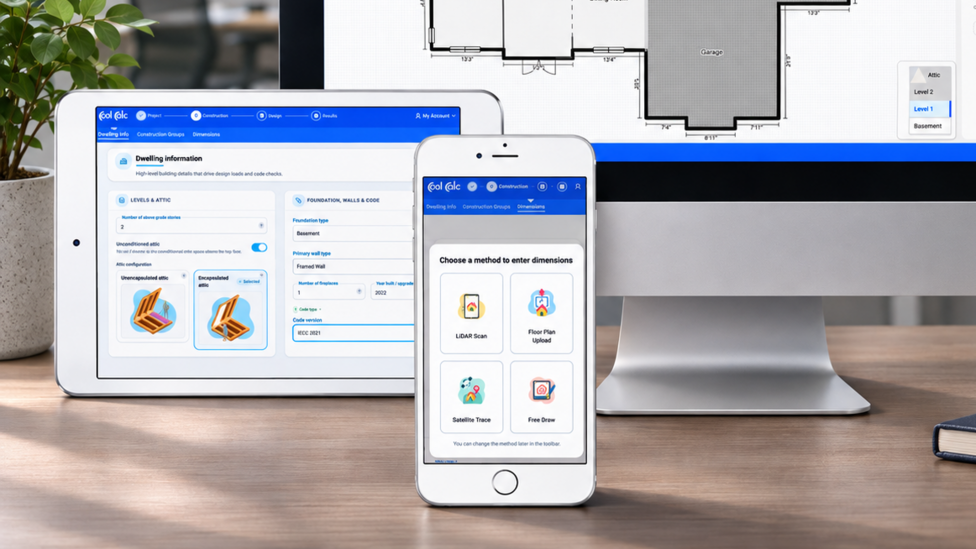
According to BBC News, roughly 150 new users daily to Cool Calc, an application that calculates the heat requirements of properties across the United States. Just over one third of these new users are private homeowners rather than professional tradespeople, says founder and chief executive Bill Fiore. The trend reflects growing consumer skepticism about accepting a tradesperson's recommendations without independent verification.
What is a heat loss calculation and why does it matter?
A heat loss calculation is a measurement, typically expressed in watts, that quantifies how much thermal energy a building loses during cold weather. Engineers determine this figure by analysing each room individually, and it forms the foundation of any efficient heating system design. The calculation becomes especially critical when installing a heat pump, which must be sized with considerable precision based on the projected heat loss.
If this calculation proves inaccurate, the consequences are significant. An undersized heat pump will struggle to maintain comfortable temperatures throughout the property. Conversely, an oversized system wastes energy and money. Given the substantial investment involved, homeowners understandably want to ensure installers get this right.
How accurate are professional heat loss calculations?
Recent research raises serious concerns about the quality of calculations provided by heating professionals. Kevin Kircher at Purdue University and colleagues conducted a study examining heat loss calculations supplied by tradespeople to approximately 75 US homeowners. The findings were troubling: the calculations frequently overestimated design heat loads by a factor of two or more, resulting in systems far larger than necessary. Some homeowners reported being charged more than $1,000 for a heat loss survey alone, with one case reaching $2,500.
The problem extends beyond wasted money. Dan Dempsey, a former senior engineering fellow for a major heating and cooling provider in the US and participant in Kircher's study, has spent years monitoring heating system performance in homes across Indiana by analysing data from smart thermostats. He observes that oversized systems create a cycling problem: they switch on and off in rapid succession rather than running steadily. This constant switching produces noticeable temperature fluctuations, leaving rooms unable to maintain their target temperature of around 20°C (68°F), creating discomfort for occupants.
What role does artificial intelligence play in heating advice?
Homeowners seeking information increasingly turn to AI chatbots, but Fiore warns this approach carries significant risks. "People are going to AI and they're getting a lot of misinformation because it's not backed by anything credible," he explains. Cool Calc is planning to integrate with AI systems to improve the quality of guidance these tools provide, recognising that unreliable information could lead to poor heating decisions.
What tools are available for homeowners to calculate their own heat loss?
Several free or partially free applications now allow homeowners to estimate their property's heat requirements. Cool Calc and AutoHVAC serve users in the United States, while UK homeowners can access Heatpunk, a web-based tool. These applications typically allow users to draw a floor plan and input property details—insulation levels, glazing type, radiator size, and other factors—to estimate heating performance.
Heatpunk, operated by Midsummer Energy, attracts thousands of monthly users, predominantly professional installers. The platform goes further by recommending specific heat pump models tailored to each property's calculated requirements, naturally drawing from Midsummer Energy's product range. "It's been a very effective marketing tool," acknowledges founder and managing director Andy Rankin.

Dwellow, a UK heat pump installation company, recently launched its own heat loss estimator, recognising the value of encouraging homeowners to conduct preliminary "self surveys." Co-founder and director Ian Mclaren suggests this approach could streamline professional surveys: "Going into a home and just being able to check the information rather than start from scratch could turn a survey into a half-hour trip – far more efficient and less costly."
How do new regulatory standards address sizing problems?
Regulatory bodies are beginning to tackle oversizing directly. New York City HPD's August 2026 right-sizing guidelines now require documented room-by-room load calculations and equipment selection based on performance at local design temperatures. The guidelines specify a heating indoor design temperature no higher than 72°F and, for New York City, a typical outdoor heating design temperature of approximately 13°F. Critically, the rules prohibit unjustified oversizing beyond established industry limits.
These standards reflect a broader recognition that heat pump capacity varies significantly with outdoor temperature. A 2026 building-safety analysis illustrates this problem: a standard 3-ton heat pump delivers 22,000 Btu/h at 17°F and only 17,000 Btu/h at 5°F, compared with its nominal 36,000 Btu/h rating at 47°F. Installers must account for this performance degradation in cold climates.
What is the proper methodology for heat pump design?
Industry standards establish a three-step design sequence: ACCA Manual J calculates heating and cooling loads, Manual S selects appropriate equipment, and Manual D designs the ductwork. Code requirements vary by location and local amendments, meaning standards differ across jurisdictions.
Should homeowners do their own heat loss surveys?
Experts remain divided on whether homeowners should attempt their own calculations. Adam Chapman, chief geek at Heat Geek, a heat pump training firm and installer network, questions the value of this approach. "I don't personally see what a homeowner would gain from it," he says. Chapman argues that only the most meticulous surveys capture a home's true heat loss, and that homeowners often miss critical details invisible to the untrained eye.
Chapman points to common oversights his installers discover: retrofitted windows that lack proper foam insulation around their frames, leaving draughty gaps, or cavity walls that homeowners believed had been insulated but were actually missed during construction. "It's stuff you can't see," he explains. "What we actually need is home surveys that go and spot for these sorts of things."
Maurizio Sibilla, of the Centre for Advanced Built Environment Research at the University of West England, Bristol, takes a middle position. He emphasises that professional engineers must maintain high standards, but argues the real solution involves multiple components: "The solution is better installer practice, clearer customer-facing evidence, and improved methods, not expecting homeowners to do the engineering themselves." Sibilla suggests that providing homeowners with information about the calculation process and post-installation performance data can reassure them that their system operates as designed.
What broader context shapes heat pump adoption?
The debate over heat pump sizing occurs against a backdrop of broader challenges facing heat pump deployment. UK heat pump installations grew by just 7 percent last year following government support cuts, according to climate watchdog assessments, raising concerns about meeting climate targets. Meanwhile, rising electricity costs are challenging the economic case for heat pumps, prompting questions about whether affordable power may ultimately prove more important than clean power in achieving net zero goals.
Proper sizing becomes even more critical in this context. An oversized system not only wastes energy but also increases operating costs at a time when electricity prices are already straining household budgets. Ensuring heat pumps are correctly matched to actual property requirements protects both environmental and financial outcomes.