

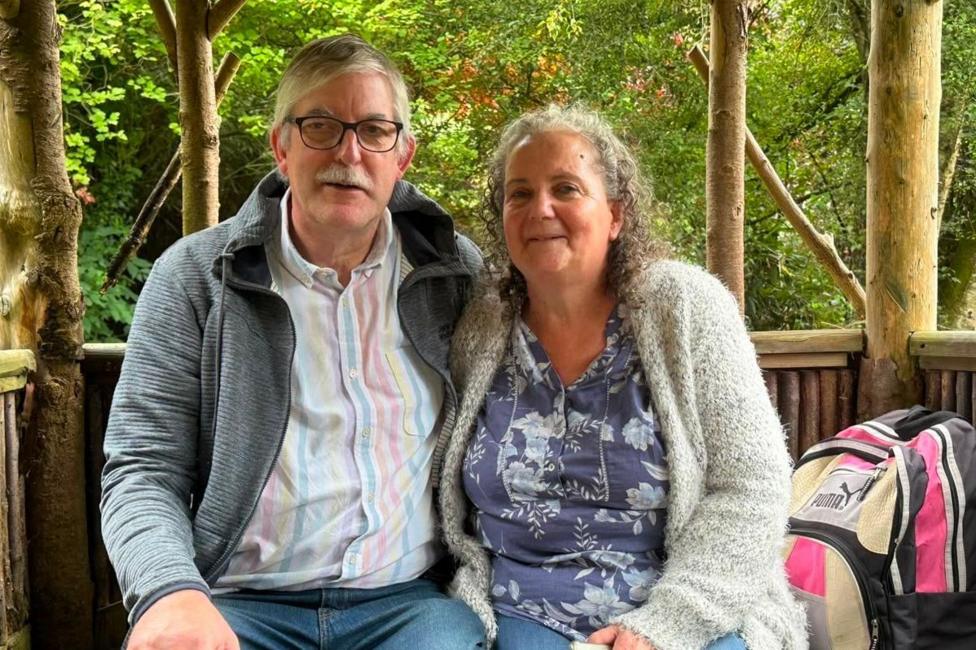
Alan Dutton, 60, from Burton near Wrexham, said he removed his wife Julia, 63, from Wrexham Maelor Hospital and took her home because he feared she was not safe there, after staff were, in his words, "too busy" to properly monitor her. Julia has a benign pituitary gland tumour that affects her ability to recognise when she needs to eat or drink, and she had been admitted with dehydration. Alan said he stayed at her bedside for 28 hours before deciding to take her home himself.
He said he arrived at the hospital's A&E car park to find her standing outside with her bag packed to leave, still attached to an intravenous tube, which made clear to him that she had not actually been discharged.
"She rang me to say... I've had the drip, I am coming home. I literally jumped in the car, drove to the hospital and I found her standing outside A&E with her bag ready to come home," Dutton said.
"I spoke to the nurses and I said... 'You can't just let a vulnerable patient walk out… she's in your care. This is not good enough'."
What happened after she was taken back inside?
Staff brought Julia back into a treatment room, reconnected her to fluids, and later transferred her to an observation unit. Alan said he remained with her overnight and into the following evening because he was worried she was not being adequately watched over, noting there were stretches of time when no member of staff checked on her at all.
He said there weren't enough nurses, there weren't enough healthcare assistants and there weren't enough beds, adding she was on a trolley the whole time, as were other patients.
Alan said he did not blame frontline staff for the situation, but rather management failings, describing the hospital as trapped in a "vicious circle." He ultimately decided to take her home himself a few days later, once she had eaten, even though further tests had been scheduled.
How is the family coping now?
Alan said keeping his wife eating and drinking at home has become a round-the-clock task, and he described it as unsettling to think they might have no option but to return to an emergency department he sees as already stretched to its limit. He said he currently sees no alternative pathway for urgent specialist treatment, even though some clinicians have told him A&E is not the right setting for her condition.
He credited the endocrinology and mental health teams now supporting his wife through outpatient appointments, though he said their efforts are limited by broader pressures on the system.

What has the health board said?
Betsi Cadwaladr University Health Board, which runs Wrexham Maelor Hospital and covers the whole of north Wales, has been in special measures for nine years. It was recently told by Health Minister Mabon ap Gwynfor that this was its final opportunity to improve, with the Welsh government stepping in more directly and an expert panel expected to report back by the end of October.
Tehmeena Ajmal, the health board's chief operating officer, said she was "very sorry" whenever a patient felt they had not received proper care.
"We want patients to engage with us and tell us where they feel care could have been improved or where it has worked for them," she said.
"We take note of every interaction and they help us to understand where we can strengthen services, where necessary, and/or find resolutions."
Alan said he is now weighing up whether to lodge a formal complaint with the health board, though he stressed he remains thankful to the staff who looked after his wife.
"[They] really are working under very difficult circumstances," he said. "They're doing everything they can. The problem is the system they're working in."
How does this fit into wider concerns about hospital overcrowding?
This case follows a series of similar incidents at hospitals across Britain that have drawn scrutiny over emergency care conditions. In one earlier case, an elderly patient spent 24 hours in a narrow hospital corridor where her catheter was accidentally dislodged twice by passing trolleys. In north Wales specifically, an elderly woman died alone in a crowded A&E corridor at Ysbty Glan Clwyd, another hospital run by Betsi Cadwaladr, prompting investigations by both the health board and the Welsh Government.
According to a further report from a national broadcaster, a separate patient with a terminal illness was left waiting in a hospital corridor for 36 hours, underscoring how widespread concerns about overcrowding and delayed care remain across the health service.
What happens next?
The Welsh government's expert panel overseeing Betsi Cadwaladr's special measures status is due to report back by the end of October. Alan Dutton said he is still deciding whether to file a formal complaint about his wife's treatment, while the couple continue to manage her condition at home ahead of a possible referral for surgery at Walton Medical Centre in Liverpool.


