

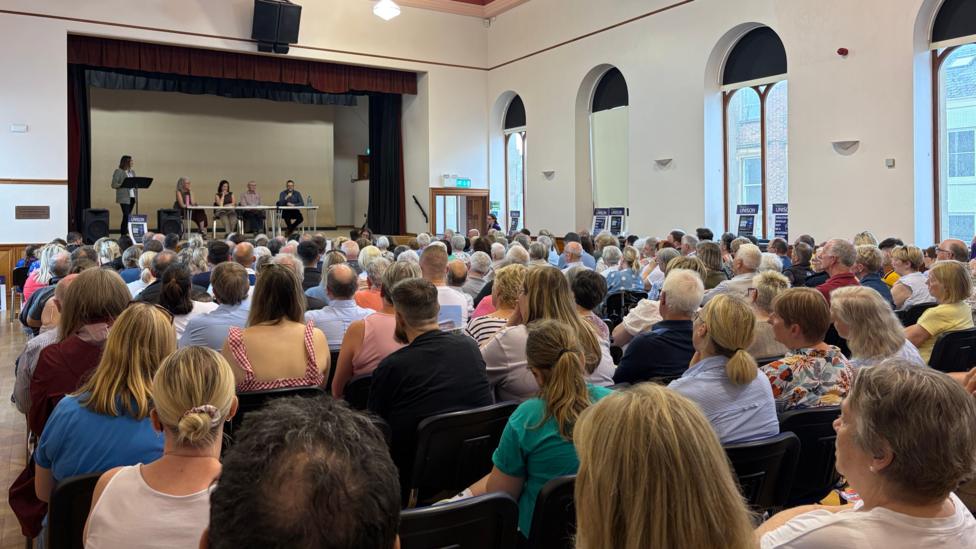
More than 200 people packed Coleraine Town Hall on the evening of the meeting to demand that Health Minister Mike Nesbitt block plans to transfer emergency general surgery (EGS) from Causeway Hospital to Antrim Area Hospital. Campaigners argued that removing the service would trigger a wider collapse of care at the hospital, while the Northern Health Trust maintained the change was needed to keep surgical services safe and sustainable. The proposal cannot proceed unless Nesbitt formally signs it off.
Gemma Brolly, of the SoS Causeway Hospital campaign group and deputy leader of Aontú, told the gathering that the scale of the turnout reflected the depth of public concern.
When emergency surgery goes, other dominoes fall following that.
What we're hearing is about this wonderful vision of a diagnostic and elective surgery hub. But you heard from the professionals tonight, nobody will want to be invested in that if they don't have emergency surgery on site as well. There's a strong message going out - it's time to start listening and it's time to turn things around because we're not going anywhere.
What is the Trust proposing and why?
In May 2025, the Northern Health Trust's board backed a recommendation to consolidate emergency general surgery at a single site rather than splitting it between Causeway and Antrim Area hospitals. Under the plan, elective general surgery — planned, lower-complexity procedures such as gallbladder removal — would continue to be delivered at Causeway, which the Trust wants to develop into an elective and diagnostic hub serving the wider north-west.
A Trust spokesperson said the current arrangement, which sees emergency inpatient surgery split across two acute sites, has become increasingly difficult to sustain.
The current model of providing emergency general surgery across two sites is becoming increasingly unsustainable and our preference is for a planned and managed change to avoid potential service collapse.
Our ambition is to further develop Causeway Hospital as an elective and diagnostic hub for the entire north-west area.
The recommendation followed a 14-week public consultation. The Trust has said Causeway will remain a 24/7 emergency department and acute inpatient hospital regardless of where emergency surgery is centralised, and that no change to the existing service model will take effect until the health minister makes his decision.
How have those affected responded?
Rebecca Gill, who attended the meeting, said she had a difficult experience travelling to Antrim Area Hospital during her pregnancy after maternity services were relocated from Causeway in 2023.
My concern is that with emergency services - particularly emergency surgery - it's much more unforgiving.
Unfortunately when we need emergency surgery we don't have the luxury of time to travel to another hospital. My main concern is that people who need these services won't get them.
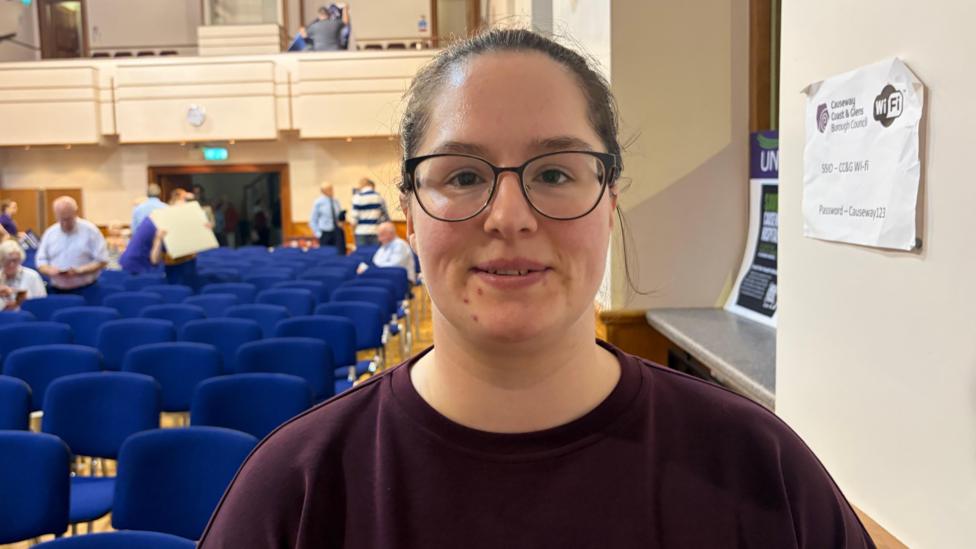
Carol Wallace, from Coleraine, said her late husband had been treated at Causeway Hospital on several occasions and that its proximity had made visiting far easier than a trip to Antrim would allow.

It's important to keep a hospital here, because you can be over in Causeway if you live in this area in 10 or 15 minutes.
Going up to Antrim it could be three-quarters-of-an-hour up to an hour.
What did politicians and unions say?
The meeting was addressed by Democratic Unionist Party MLAs Paul Frew and Maurice Bradley, Ulster Unionist Party leader Jon Burrows, Traditional Unionist Voice MP for North Antrim Jim Allister, and independent unionist MLA Claire Sugden.
Burrows, whose party holds the health minister's post at Stormont, told attendees he opposed the removal of emergency surgery from Causeway, though he did not commit to directing Nesbitt against approving the move.
I do not agree with it and I will never agree with it. I cannot get any clearer than that.
Emergency surgery must remain at the Causeway Hospital and it should be built up, not run down and that is my position and it's not for negotiation.
James Large, representing the trade union Unison, said reform of the health service was necessary but should not be pursued without proper public involvement.
We have said from the outset that Unison is not opposed to reform of the health service.
The health service needs reformed... but reform needs to be done appropriately and it needs to be done in conjunction with the public.
The pressure on Causeway comes against a backdrop of wider strain across Northern Ireland's health system. Emergency departments across the region have faced record-long waits and staffing shortages, forcing doctors to prioritise the most seriously ill patients, as detailed in earlier coverage of the crisis facing Northern Ireland's emergency departments. Hospital doctors across Northern Ireland have also voted to strike over pay, with two 24-hour walkouts affecting planned procedures, according to reporting on the pay dispute and strike vote, though emergency care itself was not expected to be affected by that action.
What has the Department of Health said?
A Department of Health spokesperson said officials continued to work with the Trust to determine how both elective and emergency surgery could be delivered safely and sustainably at Causeway.
Every hospital is needed and Causeway Hospital continues to have a crucial role in providing appropriate care to our population.
We recognise that the health needs of our population are constantly evolving and need to consider a dynamic approach to maintaining our health and social care services.
The spokesperson added that ongoing engagement and analysis would take time, but that any decision needed to be underpinned by relevant data, and that the Trust must follow official guidance on changing or withdrawing services.
What is emergency general surgery, and what else has moved?
Emergency general surgery covers unplanned surgical assessment, diagnosis or treatment, often for patients arriving through an emergency department — conditions such as appendicitis or a blocked bowel fall into this category. Elective general surgery, which the Trust intends to keep at Causeway, covers planned, lower-complexity procedures such as gallbladder removal.
Trauma patients, including those injured in road traffic collisions, already bypass both Causeway and Antrim, being transferred directly to the Royal Victoria Hospital in Belfast. Emergency general surgery has already been permanently moved from Daisy Hill Hospital in Newry to Craigavon Area Hospital, and has been temporarily suspended at South West Acute Hospital in Enniskillen, reflecting a broader pattern of consolidation across Northern Ireland's hospital network. Separately, the Department of Health has said Causeway already operates a dedicated ambulatory surgical assessment unit, open Monday to Friday from 9am to 5pm, aimed at reducing emergency department admissions and attendances, according to a Department of Health announcement.
What happens next?
Any change to emergency surgery provision remains contingent on sign-off from Health Minister Mike Nesbitt, and the Trust has said the current two-site model will stay in place until that decision is made. Nesbitt is reported to be pursuing a wider £80 million plan to boost elective capacity across Northern Ireland's hospitals in 2026/27, which reportedly includes additional general surgery capacity at Causeway itself, according to a report on the minister's waiting list strategy. The Northern Trust's own planning document, titled "Causeway Hospital: A Strategic Vision" and published in May 2026, indicates that work shaping the hospital's future role has continued well beyond the original 2025 recommendation.
Key Facts
- More than 200 people attended a public meeting at Coleraine Town Hall opposing the removal of emergency general surgery from Causeway Hospital.
- The Northern Health Trust's board recommended in May 2025 that emergency general surgery be centralised at one site, with Causeway retaining elective surgery and becoming a diagnostic and elective hub.
- The recommendation followed a 14-week public consultation and still requires approval from Health Minister Mike Nesbitt before taking effect.
- Maternity services were moved from Causeway to Antrim Area Hospital in 2023, a change cited by campaigners as a precedent for their concerns.
- Nesbitt is reportedly pursuing an £80 million plan to expand elective capacity, including at Causeway, across Northern Ireland hospitals in 2026/27.


