Climate change fuels surge in global heat stress – study
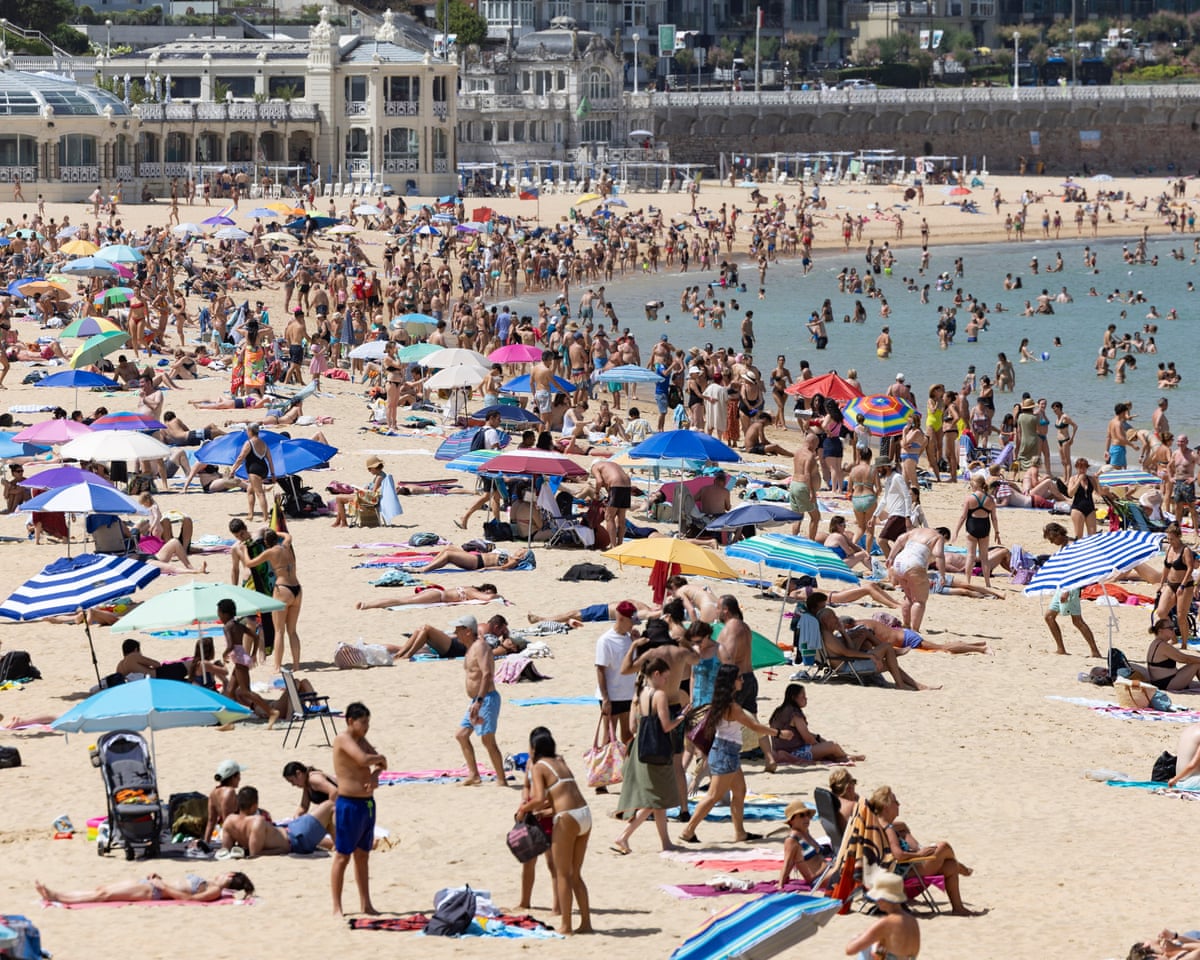
Recent images from news agencies depict people seeking relief from the intense heat across Europe.
The number of individuals exposed to dangerous heat stress worldwide has increased significantly over the past fifty years, driven by climate change, according to a study released amid a severe heatwave sweeping the continent.
Heat stress, defined as the hazardous accumulation of body heat due to high temperatures, humidity, and other factors, is a leading weather-related cause of fatalities.
The study, published on Monday in the journal Nature Climate Change, analyzed the rise in heat stress levels from the 1970s through 2024.
"On every continent, strong to extreme heat stress is now more frequent," said lead author Rebecca Emerton of the European Centre for Medium-Range Weather Forecasts, as reported by Agence France-Presse.
In the 1970s, 16% of the global population experienced at least one day of extreme heat stress, defined as a "feels-like" temperature of at least 46°C. This figure has risen to 22% today.
"That might not sound like so much. But that’s an extra approximately one billion people that are seeing at least some extreme heat stress now that wouldn’t have done in the 1970s."
Numerous schools across England and Wales have announced closures or early dismissals this week to protect students amid the extreme heat, while transport authorities have advised against all but essential travel.
The Buckingham School in Buckinghamshire declared it would close on Wednesday and Thursday, transitioning students to online learning.
St John’s Marlborough in Wiltshire announced early closure on Tuesday and full closure on Wednesday and Thursday, reopening on Friday, according to .
The National Association of Head Teachers issued guidance to its members regarding heat management, including impacts on pupils and staff, legal considerations, and criteria for school closures.
Transport advisories include warnings from Network Rail urging passengers to travel only if absolutely necessary on Wednesday and Thursday, noting that extreme heat can significantly affect railway operations.
The heatwave affecting much of Europe is characterized as an Omega block, named for its Greek letter shape, featuring a central bulge of hot air flanked by cooler air masses, according to climate expert Clair Barnes of Imperial College London.
"It’s drawing warm air up from North Africa, from the Sahara, and that’s why we have this really intense heat," Barnes said, as cited by .
"It’s very slow moving and it means there’s kind of no wind, no breeze for respite."
She added that climate change is intensifying heatwaves and storms, leading to higher temperatures and increased rainfall.

Health warnings issued to English regions amid heat's 'risk to life'
The UK Health Security Agency has issued a red health warning for six English regions from 1 a.m. Wednesday until 11 p.m. Thursday.
This warning indicates a "risk to life for even the healthy population," as well as potential disruptions beyond health and social care, including impacts on transport, food, water, energy supplies, and businesses.
The affected regions are the West Midlands, East Midlands, South East, South West, London, and the East of England.
This is the second red heat health warning issued in the UK, following the first in July 2022 when temperatures exceeded 40°C for the first time, according to .
An amber health alert is also in place for the North West, North East, and Yorkshire and the Humber for the same period, indicating widespread impact on health services in these areas.
Dr. Agostinho Sousa, head of extreme events and health protection at the agency, stated:
"It is vitally important that people understand the risk posed by high temperatures like these, and take steps to keep themselves and their friends, families and neighbours safe."
UK red alert warns of 'severe' impacts from heat
With temperatures forecasted to reach 38-40°C in parts of England and Wales, the Met Office issued a rare red weather warning covering an area from London to Swansea and Somerset to Birmingham, effective from 9 a.m. Wednesday to 9 p.m. Thursday.

These warnings are reserved for the most severe events, with this heatwave expected to cause "severe and significant impacts," including widespread health risks affecting many people, not only those typically vulnerable to heat, and posing a danger to life.
The alert also cautions that "substantial changes" in work practices and daily routines will be necessary, and warns of a high risk of failure in heat-sensitive systems and equipment, potentially causing loss of power and other essential services such as water, electricity, gas, or mobile phone connectivity, according to .
An amber weather warning is in effect for a broader area of England and Wales from Monday through Thursday.
A yellow warning for thunderstorms is active until 9 p.m. Monday, covering a region from Bristol to Aylesbury, Buckinghamshire.

Opening summary: UK heat set to break records; half of France under red alert after deaths
Today’s coverage focuses on the deadly heatwave impacting Europe.
Rare red warnings have been issued in the UK as extreme temperatures are expected to reach record highs for June this week amid a fierce heatwave gripping the continent.
Forecasters predict temperatures between 38°C and 40°C in parts of England and Wales, surpassing the June record set in 1976 by several degrees, as human-driven climate change intensifies a "heat-dome" over western Europe.
In France, a red heat alert covers more than half of the country’s departments, affecting approximately 39 million people. At least 18 deaths have been reported since the weekend, including a child left in a hot car.
French Prime Minister Sebastien Lecornu was scheduled to hold a crisis meeting on Tuesday, according to an aide. Over 1,350 schools have closed due to the heat.
The UK’s rare hot conditions are accompanied by high humidity and warm nights, making overnight recovery difficult, forecasters noted.
Italy issued heatwave red alerts for 12 cities on Monday. In France, a nuclear plant near Toulouse shut down a reactor because the cooling water from a nearby river became too warm, a spokesperson confirmed.
In south-east France, first responders were unable to revive two children, aged two and four, found unconscious in a family car outside their home on Monday, a prosecutor in Carpentras reported.
These deaths followed those of three elderly individuals aged between 80 and 95 near Bordeaux over the weekend, attributed to health issues caused by extreme temperatures, an official stated. Additionally, thirteen people drowned in swimming accidents.
In San Sebastian, northern Spain, temperatures are expected to reach 40°C, more than double the city’s historic average for June 22, according to the Climate Monitor.
Belgium’s heatwave is forecast to last a week, with temperatures described as "the hottest ever recorded," warned the IRM meteorological institute’s head of forecasting.
Paris is projected to reach its highest June temperature at 38.4°C, based on preliminary data from Meteo-France.
Germany experienced a rise in fatal swimming accidents, with five deaths reported over the weekend. Police noted that several heat-stricken passengers at Frankfurt airport required emergency treatment after their plane was delayed on the apron for over an hour before take-off on Monday.
In Spain, temperatures were 5-10°C above normal for this time of year, exceeding 10°C in some northern regions, according to the Aemet weather agency.