

Jessie and Joe Roper have given up city life in Manchester to convert an 80-acre (32-hectare) farm they inherited near Cockermouth, Cumbria, into a long-term wildlife restoration site. The couple took charge of Greenbank Farm after Jessie's father, Jim Parkin, who had run the farm for years, died suddenly in 2023. Rather than sell the land or continue traditional farming, they have signed up to a 30-year nature recovery scheme designed to secure the farm's future while restoring its habitats.
Jessie, 32, grew up at Greenbank Farm but moved away roughly 12 years ago to study in Manchester and had little hands-on farming background. When her father passed away unexpectedly, she felt unable to let a stranger take on the land, prompting her and her 33-year-old husband to relocate and take over.
"I couldn't really face anyone else having it, so selling it was out of the question," Jessie said.
"We just kind of thought if we went back, if we had turned into full-time traditional farmers, it just wasn't really for us."
How difficult was the transition to farm life?
The move proved harder than expected, with Joe — who had never set foot on a farm before — describing a brutal first winter marked by relentless rain, a flooded cellar, frozen pipes and a broken-down tractor.
"It was quite hard work, adjusting to life on the farm, we also had the worst winter that year when we moved back, I don't think it stopped raining for about four months," Joe said.
"It was like, 'oh god, what have we done?'"
Jessie explained that her father had handled all the day-to-day running of the farm, leaving the couple with little guidance after his death.
"It's not as if he gave a handover," she added.
Greenbank Farm previously produced dairy and beef, and Jim Parkin had also rented out fields to a local shepherd — an arrangement that continues to generate income for the farm today.
What does the nature recovery project involve?
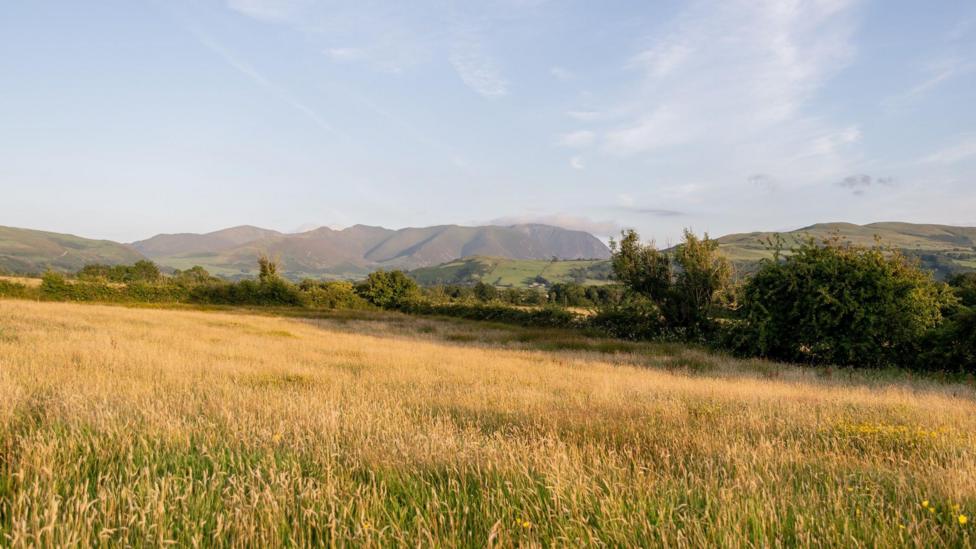
Working with biodiversity organisation Environment Bank, Jessie and Joe are now overseeing a 30-year habitat restoration plan that relies on grazing animals to help regenerate the land.

Anne Gray, senior land manager at Environment Bank, said traditional methods would underpin the long-term approach to managing the site.
"Traditional summer hay cuts and cattle grazing will be the long-term management mechanism for the site."
She added that such schemes matter given the scale of habitat loss the UK has experienced.
"Nature recovery projects like this are important because the UK has experienced significant biodiversity loss over many decades."
"For many, it provides a secure, diversified source of income that allows them to invest in the long-term future of their land, while continuing to play an important role in managing the countryside, supporting wider environmental outcomes, and supporting the rural economy."
Why did financial security matter to the couple?
Guaranteed income over three decades was a key reason Jessie and Joe chose this route rather than sticking with conventional farming. Environment Bank provides lease payments to Greenbank Farm, alongside additional payments to the couple for managing the land through livestock grazing and hay cutting.
"One of the main things for us is that it's 30 years of guaranteed income," Jessie said.
"With farming, you just never know what's going to happen."
"If we solely rely on producing haylage, we could have a really bad year of rain like we did a few years ago - we produced rubbish haylage to be honest so we didn't really make that much in terms of profit."
"It's like a diversification project for us."
The pressures facing conventional livestock farming are not unique to Greenbank. Separate reporting has highlighted a broader decline in UK sheep farming driven by rising costs and shifting subsidy structures, even as demand from some communities offers a degree of resilience for upland farms.
How does this compare with other rewilding efforts?
Jessie acknowledged that similar habitat restoration projects have drawn opposition elsewhere, and said neighbouring farmers in the area have been sceptical of their plans.
"We're like the guinea pig of the area," she said.
Greenbank's transformation echoes a wider pattern of landowners across Britain repurposing agricultural ground for conservation. In North Somerset, the Avon Wildlife Trust recently used a £5m grant to purchase Ebdon Farm near Wick St Lawrence, with plans to convert the former dairy farm into wetlands and a nature reserve. In Wales, Adam and Lou Bourns took a comparable path over a decade ago, leaving London to spend 14 years building an 80-acre sustainable nature reserve and glamping retreat in Carmarthenshire that has since won multiple eco-tourism awards.
One of the most established examples of this approach is Knepp Estate in West Sussex, where rewilding began in 2001 and became a widely cited template for allowing livestock and wildlife to reshape depleted farmland, according to CNN. That project has since been credited with substantial ecological gains, including 69 singing nightingales, 24 stork nests and 93 eggs recorded on the estate, alongside a rise in full-time staff from 23 to 90 as the operation diversified, according to a national newspaper's report.
What legacy does the project represent for the family?
Despite the scepticism from some quarters, Joe believes his late father-in-law would have approved of the direction the farm has taken, given his affection for the natural world.
"Jim really loved nature," Joe said.
"So it's kind of like a bit of a nod to him as well, like it's nice to do something with the land that he would approve of."
Key Facts
- Greenbank Farm covers 80 acres (32 hectares) near Cockermouth, Cumbria.
- Jessie Roper inherited the farm after her father, Jim Parkin, died suddenly in 2023.
- The farm has entered a 30-year nature recovery agreement with Environment Bank.
- The scheme uses cattle grazing and traditional summer hay cuts to restore habitats.
- Environment Bank pays lease and management fees, providing guaranteed long-term income.


