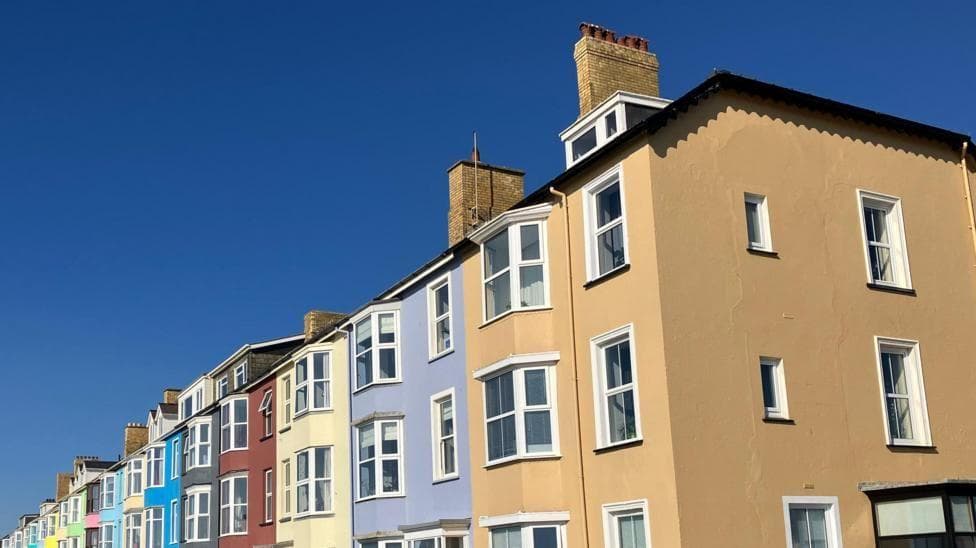
House prices across Wales increased by 4% in the year to June, yet affordability continues to present a significant obstacle for prospective buyers, according to new data from the Principality Building Society. The market has demonstrated considerable resilience despite economic headwinds, though price-to-income ratios have climbed to more than 7.5 times average earnings in certain areas. According to BBC News, 17 of Wales' 22 local authority areas recorded price gains during this period.
The Wales House Price Index revealed substantial regional variation, with Anglesey recording the strongest performance at a 22% annual increase. However, four regions experienced declines, with Ceredigion seeing the steepest fall of 9%, while Flintshire remained flat year-on-year. The overall average house price stood at £258,129 across Wales.
Andy Mottram, representing the Principality Building Society, acknowledged the market's strength while highlighting the persistent challenge.
"While the market had shown real resilience with strong price growth in many places, affordability was a real challenge for people,"he stated. This tension between rising values and purchasing power has created distinct pressures for different buyer categories.
How do first-time buyers compare to existing homeowners?
First-time buyers face markedly different affordability pressures depending on their location. In Cardiff, first-time buyer properties command prices equivalent to four-and-a-half times household income, whereas Blaenau Gwent—where houses are most affordable—sees ratios of just over three-and-a-half times. For those already owning property and seeking to relocate, the disparity widens considerably: Cardiff properties reach 7.6 times income while Blaenau Gwent sits at 5.2 times.
Blaenau Gwent presents a paradoxical picture of the Welsh housing market. First-time buyer properties averaged £155,000 with an overall house price of £167,239, the lowest in Wales. Yet the area also recorded the lowest average household pre-tax income at £42,000. Between April and June, Blaenau Gwent saw a 47% increase in mortgages issued compared to the first three months of 2026—the largest rise anywhere in Wales.
This contrasts sharply with Monmouthshire, which boasted the highest household income at £61,700 alongside the most expensive average house prices: £285,000 for first-time buyers and £387,606 overall.
What are estate agents observing on the ground?
Layla Mangan, an estate agent at Alexanders in Aberystwyth, expressed surprise at the recorded 9.3% price decline in Ceredigion.
"That's not been our experience,"she said.
"It's a hard market, yes, but it doesn't feel that we've dropped nearly 10%."Her observations suggest that headline figures may not capture the full complexity of local market dynamics.

Mangan has detected a broader shift in buyer and seller sentiment.
"I've noticed a lack of confidence among buyers and sellers,"she explained, attributing this to wider economic uncertainty.
"We don't have to look hard to work out why that would be. What an uncertain time we're in. I can understand people feel reluctant to wanting to essentially get into more debt. I understand that and it's hard at the moment."
Despite these concerns, Mangan offered perspective on the longer-term view.
"If you aren't looking at selling again in 12 months' time I'd hold your nerve, I'd go for it. We can't expect to be buying houses and making money on them straight away and where we go wrong is if that's what we're expecting."She also highlighted the symbolic importance of house prices in public consciousness.
"Everybody is really into house prices, whether you're a homeowner or not, because we can use it as this kind of thermometer, this gauge for what the economy and our finances are doing in general,"she noted.
Why has Anglesey seen such strong growth?
Anglesey's 22.2% annual price rise represents the strongest performance among Welsh regions, though the market there remains mixed. Richard Tuke, who has lived on the island for two decades, decided to sell and relocate to Spain.
"Anglesey has always been a desirable area for people to live,"he said, observing that conditions have improved from their worst point. After receiving limited interest initially, Tuke reduced his asking price twice—from £475,000 to £425,000—which yielded results.
"We've had a wave of viewings in the last two weeks and a lot of strong interest, so I think we're at the right price level now,"he reported.
The number of properties sold in any given region can significantly influence how prices rise or fall relative to other areas, meaning Anglesey's strong growth reflects both genuine demand and the composition of sales activity.
What external pressures are affecting the market?
Broader economic forces are shaping the housing landscape. Turbulence in the Middle East and its effects on oil and gas prices have already driven up fixed-rate mortgage costs. The Bank of England is widely anticipated to raise interest rates, which would increase borrowing expenses in the coming months.
Despite these headwinds, Mottram remained cautiously optimistic about the market's trajectory.
"If you look back over the year to date, the market's shown remarkable resilience in spite of those pressures. I think that's broadly likely to continue as we look forward."He acknowledged that cost-of-living pressures would persist but stressed that options remain available for prospective buyers.
"If people are worried, the best thing they can do is talk to their lender or talk to a mortgage broker to understand their options,"he advised.
How do these figures compare to broader UK trends?
The Principality Building Society's June data showing a 4% annual increase in Welsh house prices reflects conditions specific to the region. However, more recent government figures provide additional context: the UK House Price Index's July figures put Wales' average house price at £215,000, up 2.6% year on year, with 18 of 22 local authorities recording annual increases. This suggests some moderation from the Principality's June snapshot.
Later data from Nationwide's September report showed Welsh house prices up 3.5% year on year, with an average price of £214,816, indicating continued but measured growth. Property type also matters: terraced homes in Wales demonstrated the strongest annual price inflation among property types, rising 2.6% to an average £171,000 according to the government's June data.
The Principality Building Society has paused quarterly updates to its Wales House Price Index while it revises how the index is presented, meaning the figures discussed here represent the most recent published snapshot from that source.
What happens next for the Welsh housing market?
The August 2026 UK House Price Index is scheduled for publication at 9:30am on 21 October 2026, which will provide the next official snapshot of Welsh housing trends. Market observers will be watching to see whether the resilience noted by industry figures continues or whether rising interest rates begin to dampen activity.
For buyers and sellers navigating this environment, the message from estate agents and lenders remains consistent: seek professional advice, understand your options, and avoid making decisions based solely on short-term price movements. The Welsh housing market, like those elsewhere, reflects broader economic conditions that extend well beyond property values alone.