
Global bond markets are experiencing a sharp downturn that is pushing up government borrowing costs worldwide, with the United Kingdom facing particular pressure. The yield on Britain's 30-year gilts has reached 6% for the first time since 1998, a milestone that reflects intensifying concerns about inflation and geopolitical instability. This development comes as shorter-dated UK bonds also climb, threatening to increase London's borrowing costs and complicate the fiscal position ahead of Chancellor John Healey's budget announcement later this month.
According to recent reporting, 30-year gilt yields reached 6.029% on Thursday, marking their highest level since early 1998. The sell-off reflects a combination of factors: persistent inflation fears fuelled by Middle East tensions restricting oil supplies, concerns about government spending levels, and expectations that central banks may maintain elevated interest rates for longer than previously anticipated.
The turmoil extends far beyond the UK. US 10-year Treasury yields hit their highest level since 2002 overnight, while Japan's 10-year bond yield has climbed towards the 30-year high established last month. Remarkably, US bonds weakened despite a softer-than-expected inflation reading yesterday, suggesting that investor anxiety about future rate trajectories outweighs relief from current data.
Axel Rudolph, chief technical analyst at investing and trading platform IG, explained the dynamics:
US bond yields are refusing to budge, with the 10-year yield hitting its highest level since 2007 despite softer-than-expected inflation. While the latest data has reduced expectations of an October Fed rate hike, investors remain wary that persistent inflation and higher oil prices could keep rates elevated for longer. The dollar is benefiting from that caution, climbing to a three-month high, while the prospect of a December rate increase keeps pressure on bond markets.
Kathleen Brooks, research director at XTB, warned that the bond market sell-off is accelerating. She identified multiple drivers, including concerns over US government spending and rising oil prices:
Global bonds sold off more than 2% in September, the most since 2024, after Donald Trump was elected for a second term. Back then, bonds sold off due to Trump's expected expansionary fiscal policy. Today, bonds are selling off on the back of his foreign policy, as well as his fiscal largess. While bond markets are pricing in stronger growth across the developed world, there is also the realization that there is now a structural premium attached to the oil price and to refined products. This will keep prices elevated for the long term, as it does not appear that a neat diplomatic solution to the war in the Middle East will be reached any time soon.
Oil prices have become a focal point for market anxiety. Brent crude has climbed back above $100 per barrel, a significant psychological threshold that mirrors the symbolic importance of the 6% yield on 30-year gilts. The combination of these two developments signals to investors that structural shifts in both energy markets and government financing costs may persist.
How are European stock markets responding?
The bond market turmoil has cascaded into equity markets, triggering sharp declines across Europe. The pan-European Stoxx 600 index has fallen by 1.2%, with losses of at least 1% recorded in Germany, France, Spain and Italy, as well as the United Kingdom. Britain's FTSE 100 index has led the decline, dropping 1.9% or 201 points—its largest one-day fall since March.
Neil Wilson, Saxo UK investor strategist, characterised the moment as potentially pivotal:
This could be a significant moment for the market as the pressure build-up in the bond market is finally hitting equities. Selling in bonds is heavy across the board and the US 10yr has just taken out its highest since 2002 above 5.33% and the UK 30yr gilt has just broken 6%, its highest since 1998....there is carnage in the bond market which is hitting stocks hard.
Individual stocks have suffered accordingly. British American Tobacco has fallen 3.2%, while engineering company Weir has declined 2.7%. The FTSE 100 opened October down 116 points, or 1.1%, at 10,489 points.
What is happening in other European bond markets?
The sell-off is not confined to the UK. Italy's 10-year government bond yield has touched its highest level since November 2023 at 4.7232%, a rise of 10 basis points in a single day. France has experienced even more dramatic moves, with its 10-year bond yield reaching 4.96%, the highest since July 2002. The spread between French and German government bond yields—a key market gauge of the risk premium investors demand to hold French debt—has widened to 127.51 basis points, approaching its 14-year high of 128.80 basis points set in June 2012.
What is driving the global bond market sell-off?
Mohit Kumar, economist at Jefferies, identified multiple pressures weighing on bond markets:
Inflation, deficit and issuance concerns continue to weigh on the bond market. There is also a buyers strike on the street as investors do not want to step in till we get some form of stability. Hedge Funds have suffered in the latest round of sell-off and do not have the risk appetite to fade the move. Real money, potentially has the risk appetite, but won't step in till we get some stability.
The combination of inflation concerns, government deficit worries, and the sheer volume of debt issuance required to fund those deficits has created a perfect storm. Investors are reluctant to commit fresh capital until market conditions stabilise, leaving fewer buyers to absorb the supply of new bonds being issued.
What does this mean for UK government finances?
Susannah Streeter, chief investment strategist at Wealth Club, warned that the bond market is
flashing warning lights ahead of the UK Budget, with the 10-year gilt yield climbing to around 5.49%, the highest level since July 2007. The warning lights are flashing in a week when the government paid the highest yield on a 10-year gilt auction since 1999, underlining how much more expensive it is becoming to borrow. With debt already high and interest payments eating up a hefty chunk of public finances, sustained yields at these levels could further squeeze the Chancellor's wiggle room when he sets out his spending plans.
According to recent market data, Britain's Tuesday sale of new 10-year benchmark bonds was priced at an average yield of 5.383%, the highest for a UK issuance of that maturity since 1999. This reflects the deteriorating conditions facing the government as it seeks to refinance maturing debt and fund new spending commitments.
A September analysis estimated that if the bond sell-off persisted, the chancellor's fiscal headroom could fall from £26bn to £13.8bn before accounting for additional spending plans. With yields now at their highest in decades, this scenario appears increasingly plausible.
How are UK house prices responding to rising mortgage rates?
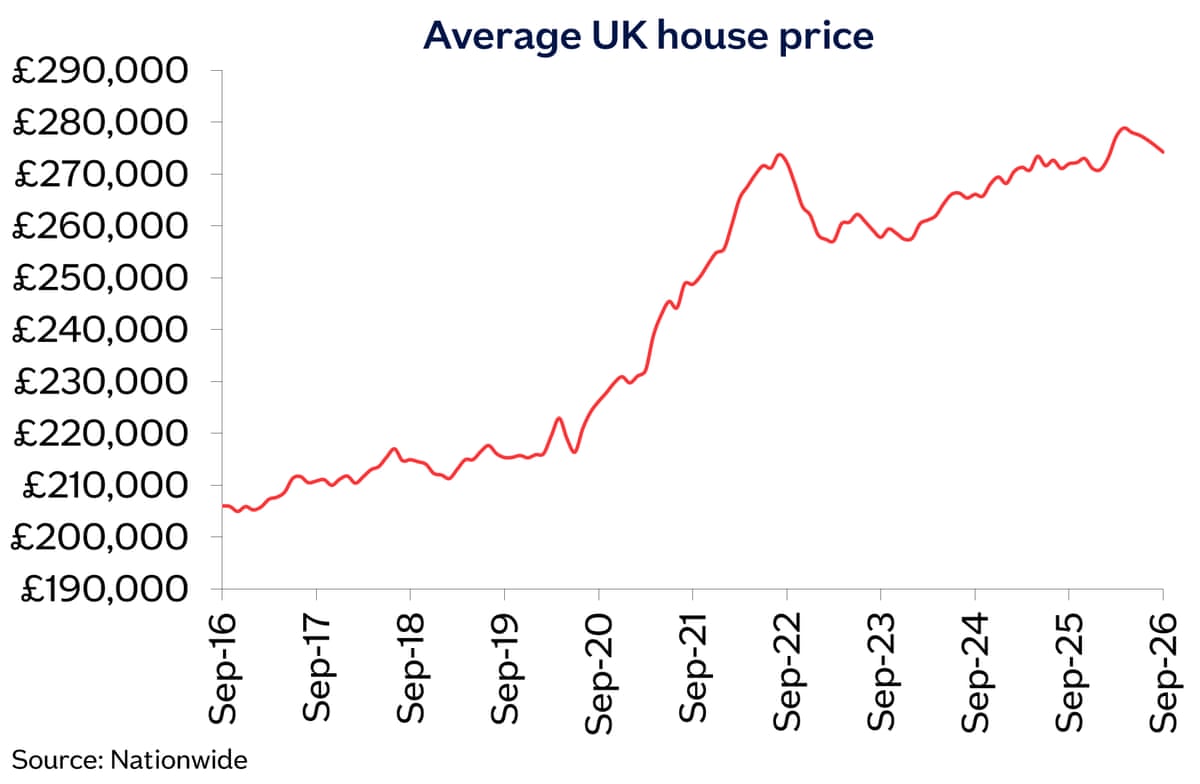
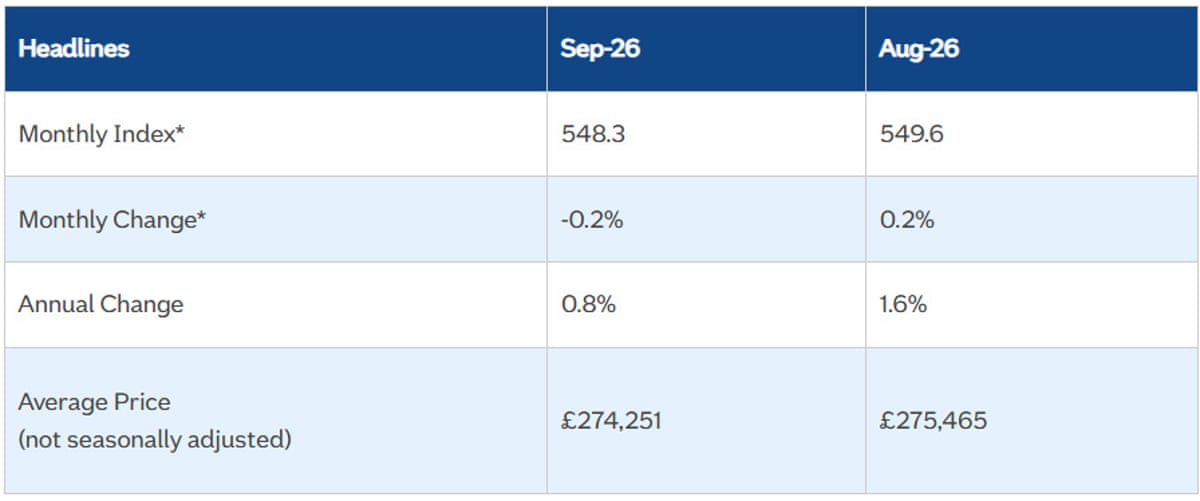
The impact of higher borrowing costs is already visible in the UK housing market. The rate of annual house price growth across the UK has halved, according to lender Nationwide, as rising mortgage rates cool demand. Nationwide's latest gauge shows that prices fell by 0.2% in September, dragging annual house price growth down to 0.8%, the weakest rate since December 2025 and down from 1.6% in August.
This outcome was weaker than City expectations. Economists polled by had forecast prices would be flat on the month and rise by 1.3% year-on-year. The average price of a home across the country slipped to £274,251 last month.
Robert Gardner, Nationwide's chief economist, attributed the slowdown to recent increases in mortgage rates from lenders:
Market activity and house prices have remained subdued in recent months, in part reflecting the uncertain economic backdrop. Geopolitical tensions remain high, with the conflict in the Middle East exerting upward pressure on energy prices, fanning inflation concerns. This in turn has led to mounting financial market expectations of Bank Rate increases, which has maintained upward pressure on the market interest rates which underpin mortgage pricing.
Yesterday, Moneyfacts reported that the average two-year fixed residential mortgage rate is at its highest since July 2024, while the average five-year is at its highest since 10 October 2023—with both rates above 5.9%.
Which regions are seeing the biggest price changes?
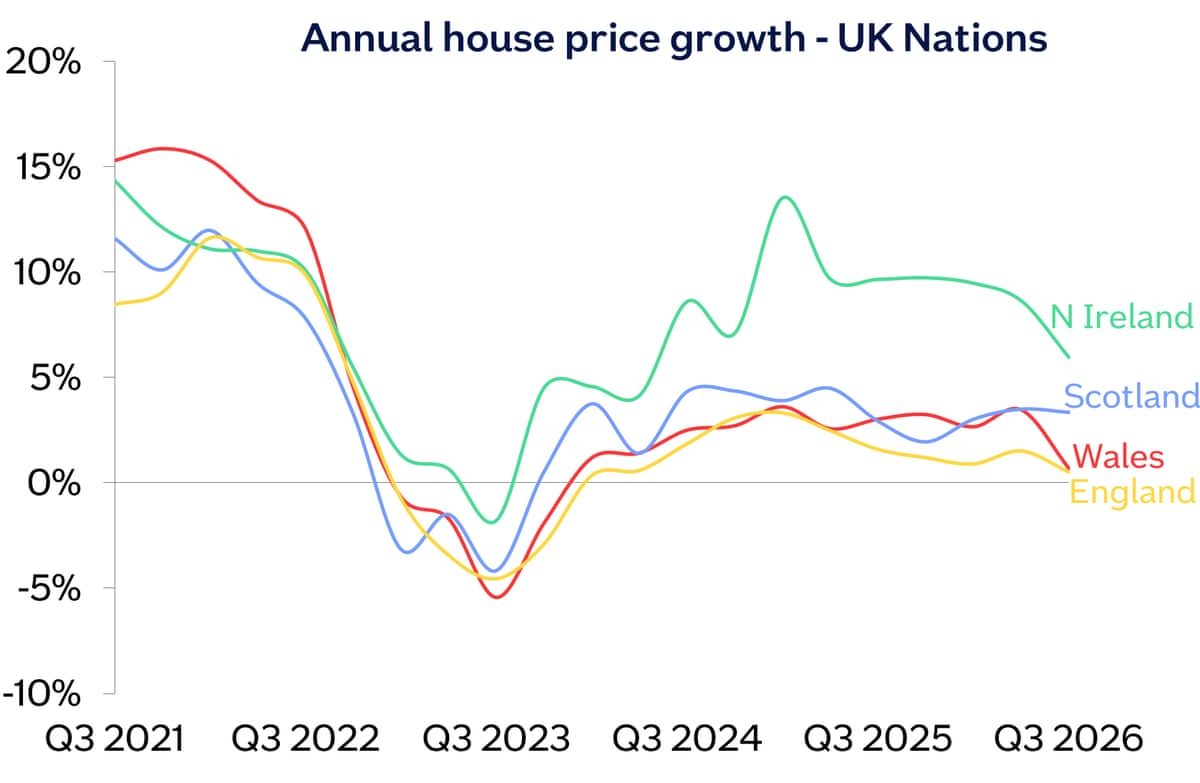
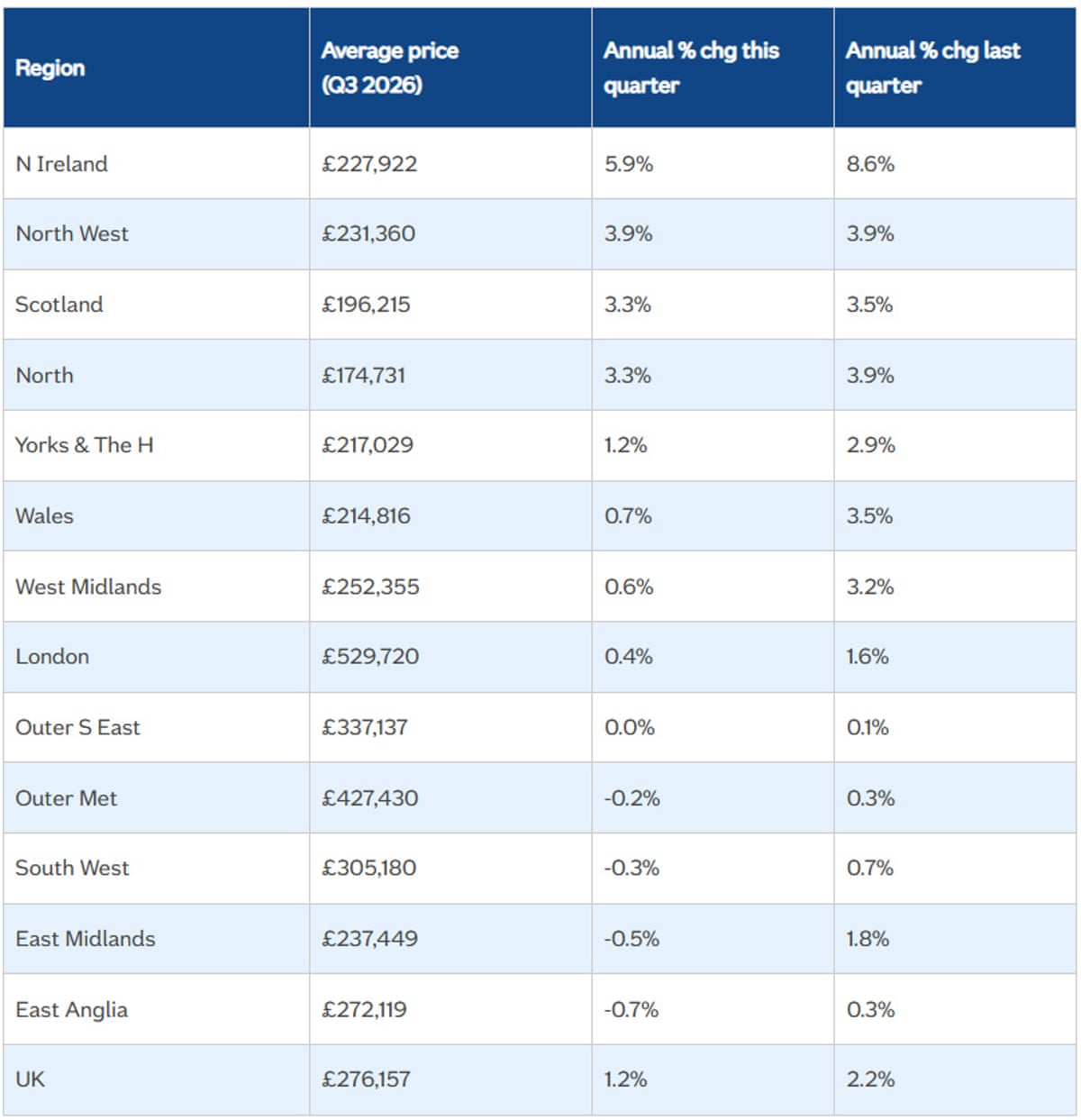
House price growth has slowed in most UK regions over the last three months. Prices rose fastest in Northern Ireland, where they have climbed 5.9% year-on-year, while East Anglia was the weakest performing region, with an annual decline of 0.7%. The average price of a terraced home is up 1.8% over the last year, making it the strongest performing property type. Flats, however, saw much less demand, with their prices essentially unchanged compared with a year ago.
Prices dropped year-on-year in four regions: the Outer Metropolitan area outside London, South West England, the East Midlands and East Anglia.
What happens next?
Chancellor John Healey is due to deliver the Budget on 28 October, with an Office for Budget Responsibility forecast published alongside it. The timing places the government under considerable pressure, as gilt yields remain elevated and the fiscal environment has deteriorated sharply. The Debt Management Office's October–December calendar includes a 5⅜% Treasury Gilt 2056 auction scheduled for 10 November, which will test investor appetite for longer-dated UK debt in the current market environment.
In the immediate term, markets will watch for any signs of stabilisation in bond yields and oil prices. The outcome of upcoming economic data releases—including manufacturing PMI figures for the Eurozone, UK and US—will influence whether the current sell-off continues or whether investors begin to re-enter the market.
Key Facts
- UK 30-year gilt yields have reached 6% for the first time since 1998, driven by inflation concerns and geopolitical tensions in the Middle East.
- US 10-year Treasury yields hit their highest level since 2002, while the FTSE 100 recorded its largest one-day fall since March as the bond sell-off cascaded into equity markets.
- Annual UK house price growth has halved to 0.8% in September as rising mortgage rates cool demand, with the average home price falling to £274,251.
- The government paid the highest yield on a 10-year gilt auction since 1999 this week, significantly increasing the cost of government borrowing.
- Chancellor John Healey will deliver the Budget on 28 October against a backdrop of deteriorating fiscal conditions and elevated gilt yields.