US President Donald Trump has notified Congress of his intention to remove South Africa and Rwanda from the African Growth and Opportunity Act (Agoa), a preferential trade programme that permits eligible African nations to export thousands of products to the United States without tariffs. The termination will take effect on 1 January 2027, according to BBC News.
US Trade Representative Jamieson Greer announced the decision in a statement, explaining that an annual review had determined both countries were engaging in practices inconsistent with the programme's eligibility requirements. The Trump administration cited barriers to US trade and investment, as well as concerns over national security and foreign policy interests in the region, though Deutsche Welle reported that the US did not specify which particular trade barriers or security issues prompted the decision.
For Rwanda, Washington raised concerns about human rights, political pluralism, the rule of law and workers' rights. The timing of the announcement follows closely on sanctions imposed by the US Treasury against Rwanda's defence ministry for its alleged role in supporting the armed M23 rebellion in eastern Democratic Republic of Congo. The Treasury stated that Rwanda's defence ministry directed thousands of troops to fight alongside M23 rebels, providing weapons, equipment, logistics and training.
South Africa faces additional criticism from the Trump administration over corruption. The country's trade minister, Parks Tau, characterised the decision as "unfortunate", noting that Washington was raising new issues that had not been part of trade negotiations between the two countries which began in 2025.
"We will continue to accelerate the diversification of South Africa's export markets to protect jobs,"Tau said in response.
US Ambassador to South Africa Leo Brent Bozell III stated it was regrettable that South African policies led to its removal from Agoa.
"This was a predictable and preventable outcome resulting from the rejection by South Africa's government of real concerns raised by the US,"he wrote on X.
What is the scale of the trade impact?
The removal carries significant economic implications for both nations. According to Deutsche Welle, South Africa's Agoa exports account for approximately 10% of its exports to the US and 1% of its total global exports, meaning the impact, while notable, represents a relatively modest share of the country's overall trade portfolio. Rwanda's exposure to the programme is similarly limited, though the country had already lost Agoa benefits for apparel exports in 2018 following a dispute over US tariffs on imported second-hand clothing.
What is the broader context of US-South Africa tensions?
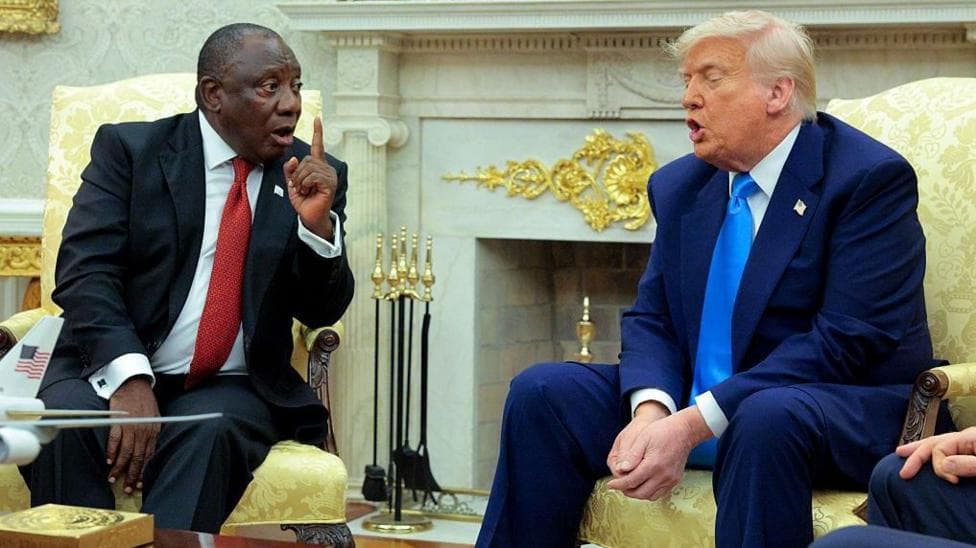
The Agoa termination reflects escalating friction between Washington and South Africa under the Trump administration. In 2025, Trump accused South Africa of white genocide during a meeting with President Cyril Ramaphosa at the White House and subsequently launched a US refugee pathway for Afrikaners. These tensions have intensified through 2026, with the US imposing visa restrictions on South African officials over discrimination claims in September 2026 and ending HIV funding for South Africa in June 2026, citing failure to protect the Afrikaner minority. The US has also resettled thousands of South African refugees under the new pathway, with nearly all 4,499 refugees resettled since October 2025 being South African Afrikaners.
South Africa's government responded to the Agoa decision by pledging support for sectors affected by the termination and reaffirming its commitment to treating the US as an important trade partner, despite the deteriorating relationship.
How does this fit within the broader Agoa framework?
The Agoa programme, established to promote trade between the United States and Africa, allows participating nations to export duty-free to American markets. Congress extended the overall programme through December 2028, but individual country eligibility remains subject to annual US review. The planned exclusions of South Africa and Rwanda affect only those two countries individually and do not end Agoa benefits for other eligible African nations.
What happens next?
The termination is scheduled to take effect on 1 January 2027. The Trump administration has stated it is working with African partners to identify the steps necessary to meet Agoa eligibility requirements, though no timeline has been provided for potential reinstatement of either country's benefits.