
Oil prices have climbed towards $103 a barrel amid escalating concerns about crude supplies from the Middle East, where shipping attacks in key waterways have intensified, while reduced US offshore production following hurricane damage has added further upward pressure. Brent crude, the global benchmark, advanced $2.62 a barrel to $102.8, representing a 2.6% increase. The surge in energy costs is stoking inflation worries across financial markets and adding to headwinds facing Britain's housing sector, where the prospect of higher interest rates is dampening buyer activity.
Tanker attacks in the Strait of Hormuz reached their highest weekly frequency since geopolitical tensions escalated on 28 February, according to maritime security sources cited by . During the week ending 5 October, at least 12 assaults targeted oil, liquefied natural gas and liquefied petroleum gas vessels transiting the waterway. According to reports from maritime trade operations, a tanker north of Qatar sustained multiple projectile strikes with casualties reported. The Strait of Hormuz carries shipments equivalent to approximately 20% of global oil and fuel supplies, making disruptions there particularly consequential for world energy markets.
How are financial markets responding?
European equity indices are retreating as investors reassess risk amid the combination of higher oil prices and mounting inflation concerns. The pan-European Stoxx 600 index has fallen nearly 1%, touching its lowest level in almost four months. Asian markets declined overnight, with Japan's Nikkei losing 1.4% and South Korea's Kospi tumbling 2.6%, despite Samsung Electronics projecting a nearly ninefold jump in third-quarter operating profit to 107.4 trillion won (£61 billion) compared with the same period last year.
Eurozone government bond yields have surged as investors worry about debt sustainability and inflation trajectories. France's 10-year bond yield climbed 6 basis points to 4.931%, approaching the 24-year high of 4.994% reached on Friday. The spread between French and German 10-year yields—a measure of the risk premium attached to French debt—widened 4 basis points to 142 basis points, down from almost 160 basis points last week but still the highest since 2012. Germany's 10-year yield, the eurozone benchmark, rose 2 basis points to 3.504%. France faces particular pressure as it grapples with its budget deficit while contending with widespread street protests from teachers and students over staff shortages, overcrowded classrooms and deteriorating school conditions including mould and pest infestations.
Minutes from the US Federal Reserve's latest policy meeting revealed officials were divided on whether further interest rate increases are necessary, signalling potential shifts in monetary policy direction. Attention now turns to remarks from several Bank of England policymakers, including governor Andrew Bailey, alongside statements from the European Central Bank's chief economist Philip Lane.
What is happening in the UK housing market?
The prospect of higher interest rates is weighing on Britain's housing sector, with buyer confidence softening and transaction momentum slowing. The Royal Institution of Chartered Surveyors reported that its house price balance fell to -32 last month, down from a five-month high of -28 in August, a steeper decline than anticipated. The balance metric subtracts the proportion of surveyors and estate agents reporting falling prices from those reporting rises.
New buyer enquiries weakened for the first time since March, though they remain substantially above the lows recorded immediately after geopolitical tensions began. Surveyors and estate agents anticipate further price declines over the next three months but expect stability over the coming year. London registered the most negative price balance, while Scotland and Northern Ireland reported rising prices.
Financial markets are pricing in a Bank of England rate increase from 3.75% to 4% in November, followed by three additional quarter-point rises throughout 2024. Unlike the US Federal Reserve, European Central Bank and Bank of Japan, the Bank of England has held borrowing costs steady despite a pickup in inflation. According to recent mortgage market data, the average two-year fixed mortgage rate reached 5.98% on 5 October, while the average five-year rate hit 6%.
Rics head of market research Tarrant Parsons commented on the market dynamics:
A renewed rise in interest rate expectations has created a fresh headwind for the housing market, with buyers becoming a little more cautious and sales activity losing some momentum.
The number of new properties entering the market rose for the first time since the middle of last year, suggesting some sellers are attempting to capitalise on current conditions. Rising rents are also evident, with growing tenant demand and declining landlord participation pushing the net balance for rental growth above its first-half average, though below August levels.
Recent house price data from mortgage lenders corroborate the slowdown. Lloyds reported unchanged house prices in September both month-on-month and year-on-year, while Nationwide building society recorded a modest decline.
What is Tesco's market performance?
Tesco, the UK's largest grocer, has lifted its annual profit forecast and signalled that consumer confidence has remained relatively resilient despite ongoing geopolitical uncertainty. The company's shares gained 2.5% in early London trading, making it one of the top risers on the FTSE 100 index, which itself declined 0.7% or 76 points to 10,381.
In the first half of its financial year, Tesco achieved sales growth of 2% to £33.8 billion, while underlying profit expanded 6.5% to £1.8 billion. Chief executive Ken Murphy attributed the performance to strong online expansion, which surged 8%, and a 9% increase in revenues from its premium own-label Finest range.
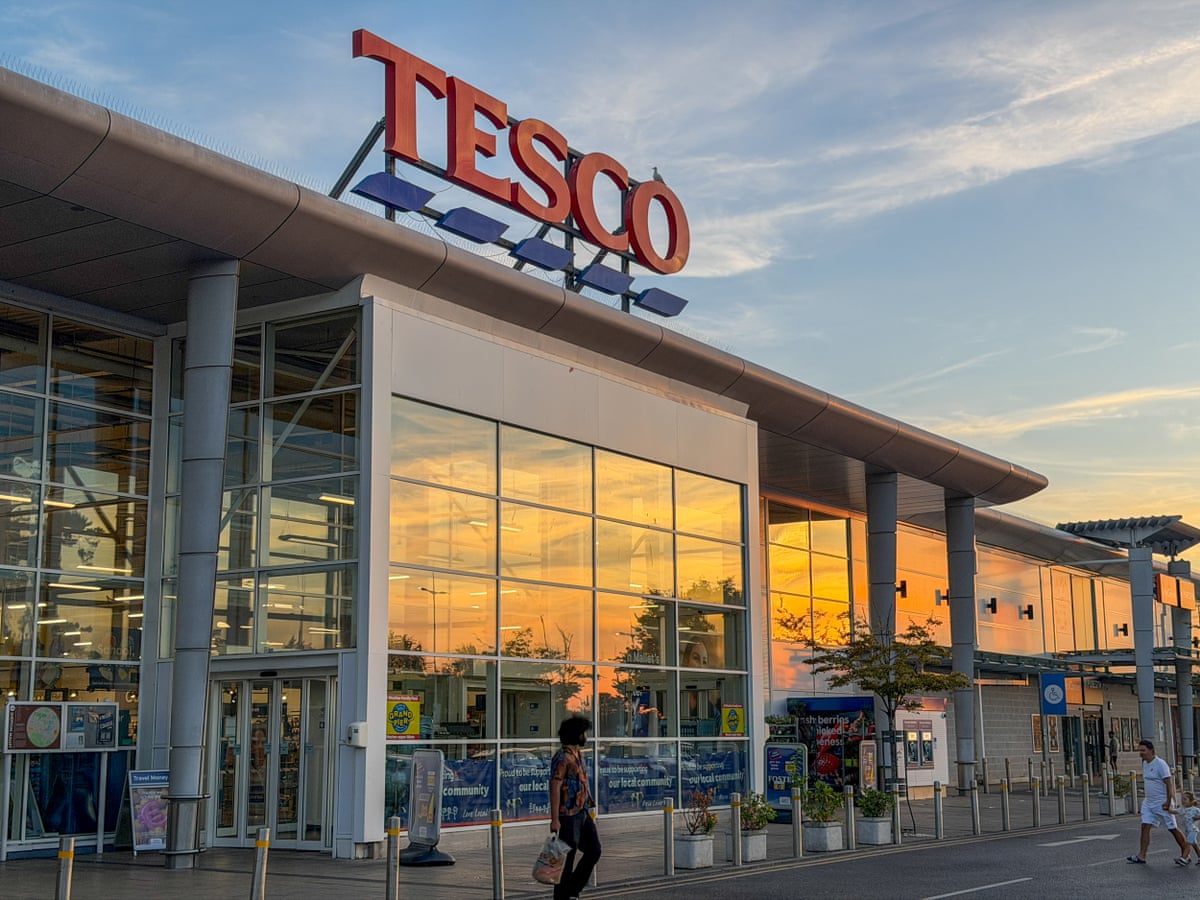
The supermarket now expects underlying annual profits between £3.15 billion and £3.3 billion, upgrading from its previous guidance of at least £3 billion. The bottom end of the new range would still represent a decline from the prior year. Sales at established UK Tesco stores rose 1.5% as food categories performed strongly, though the group's Booker wholesale division continued struggling with a 2.6% sales decline.
Murphy stated:
While consumer confidence has remained relatively resilient in the first half of the year, ongoing geopolitical tensions continue to create uncertainty and we remain focused on helping customers get the best possible value from their weekly shop.
The company is increasingly deploying artificial intelligence across operations, including a meal planning assistant that underwent testing from April with 280,000 staff members before launching to customers in September. According to analysis from the consultancy Label Sessions, Tesco's trajectory increasingly resembles a consumer data platform rather than a traditional supermarket chain. The Clubcard loyalty programme represents one of the UK's richest customer datasets, and its retail media business is leveraging that information to sell effectively to suppliers. Personalised offers, expanded rewards and AI-driven tools appear to be deepening customer relationships and driving repeat purchases, positioning Tesco advantageously in the competitive UK grocery sector.
What regulatory action has affected Go-Ahead Group?
Deloitte has been fined £6.05 million by the UK's Financial Reporting Council over its audit of bus and rail operator Go-Ahead Group spanning 2016 to 2020. The FRC, the UK's accounting watchdog, reduced the penalty from an initial £11 million in recognition of Deloitte's
exceptional cooperationand admissions, with Deloitte also bearing investigation costs.

The breaches centred on three Go-Ahead subsidiaries operating passenger rail services: London & South Eastern Railway (LSER), London & Birmingham Railway (LM) and Go-Ahead Bayern in Germany (GABY), which was subsequently sold to Austrian national rail operator ÖBB two years ago. LSER had received erroneous overpayments from the Department for Transport under a rail franchise agreement prior to Deloitte's appointment as auditor. Despite being contractually obligated to repay these sums, LSER retained the funds. When the franchise expired, the transport department declined renewal, initiated recovery proceedings and imposed a financial penalty of £23.5 million on LSER.
The FRC determined that Deloitte, in its auditor capacity, failed to conduct sufficient enquiries into LSER and LM's conduct, failed to exercise adequate professional scepticism and failed to evaluate evidence indicating fraud risk factors. Deloitte did not recognise that the company operated under a contractual obligation to act in good faith and therefore should have brought the LSER overpayments to the Department for Transport's attention.
What happens next?
The Bank of England's next interest-rate decision is scheduled for 5 November. Andrew Bailey, the Bank of England governor, chief economist Huw Pill, deputy governor for monetary policy Clare Lombardelli, and rate-setting committee member Megan Greene are delivering speeches today, with Bailey speaking at the Istanbul Economic Forum at 1.15pm BST. The Bank of England's credit conditions survey is due at 9.30am BST, and Greene will address an audience in Cape Town at 10.15am BST.
According to the Bank of England, inflation has risen to 3.1%, and the institution has warned that sustained high energy prices could make a rate increase more probable. Market participants will be closely monitoring these communications for signals about the central bank's policy trajectory.
Key Facts
- Brent crude advanced to $102.8 a barrel, up 2.6%, amid tanker attacks in the Strait of Hormuz that reached their highest weekly frequency since late February
- Eurozone bond yields surged as inflation concerns mounted, with France's 10-year yield climbing to 4.931%, near its 24-year high
- The Royal Institution of Chartered Surveyors reported a sharper-than-expected decline in house price sentiment, with buyer enquiries weakening for the first time since March
- Tesco raised its annual profit forecast to £3.15–£3.3 billion, citing resilient consumer confidence and strong online growth
- Deloitte was fined £6.05 million for audit failures related to Go-Ahead Group's rail subsidiaries between 2016 and 2020