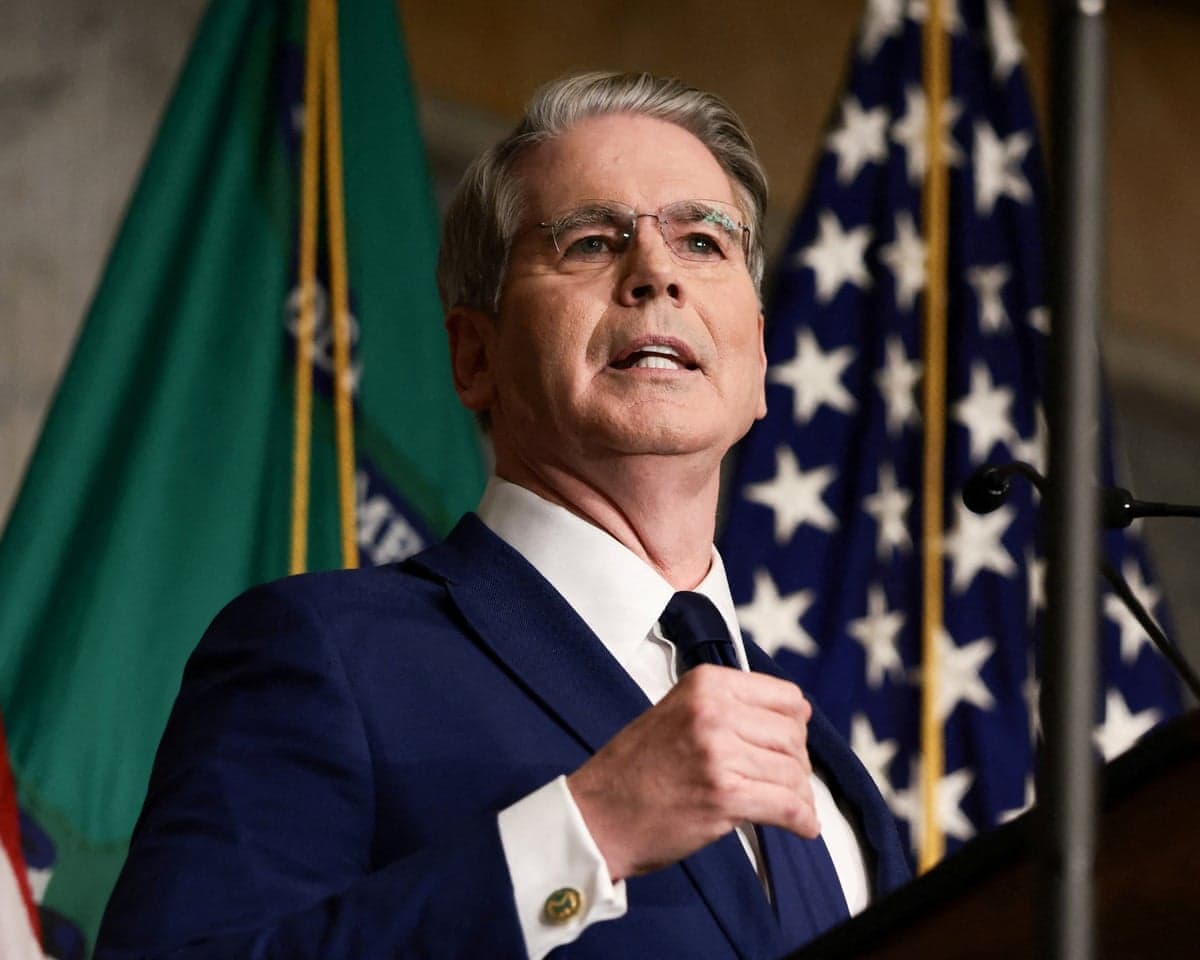
The United States has announced what it describes as "the single greatest financial offensive ever" designed to support its and Israel's military objectives in their ongoing conflict with Iran. Treasury Secretary Scott Bessent has warned that the new measures will "tighten the noose and block every potential source of revenue" from the Iranian regime.
Iran has dismissed these threats, stating it remains "fully prepared" to withstand the economic pressure. However, the regime's response masks a more complex reality: for decades, Iran has cultivated trading relationships with nations willing to overlook or defy American sanctions, and those partnerships will now face intense scrutiny and potential punishment.
On 24 August 2026, the U.S. Treasury expanded its sanctions framework to encompass digital assets, gold, aviation, technology and shipping, with Bessent declaring that any entity laundering money for Iran would be severed from the U.S. dollar system. This represents an escalation of economic pressure that has been building since the conflict began.
Which countries trade most heavily with Iran?
Iran's export economy depends overwhelmingly on a small number of trading partners, each with distinct relationships to Washington and varying capacity to resist American pressure.
China stands as Iran's dominant trading partner by a substantial margin. According to data from the International Trade Centre, a subsidiary of the United Nations and the World Trade Organisation, Chinese buyers accounted for 26.9% of Iranian exports in 2025. However, this figure significantly understates the true volume of trade between the two nations. China's bilateral trade with Iran reached $9.96 billion in 2025, excluding roughly $31.2 billion in unreported Iranian crude oil exports to China that year. More strikingly, China purchases more than 80% of Iran's shipped oil according to 2025 data from Kpler, making Beijing's role absolutely central to Tehran's ability to generate revenue.
China's response to the American announcement underscores the stakes. Beijing declared itself firmly opposed to what it termed "illegal unilateral sanctions," insisted that economic pressure tactics would not resolve underlying disputes, and pledged to safeguard its own interests. This defiance carries weight: China's role is so large that additional U.S. economic pressure risks retaliation against Washington because China is also a major exporter to the U.S. and a source of vital rare-earth minerals.
Turkey occupies a more precarious position. The country is Iran's second-largest trading partner, yet it maintains a far closer relationship with the United States than China does, being a NATO member. Turkey-Iran bilateral trade totaled $5.7 billion in 2024, and Iran's share of Turkey's natural gas imports rose to 18.6% this year. This energy dependence creates a genuine dilemma for Ankara: the United States has threatened to punish nations that continue trading with Iran, yet Turkey cannot abruptly halt commerce without inflicting serious damage on its own economy, which is already struggling with inflation officially recorded at 31.8%.
As the sole NATO member sharing a land border with Iran, Turkey must navigate an exceptionally difficult balancing act between its military alliance obligations and its economic survival. The country imports nearly all of its natural gas, and Iran supplies a meaningful portion of that supply, making energy security a national priority that cannot be easily sacrificed for geopolitical alignment.
Pakistan presents another complicated case. Like Turkey, it shares a border with Iran and counts the country among its largest export partners. Unlike Turkey, however, Pakistan's primary export destination is the United States, meaning it has substantially more to lose from American economic retaliation. Pakistan also serves as a key mediator in peace negotiations between Washington and Tehran, a role that would be jeopardised by deterioration in its relationship with either party.

A further complication arises from the fact that not all trade between Pakistan and Iran operates within the Pakistani government's control or oversight. Evidence indicates that petroleum products are being smuggled across the 900-kilometre border from Iran to Pakistan on a large scale, with some smugglers as young as 15 years old participating in the operation. This practice predates the current conflict but has intensified since hostilities began. Although both American officials and Pakistani oil companies have pressed the Pakistani government to enforce stricter border controls, authorities have struggled to police remote frontier regions effectively.
Armenia rounds out the list of major Iranian trading partners according to International Trade Centre data. What distinguishes Armenia most sharply from other Iranian partners is that its top export destination is Russia, which accounts for 34.9% of all Armenian goods sold in 2025. This orientation toward Moscow, despite Russia's own extensive sanctions burden following its 2022 invasion of Ukraine, suggests that Armenia may prove willing to maintain commerce with Iran regardless of mounting American pressure.
How effective will these new sanctions actually be?
Economists and policy analysts express considerable scepticism about whether the latest American measures will achieve their stated objectives. The advisory firm Oxford Economics characterised the direct impact on Iranian revenues as "somewhat of a damp squib," suggesting the sanctions will prove less consequential than their architects hope.
Ali Vaez, deputy director at the International Crisis Group, observed that
"Anything that moves in Iran has already been sanctioned by multiple layers of sanctions, in fact. So the question now is one of enforcement. Does the United States have what it takes to impose fines and levies on countries that continue to trade with Iran?"Vaez highlighted a telling precedent: the United States initiated an economic confrontation with China, Iran's largest trading partner, in the previous year but ultimately retreated from that position.
Aya Ibrahim, a former senior advisor at the State Department, raised two distinct concerns about the sanctions approach. First, she argued that American overreliance on sanctions
"incentivises countries to find ways around that system."Second, she warned that sanctions may inflict their heaviest toll on ordinary Iranian citizens rather than on state institutions or economic elites, as the measures "deny people necessities to stay alive."
The reaction of global financial markets provides additional evidence of limited confidence in the sanctions regime. Global oil prices declined following the announcement but remain substantially elevated compared to pre-conflict levels. Stock market traders demonstrated even less concern, with major equity indexes in the United States, Europe, and Asia barely registering movement in response to the news.
What happens next?
The sanctions package announced on 24 August represents an attempt to close additional revenue channels available to Iran's government. The immediate question facing policymakers is whether China, Turkey, the United Arab Emirates, and other significant trading partners will adjust their commercial flows with Iran or instead face secondary sanctions from Washington.
The United States has already demonstrated its willingness to employ short compliance deadlines as an enforcement tool. Buyers of Iranian oil were previously given until 17 July to wind down transactions after sanctions were reimposed, establishing a pattern of rapid implementation. Additionally, the U.S. naval blockade of ships travelling to and from Iranian ports resumed on 14 July, indicating that enforcement mechanisms beyond financial sanctions are already operational.
The fundamental challenge confronting Washington is one of credibility and capacity. The United States must convince major trading nations, international investors, and global markets that it possesses both the determination and the capability to enforce its sanctions threats. History suggests this will prove difficult: previous American sanctions campaigns have often encountered resistance from major trading partners, and the economic interdependence between the United States and countries like China creates mutual vulnerabilities that complicate enforcement.