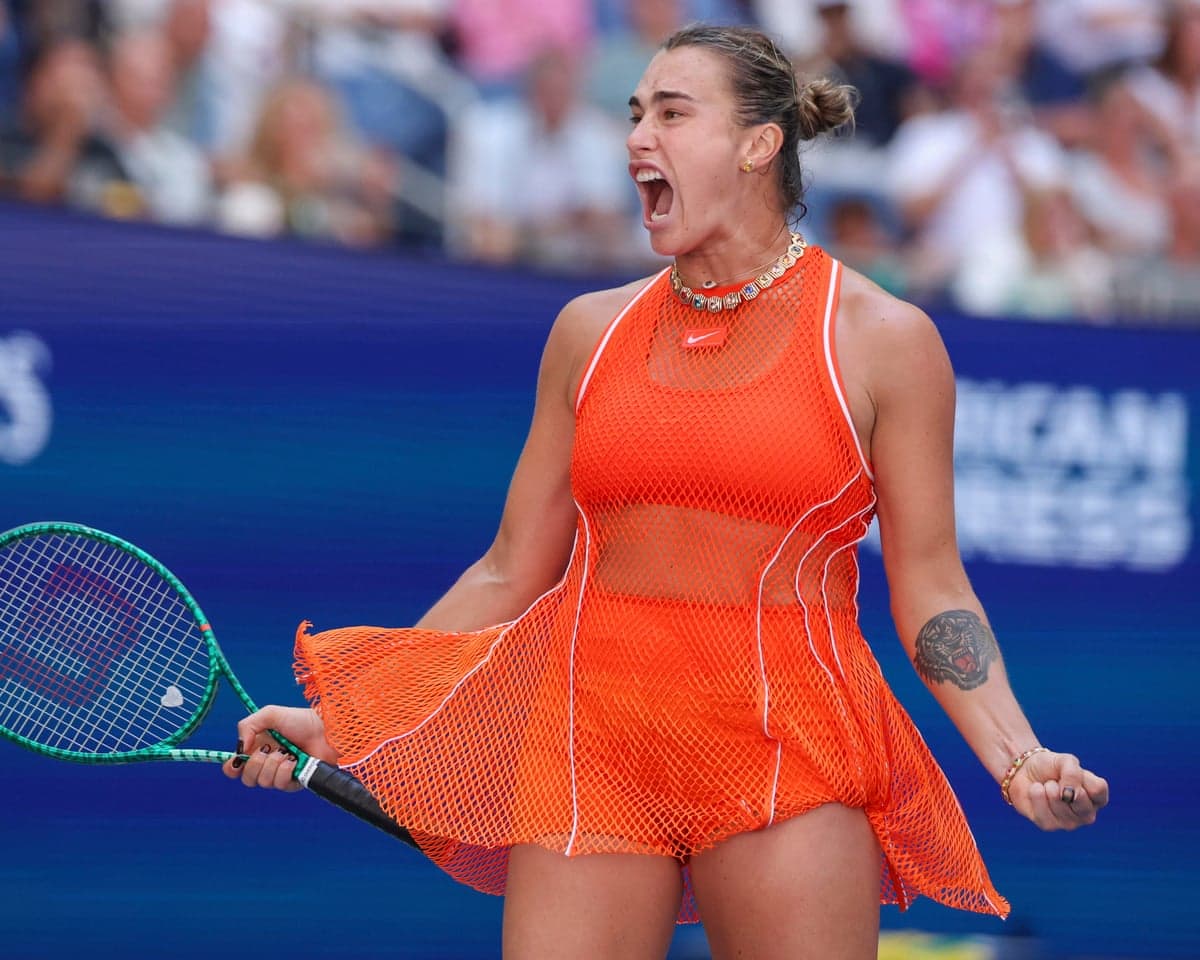
Defending champion Aryna Sabalenka recovered from a devastating position to defeat sixth seed Linda Noskova 7-6 (7-1), 3-6, 7-6 (10-7) in a quarter-final thriller, advancing to her sixth consecutive US Open semifinal. The match, played on Tuesday at Arthur Ashe Stadium, saw the top-seeded Sabalenka mount an extraordinary comeback after trailing 2-4 in the final set and 0-2 in the deciding tiebreak, ultimately closing the contest with a second-serve ace on match point. The victory extended Sabalenka's unbeaten run at the tournament to 19 consecutive matches, a streak dating back to the 2023 final.
For much of the encounter, it appeared that Sabalenka would succumb to the frustration and self-doubt that has plagued her throughout the year. At 2-2 in the decisive third set, a second double fault left her facing a 0-40 deficit. She dropped to her knees, bowed her head and released a scream of anguish. Within moments, the scoreline had shifted to 2-4 against her. After Noskova held to love for a 4-2 lead, Sabalenka appeared to be heading toward defeat.
Yet with her US Open title and world No. 1 ranking at stake, Sabalenka found reserves of mental strength that have eluded her in recent months. After falling behind 2-4, she delivered a commanding service hold followed by a flawless return game, breaking Noskova to love and levelling the set. The turning point came as Sabalenka continued to target Noskova's forehand, a stroke that had been formidable for much of the match but began to falter under pressure in the final stages. In the tiebreak, despite trailing 0-2, Sabalenka won 10 consecutive points to secure her 10th successive tiebreak victory at the US Open.
What made this match so compelling?
This encounter represented one of the finest displays of aggressive baseline tennis at this year's tournament. Both competitors demonstrated fearless shot-making, with Noskova unleashing 18 aces while Sabalenka finished with 12 aces and a 46% rate of unreturned serves. According to match statistics, Sabalenka accumulated 42 winners against 30 unforced errors, while Noskova posted 46 winners but committed 25 unforced errors. Both players attacked the baseline relentlessly, with Sabalenka's explosive power contrasting sharply against Noskova's refined timing and directional precision.
The opening set encapsulated the quality on display, with Sabalenka securing the tie-break 7-1 after a commanding display of serving. She punctuated the set with a statement second-serve ace, demonstrating her willingness to take risks even on her weaker delivery. Sabalenka began the match in cruise control, breaking Noskova's opening service game and racing into a 5-2 lead before being broken as she served for the set.
Despite the quality of Noskova's performance—she saved seven of her nine break points and hit more winners than her opponent—Sabalenka's mental resilience proved decisive. The Belarusian's four double faults in the match contrasted with Noskova's six, yet Sabalenka's ability to reset after the second set loss, when Noskova claimed a 6-3 victory, proved crucial. Rather than allowing doubt to compound, she channelled her desperation into aggressive shot selection, particularly when the match hung in the balance during the final set's climactic moments.
How did Sabalenka describe her mental state during the match?
I'm speechless right now. I was pushing to the limit in this match, especially in the third set. I honestly thought that that's it, the match is over, but probably that's what helped me to feel loose and go after my shots.
Sabalenka's ability to overcome adversity reflects a broader pattern in her recent performances. In her previous match against Taylor Townsend, she had her serve broken four times and trailed 3-1 in the second set before recovering to win. The Belarusian has a history of letting her emotions get the better of her, most notably in her quarter-final defeat from a set up at the French Open, making this comeback all the more significant.
What does this result mean for the rankings?
Sabalenka's progression keeps her in contention for a third consecutive US Open title and maintains her grip on the world No. 1 ranking. However, the rankings picture remains fluid. Elena Rybakina has the opportunity to usurp Sabalenka as world No. 1 should she defeat Zheng Qinwen in their quarter-final on Wednesday. If Rybakina loses, the final ranking will depend on the tournament's outcome, with Sabalenka, Coco Gauff or Jessica Pegula potentially finishing as world No. 1 depending on who claims the title.
When asked if she would be happy retaining her US Open title but losing the world No. 1 ranking to Rybakina, Sabalenka responded:
I'll be more than happy. Three-peat—sounds great. I'm just super happy that I put myself in the position where I have chance to go for the three-peat, even though I'm still far away from that.
What lies ahead for both players?
Sabalenka will next face Jessica Pegula in the semifinal after the American third seed pulled off an impressive comeback of her own to defeat compatriot Emma Navarro 3-6, 6-4, 6-3. Pegula withstood 24 break points across two hours and 21 minutes to secure her third consecutive US Open semifinal appearance. This will be Sabalenka and Pegula's second consecutive meeting at this stage, with Sabalenka having defeated Pegula in the 2025 semifinal. Pegula's path to a potential world No. 1 ranking requires her to win the US Open and hope that Rybakina does not reach the semifinals.
Sabalenka's path to a third straight US Open crown remains open, though the quality of opposition in the draw—where each of the top six seeds reached the quarter-finals—ensures no margin for error. This was only Sabalenka's second quarter-final victory since March, with the top seed unable to replicate her early season hard-court success, which included titles in Brisbane, Indian Wells and Miami, on the clay or grass. She suffered last-16 exits in Toronto and Cincinnati in the build-up to the US Open, but has rediscovered something approaching her best form.
For Noskova, the 21-year-old's performance represents a significant statement despite the defeat. After winning Wimbledon earlier this summer, she had struggled to maintain motivation heading into the US Open. Reaching the quarter-finals of her next grand slam and performing at such an elevated level against the world's top-ranked player demonstrates her credentials as an emerging force. The loss ended her run of 11 consecutive singles wins at Grand Slams. As she adjusts to her elevated status in the sport, Noskova will only continue to develop and pose serious challenges to the established elite.
Historical context
Sabalenka's achievement of reaching six consecutive US Open semifinals places her in rare company. According to reports, she becomes the first woman since Serena Williams in 2016 to reach six successive semi-finals at Flushing Meadows. The Belarusian is a four-time Grand Slam singles champion, with two titles apiece at the Australian Open and US Open.
Key Facts
- Sabalenka defeated Noskova 7-6 (7-1), 3-6, 7-6 (10-7) in a quarter-final lasting over three hours
- Sabalenka closed the match with a second-serve ace on match point after trailing 0-2 in the final tiebreak
- Sabalenka now has a sixth consecutive US Open semifinal appearance and a 19-match unbeaten streak at the tournament
- The defending champion remains alive for a third straight US Open title
- Noskova's performance as the sixth seed marked her breakthrough at a major following her Wimbledon triumph, though the loss ended her 11-match Grand Slam winning streak